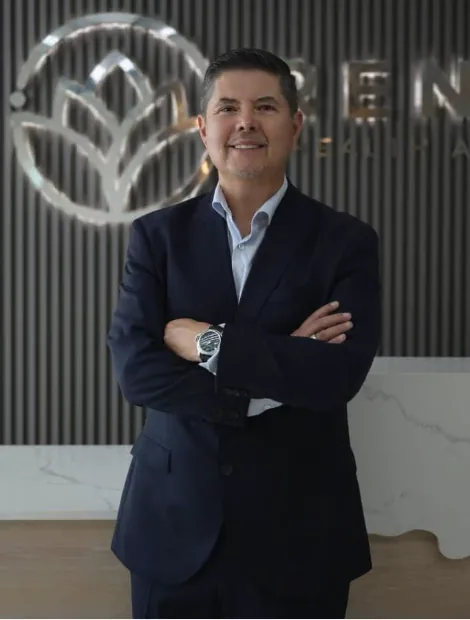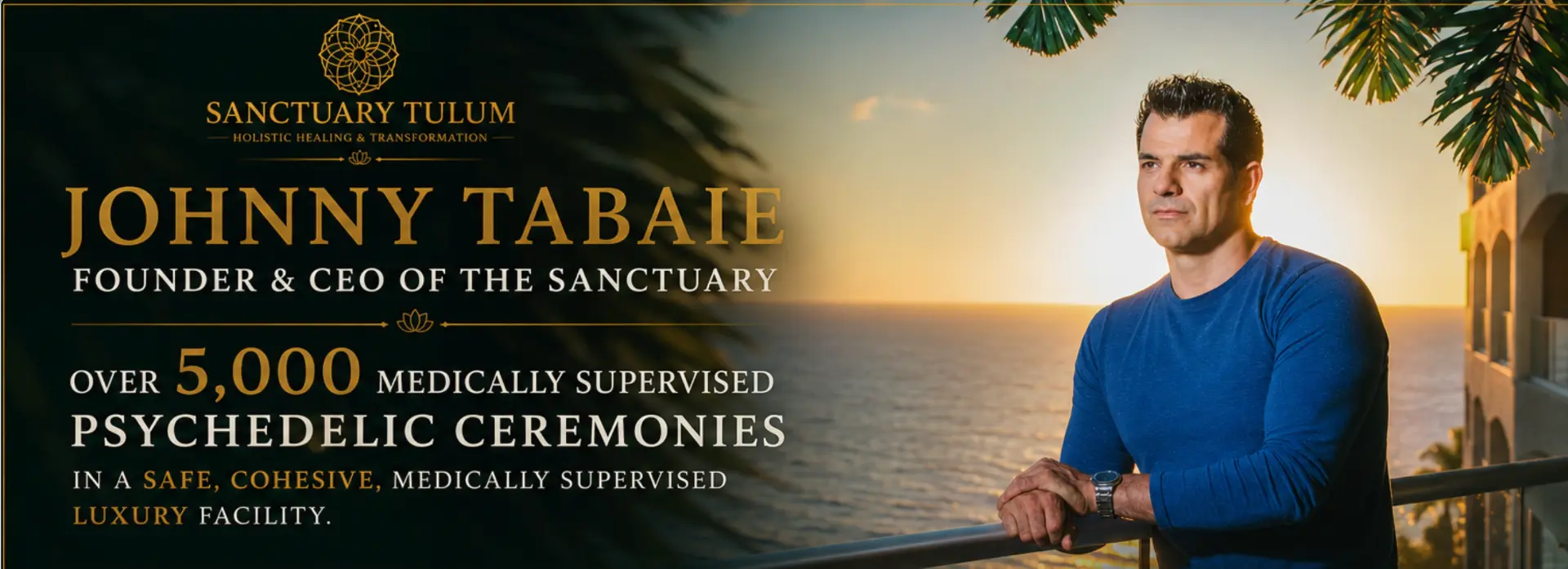
I have been asked many times to tell my story. I have avoided the full version for a long time — not because I am ashamed of it, but because I did not want it to become a marketing narrative. I did not want to turn real loss into a sales pitch.
Learn what actually happens during the ayahuasca ceremony itself — ritual structure, facilitator's role, the purge, and next-morning integration.
But people deserve to know why this place exists. Not the polished version. The real one.
The Beginning: Age 13 and Already Medicated
I was thirteen years old when I was first prescribed pharmaceutical medications. I was not in crisis — I was a kid with energy, with pain, with a family situation that was falling apart in ways no child should have to navigate. But the medical response was medication. And once that door opens, it is very hard to close.
From that age, I moved through a world of institutions. Rehabs of every kind — luxury and non-luxury, 12-step and medication-based, religious and secular, holistic and clinical. I was placed in group homes, treatment centers, hospitals, and programs designed by people who had studied addiction but had never lived inside it.
None of it worked. Not for long. Not in the way that matters.
I am not saying this to criticize anyone who works inside those systems. Many of them are trying. I am saying it because it is true — and because understanding that it is true is the only way to understand what I eventually built.
My Mother. My Brother. The Losses That Shaped Everything.
I lost my mother to crack cocaine. I do not say that lightly. She was a person before she was an addict — a person with her own losses, her own pain, her own story that I only understand fragments of. Addiction took her from her family before it took her life.
My brother David was different from me in some ways, and exactly like me in others. He was lost inside the same systems I was lost in — the street, the cycle, the search for relief from something that did not have a name but had weight.
In 2001, during a period when I had managed to stabilize myself somewhat, I went looking for him. I found David living under a bridge. I was not going to leave him there. I spent hours convincing him that help existed — that this time might be different. He agreed. On January 31, 2001, David checked into a licensed, residential dual-diagnosis treatment center in Santa Cruz, California.
I believed he was safe. I believed the system — the licensed, regulated, professionally staffed system — would protect him.
Fourteen days later, on February 14, 2001 — Valentine's Day — David took his own life inside that facility.
He had been prescribed a pharmaceutical medication with documented, known psychiatric risks including suicidal ideation. He was given that medication inside a licensed rehab. He died inside a licensed rehab.
I am not going to tell you I processed this well. I did not. What followed was six years of destruction — relapse, homelessness, suicidal ideation of my own, and the desperate attempt to survive a grief I had no tools to carry.
Homelessness and What the Street Actually Teaches You
I spent significant time homeless. I want to be specific about this because homelessness is often romanticized or flattened into a single image. It is not one thing. It is grinding, constant insecurity — physical danger, the exhaustion of having nowhere to put down your weight, the dehumanization of being invisible to the people walking past you.
But it also taught me something that no institution ever did: how to read people without pretense. When your survival depends on accurate assessment of who is safe and who is not, you develop a clarity about human beings that is very hard to learn in any other way. I carry that with me into every intake conversation, every assessment, every client I sit across from.
I know what it looks like when someone has truly given up. I know what it looks like when they haven't — even if they think they have. I learned to tell the difference when it mattered.
May 15, 2007: The Covenant
I do not know exactly how to describe what happened on May 15, 2007. I have used different words for it at different times. Surrender. Awakening. Rock bottom that had a floor.
What I can tell you is that something inside me stopped. The cycle — the blaming, the collapsing, the using to survive the grief about the using — simply stopped having momentum. I made a covenant. Call it prayer. Call it intention. Call it whatever fits your own framework.
I said: if I am given a way through this, I will spend the rest of my life helping other people find the same way.
That covenant is not inspiration copy. It is the actual reason I am still doing this work two decades later, on days when it is exhausting, on days when I question everything, on days when someone I cared about does not make it through.
What I Studied — and What I Refused to Accept
From 2007 onward, I immersed myself in everything I could find: research on plant medicine, ancient healing traditions, neuroscience, immunology, nutritional biochemistry, breathwork, energetic modalities, and the long-term physiological consequences of both addiction and its conventional treatment.
I did not do this with institutional funding. I did not do this with a research grant or corporate backing. I did this on my own — self-funded, independent, without anyone to answer to except my own observations and the people in front of me.
I want to be clear about what I found — and what I did not find. I did not find a single treatment modality that worked for everyone. I found that healing is far more complex than any single system acknowledges. What I did find was a combination of approaches — plant medicine, neurochemical restoration, cellular repair, trauma processing, spiritual reorientation — that, when applied carefully and in the right sequence, produced outcomes I had never seen in any institutional setting.
I also found that most of the existing plant medicine centers were operating recklessly. Speed over safety. Volume over integrity. Spiritual language over medical screening.
I refused to do it that way.
Why I Chose to Go Slowly — and Why That Mattered
I do not believe in seven-day miracle fixes. I never have. I have watched what happens when someone with a fragile, depleted, chemically destabilized nervous system is rushed through a high-dose plant medicine ceremony without adequate preparation, medical screening, or integration support.
It can end very badly. I have seen it end badly for other people. I was not willing for it to happen under my care.
So I built slowly. Every protocol was tested, refined, and adjusted based on real outcomes — not theory. I built in layers of safety that added time and cost and complexity but that I considered non-negotiable.
The result: over 15 years of operation. All four major plant medicines administered under one roof. Zero deaths. Zero serious incidents in any ceremony.
I do not say that to boast. I say it because it is the most important thing I have ever built — and because I know exactly what it cost to maintain.
What Sanctuary Tulum Actually Is
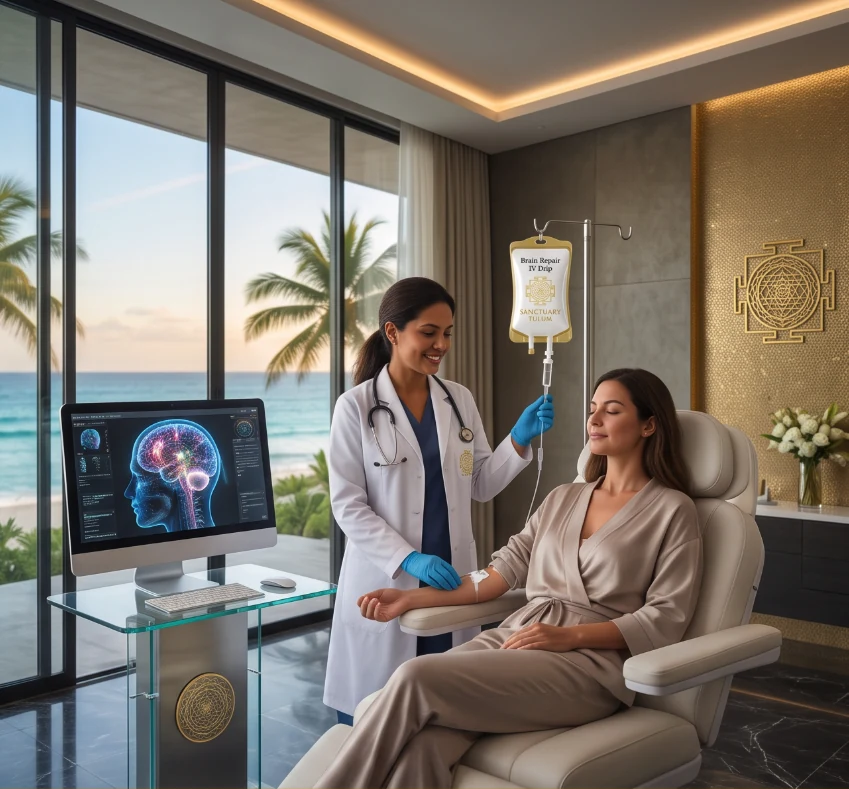
Sanctuary Tulum is not a resort with plant medicine on the menu. It is not a wellness retreat for the curious. It is a serious healing environment built for people who are genuinely suffering — who have tried everything else, who have been failed by conventional systems, and who are willing to do the difficult, sustained work of real recovery.
It is luxury — because dignity matters, because environment matters, because the condition of the space around you either supports healing or undermines it. But the luxury is not the point. The healing is the point.
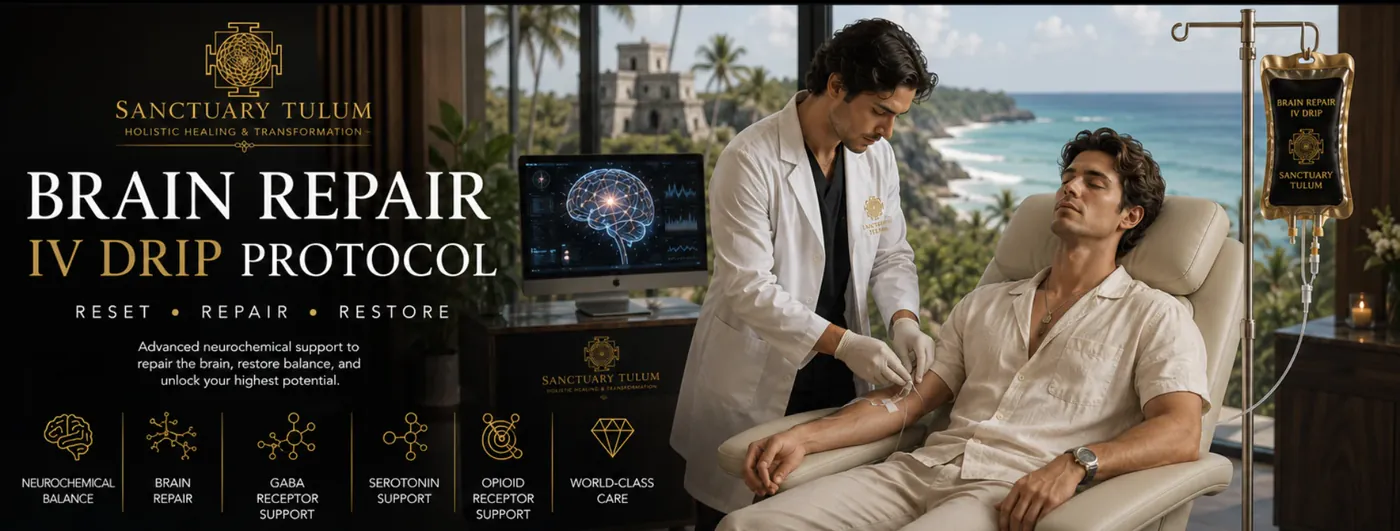
We treat addiction, trauma, PTSD, depression, benzodiazepine withdrawal, opioid recovery, and medication dependency — using Ayahuasca, Ibogaine, 5-MeO-DMT, Psilocybin, NAD+ IV therapy, proprietary Brain Repair IV drips, stem cell therapy, hyperbaric oxygen, and a daily nine-hour healing regimen that is customized to each individual.
Every client receives over 35 hours of holistic one-on-one therapy per week. No group therapy. No shared sessions. No generic protocols. Because no two people's suffering is the same — and no two people's healing should be.
What I Am Still Learning
I want to be honest about the limits of my certainty. Science evolves. My understanding evolves. What worked at one level of understanding I continue to refine as I learn more.
I approach mental health, addiction, and human suffering as something that is simultaneously biological, neurological, immunological, environmental, psychological, emotional, and spiritual. I do not claim to have the final answer to any of those dimensions. What I claim is this: I have been paying attention, without corporate bias, for over twenty years — and the protocols we use at Sanctuary Tulum are the best synthesis of that observation I have ever been able to produce.
I will keep refining them. I will never stop.
Why I Am Telling You This Now
People are dying. Inside conventional rehabs. On pharmaceutical medications that were prescribed to help them. Alone, in places where no one had the time or the tools to reach them.
My brother died in exactly that way. I have never been able to fully accept that there was nothing I could have done differently. I know, rationally, that David's death was not my fault. But I also know that his death showed me something I could not unsee — that the system we trust with our most broken people is, in many cases, making them worse.
I built Sanctuary Tulum as an answer to that. Not a perfect answer. Not a guaranteed answer. But an honest one — built from the inside of the problem, by someone who has lived it.
I can't claim to heal everyone. But if there's a way out, this is it. And I have given everything I have to making sure it exists — for David, for my mother, and for every person who is still fighting their way back from a darkness they were told was permanent.
— Johnny Tabaie, Founder & CEO, Sanctuary Tulum