Licensed · Physician-Led · Private
Luxury Psychedelic Retreats in Tulum
Medically supervised ibogaine treatment, ayahuasca, 5-MeO-DMT and psilocybin ceremonies — held inside a licensed oceanfront facility with private suites and a full integration arc.
What a Luxury Psychedelic Retreat Actually Is
The phrase "luxury psychedelic retreat" is used loosely across the industry. At Sanctuary Tulum, operating since 2011, it means something specific: a government-licensed medical facility, on-site physicians, private accommodations, one-to-one clinical attention, and an integration arc that runs alongside the medicine work rather than after it. Guests do not share ceremonies with strangers, do not sleep in bunk rooms, and do not receive medicine from unlicensed providers.
Luxury, in this context, is not a design aesthetic. It is a clinical operating standard: enough physicians per guest to intervene in real time, enough nursing hours to monitor vitals through the night, enough kitchen capacity to hold a medical-grade diet for weeks, and enough physical space to hold silence when a nervous system is asking for it. The oceanfront setting is meaningful, but the license, the physicians, and the protocol are what make the work safe.
How Sanctuary Tulum Differs From Budget Retreats
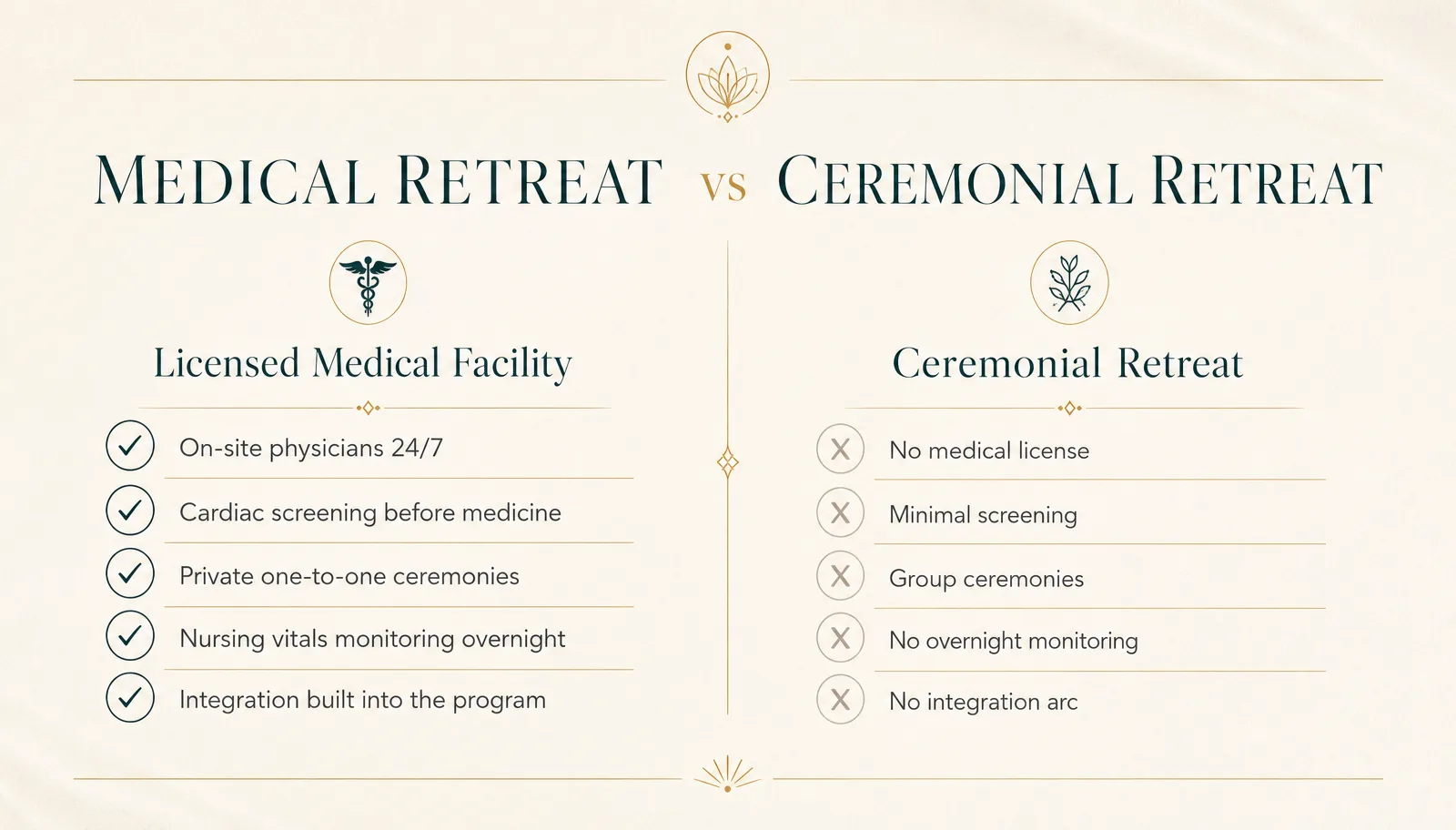
Most retreats advertising ayahuasca, 5-MeO-DMT, or psilocybin are ceremonial businesses, not medical facilities. They may deliver a single plant medicine in a group setting, screen minimally, and move on the next morning. Sanctuary Tulum runs under a Federal License of Operation for Hospital and Clinic, has operated continuously since 2011, and has maintained a clean safety record across thousands of medically supervised sessions. Every guest completes medical intake — medications, cardiac history, psychiatric history, prior treatment — before a modality is sequenced.
The clinical difference shows up in what we refuse to do. We do not run group ceremonies. We do not accept guests who cannot be safely cleared. We do not use talk therapy or replacement medications as our core protocol. And we do not stack modalities automatically — a guest arriving for medically supervised ibogaine treatment is not moved into an ayahuasca retreat unless the clinical picture supports it.
The Modalities We Offer
Sanctuary Tulum offers four plant medicine modalities under one licensed roof. Each has a distinct clinical use and a distinct safety profile, and each is matched to the guest — not the other way around.
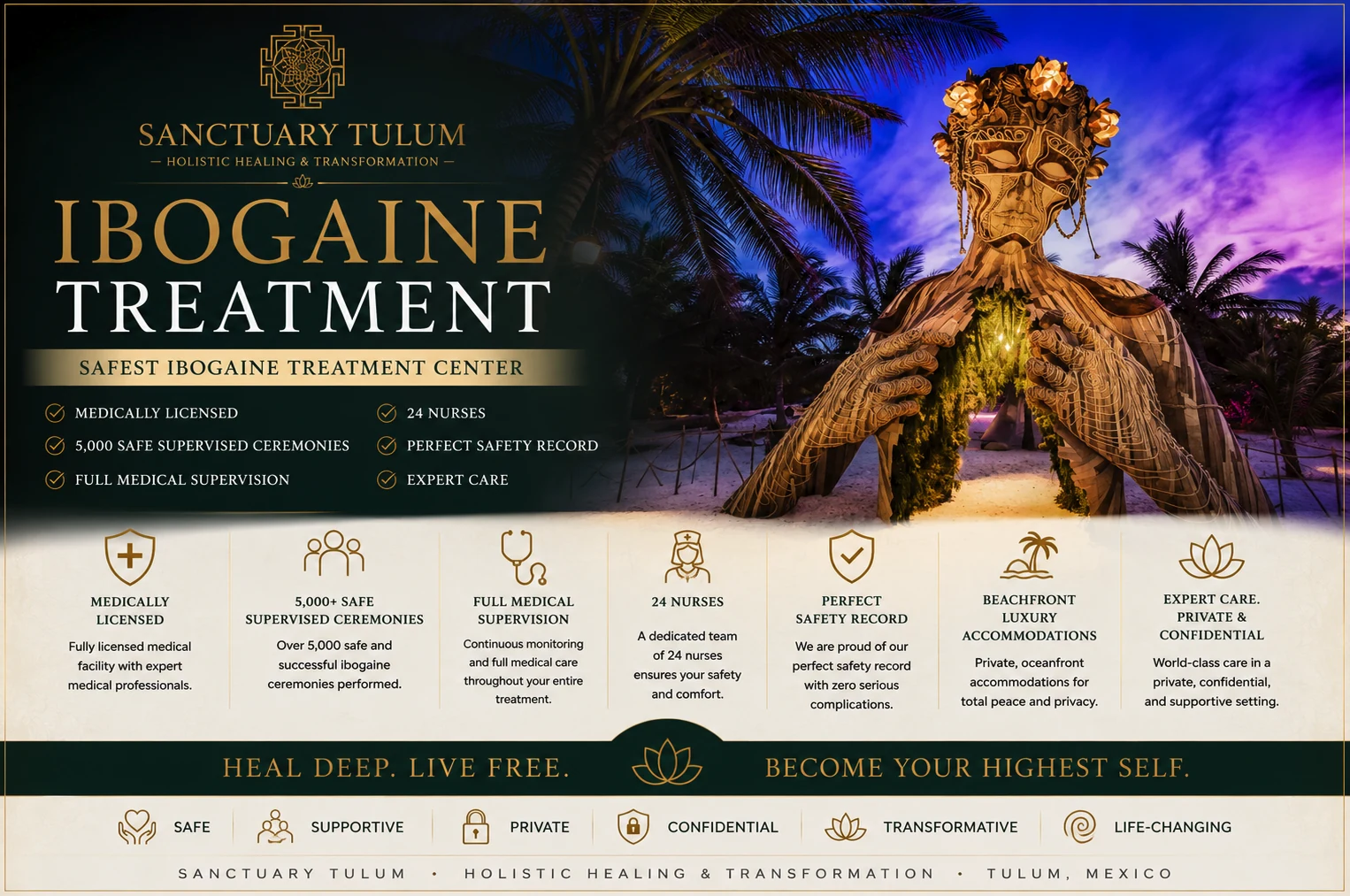
- • Ibogaine treatment — an extracted, isolated ibogaine alkaloid, administered by physicians after cardiac clearance, with continuous EKG monitoring. Used clinically for opioid use disorder, long-term benzodiazepine and SSRI dependence, and treatment-resistant depression. Ibogaine is a medical treatment, not a ceremony.
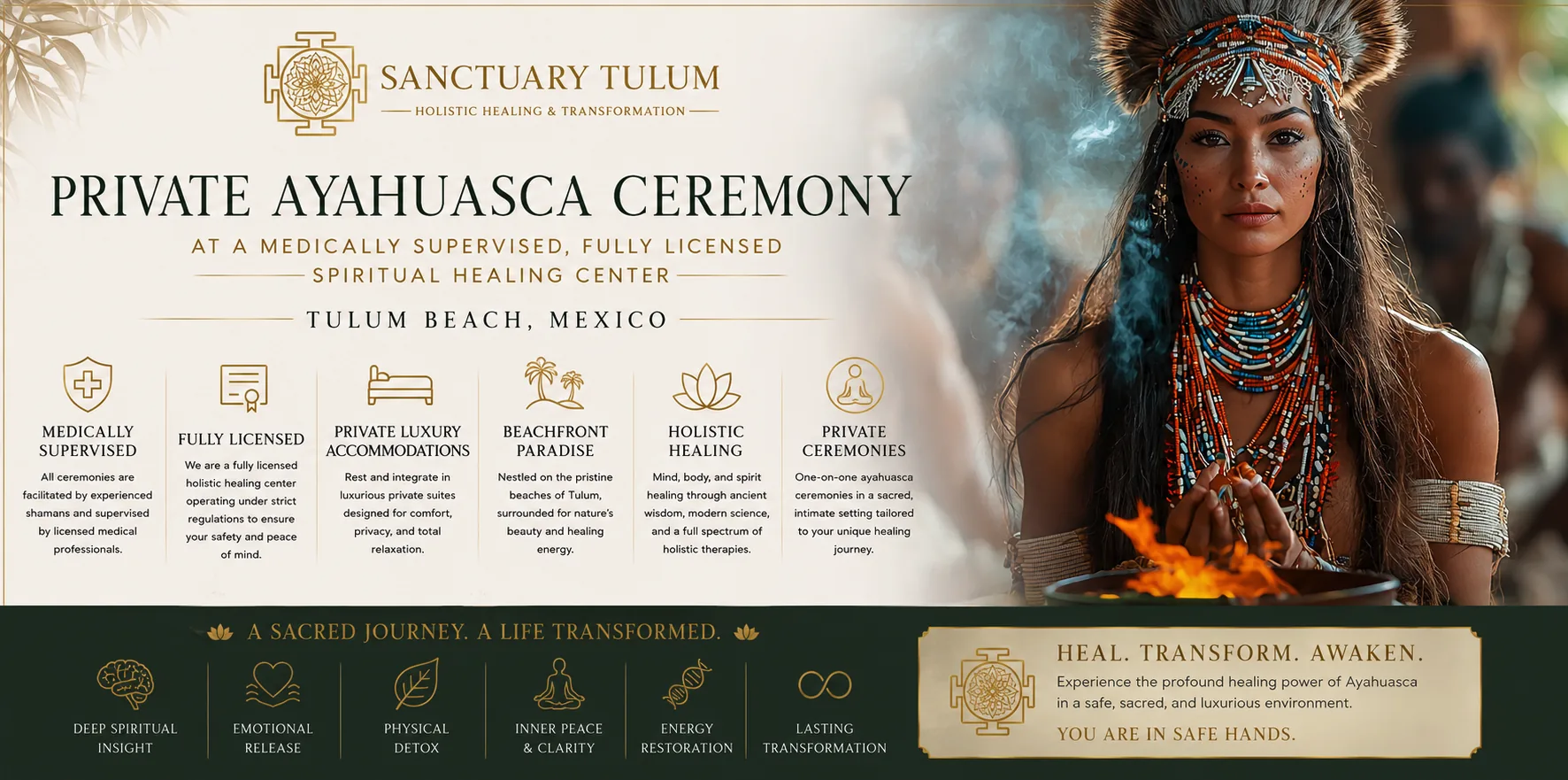
- • Ayahuasca ceremonies — private ceremonies held in a medically supervised setting, screened for SSRI and MAOI contraindications, used clinically for trauma, PTSD, and depression that has not responded to conventional treatment.
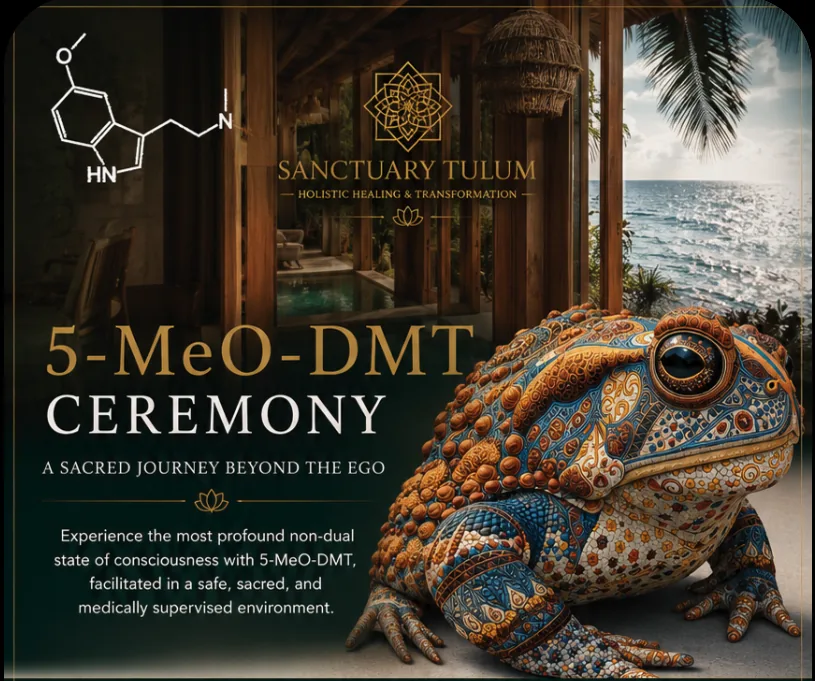
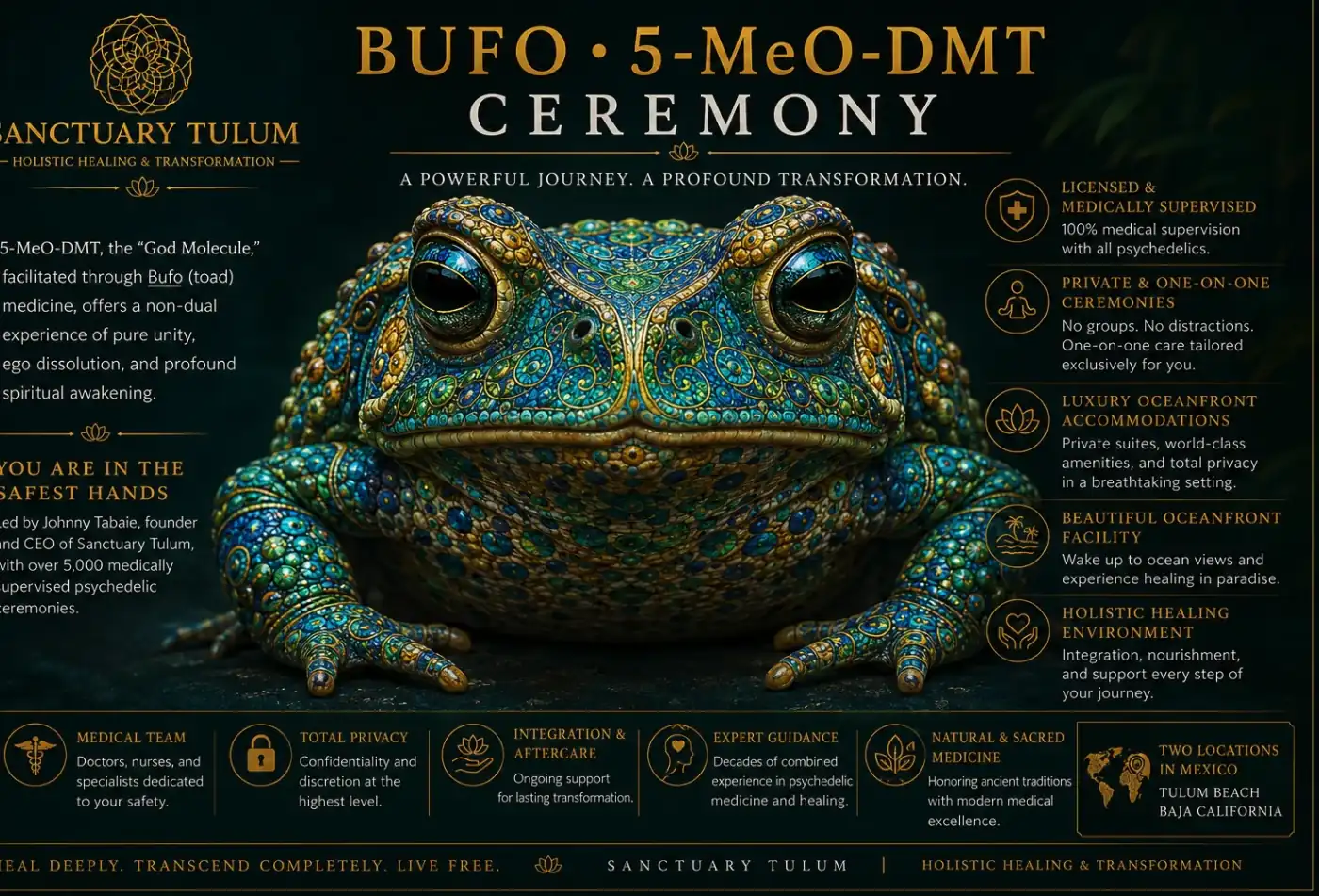
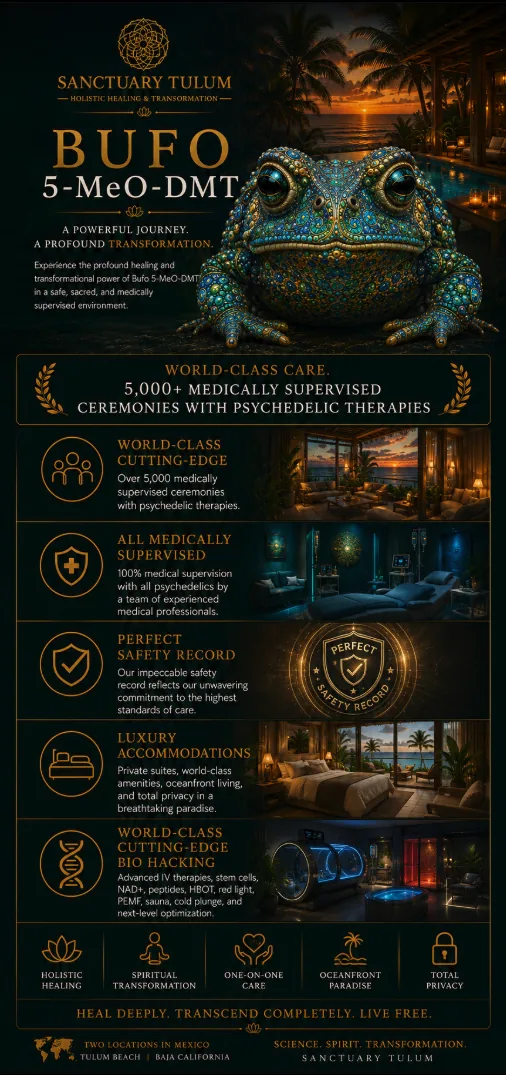
- • 5-MeO-DMT (bufo) ceremonies — short-duration, high-intensity ceremonies held under medical supervision, sequenced carefully within a broader program rather than delivered as a standalone weekend.
- • Psilocybin ceremonies — psilocybin sessions held in a supervised medical setting, used clinically for depression, end-of-life distress, and the emotional layer that opens after physical detox.
Medical Supervision Is the Standard, Not the Feature
The evidence base for supervised psychedelic-assisted work is now substantial. Phase 3 trials of MDMA-assisted therapy for PTSD have reported large, durable reductions in symptom severity when the medicine is delivered in a structured clinical setting.[1] Psilocybin trials for treatment-resistant depression have shown rapid antidepressant response persisting for weeks after a single supervised session.[2] The common denominator across the successful trials is not the compound — it is the protocol around it: screening, dose control, medical monitoring, and integration.
That is the standard Sanctuary Tulum operates against every day. On-site physicians (not on-call), pre-treatment cardiac screening prior to ibogaine, SSRI and MAOI contraindication review prior to ayahuasca, 24/7 nursing coverage during ceremony, and documented emergency protocols. If a guest cannot be cleared, they are not dosed — that decision is clinical, not commercial.
Who a Luxury Psychedelic Retreat Is For
Guests typically arrive after conventional treatment has plateaued. Long-term SSRI or benzodiazepine dependence with no clear taper path. Treatment-resistant depression that has cycled through medication changes. PTSD that has not responded to exposure work. Opioid use disorder after multiple rounds of inpatient rehab. Executives, physicians, veterans, first responders, and long-time meditators for whom talk therapy has stopped moving the needle.
The through-line is not a diagnosis — it is a stall. Medical intake determines whether medicine work is appropriate, which modalities apply, and in what order. Some guests complete a focused week; others move through a 12-week arc across our Gold, Platinum, and Elite VIP packages.
What to Expect: Intake, Ceremony, Integration, Aftercare
Intake. Medical intake begins before travel. Medication list, cardiac history, psychiatric history, prior treatment, current diagnoses, and lab work where indicated. If a modality is contraindicated, we say so before booking — not after arrival.
Arrival and stabilization. The first days are physical: nutrition, hydration, IV protocols, hyperbaric oxygen where indicated, and rest. For guests tapering benzodiazepines or SSRIs, this phase is medically managed and moves at the pace the nervous system will tolerate.
Medicine work. Ceremonies and treatments are sequenced individually. Ibogaine is administered by physicians with continuous EKG monitoring. Ayahuasca, 5-MeO-DMT, and psilocybin ceremonies are held privately with medical staff present throughout. Nothing is stacked, rushed, or delivered without the clinical picture supporting it.
Integration. Integration runs alongside medicine work rather than as an afterthought. One-on-one sessions, somatic practices, movement, nutrition, and daily rest are sequenced to help the nervous system consolidate what the ceremony opened. This is where retreats that only sell the medicine tend to fail — guests get the opening without the container to metabolize it.
Aftercare. Aftercare begins before departure and continues for months. Home protocols, nutrition guidance, and check-ins are structured so that the work done on campus does not evaporate when a guest returns to the environment that shaped the original stall.
Safety and Screening Standards
A safe luxury psychedelic retreat should meet a short, non-negotiable checklist. A verifiable government license. On-site physicians. Pre-treatment cardiac screening prior to ibogaine. SSRI and MAOI contraindication review prior to ayahuasca. 24/7 monitoring during ceremony. A documented emergency protocol and on-site emergency equipment. A willingness to say no. Ask any facility for these in writing — a legitimate facility will hand them over.
Sanctuary Tulum publishes its license number, is reviewed and overseen by our Medical Review Board, and details our full protocol on our safest psychedelic facility page. Ibogaine safety guidance is also published by SAMHSA and the FDA and is worth reviewing independently before choosing any provider.[3]
Tulum as a Wellness Destination
Tulum matters for reasons that go beyond aesthetics. It is a legal jurisdiction for the modalities Sanctuary Tulum offers. The climate supports outdoor recovery year-round, which means guests can walk, swim, do bodywork outside, and sleep with the sound of the ocean during the most vulnerable weeks of the program. Access is straightforward — direct flights from most of the US and Canada into Cancun, then a private transfer south along the coast.
The Sanctuary Tulum campus itself is walled, private, and staffed 24/7. Guests do not share space with retreat tourists. The oceanfront, the cenotes, the jungle canopy, and the food culture of the region are real, and they support the work — but the license, the physicians, and the protocol are still what make the work safe. Return to the Sanctuary Tulum homepage to see the full arc, or read our page on what makes us different.
Deep-Dive Resources
- • Medically supervised ibogaine treatment — the page for opioid use disorder and long-term dependence.
- • Ayahuasca retreat — the page for trauma, PTSD, and treatment-resistant depression.
- • Ayahuasca retreat for New Yorkers — flight logistics from JFK/LGA/EWR and the NYC clinical contrast.
- • Costa Rica vs. Tulum ayahuasca comparison — licensed medical model vs. ceremonial retreat market.
- • 5-MeO-DMT (bufo) ceremony — the DMT/bufo page within a supervised program.
- • Psilocybin ceremony — the psilocybin page for depression and integration work.
- • Safest psychedelic facility — full safety credentials and protocol.
- • Packages & prices — Gold, Platinum, and Elite VIP programs.
Citations
- Mitchell JM, et al. MDMA-assisted therapy for severe PTSD: a randomized, double-blind, placebo-controlled phase 3 study. Nature Medicine (2021). nature.com/articles/s41591-021-01336-3
- Carhart-Harris R, et al. Trial of Psilocybin versus Escitalopram for Depression. New England Journal of Medicine (2021). nejm.org/doi/full/10.1056/NEJMoa2032994
- U.S. Food & Drug Administration. Psychedelic Drugs: Considerations for Clinical Investigations — Guidance for Industry. fda.gov