Aftercare · Durable Change
How a Luxury Rehab Supports Long-Term Recovery
The stay itself is only part of the work. What determines whether it holds is the architecture built around discharge.
A residential stay, however intensive, is a short period compared to the years of life that follow it. The National Institute on Drug Abuse is direct on this point: recovery is typically a long-term process, and relapse rates for substance use disorders are comparable to those of other chronic conditions such as hypertension and diabetes when treatment is not sustained.
That framing matters because it shifts the measure of a good program away from "what happens during the four weeks" and toward "what is still in place a year later." A luxury setting can make the stay itself more effective, but the setting alone does not produce durable change — the structure built around it does.
The Substance Abuse and Mental Health Services Administration describes recovery as an ongoing process involving health, home, purpose and community — four domains that extend well past discharge day, and that a serious program should be actively building toward from the first week.
Individualised clinical time as the foundation
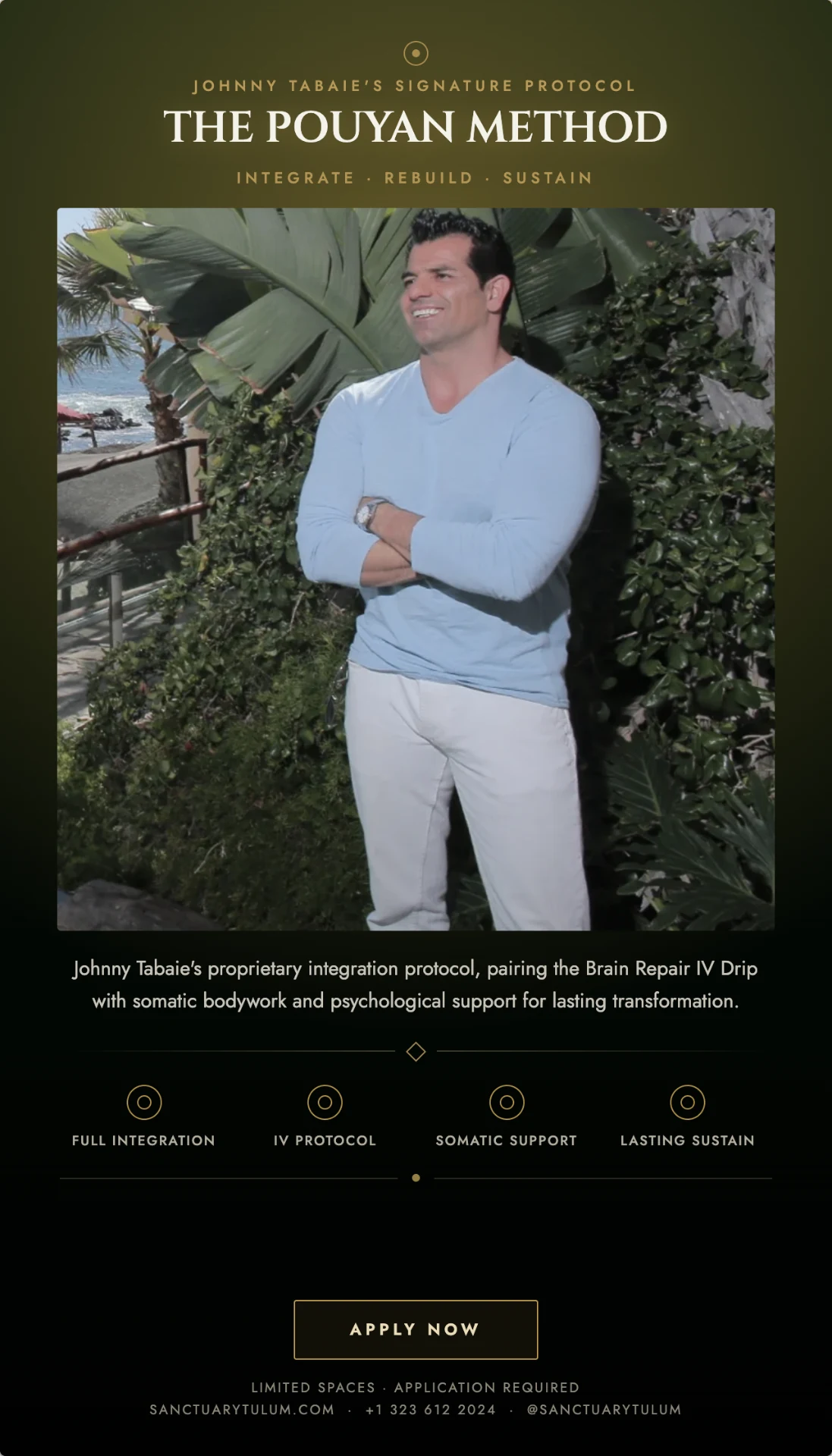
Programs built around brief group sessions and a rotating clinical staff struggle to build the kind of continuous understanding of a person's specific triggers, history and patterns that long-term planning requires. Sanctuary Tulum's Pouyan Method™ is built the opposite way: 35+ hours of one-to-one clinical work each week, with the same small clinical team throughout the stay.
That continuity means the discharge plan is not written in the final days from a summary chart — it is built incrementally, week over week, by clinicians who have direct, sustained contact with the person leaving.
Volume of individual time also changes what can be worked on. In a group-led model, the clinical hour is spent on material that applies to everyone in the room. In a one-to-one model, the hour is spent on the specific sequence of events, relationships and physical states that precede this person's difficulty — which is the only level of detail at which relapse prevention becomes practical rather than generic.
It also compresses the feedback loop. When the same clinicians see a guest daily, a change in sleep, appetite, mood or engagement is noticed within a day rather than at the next scheduled review, and the plan is adjusted while the adjustment still matters. Over four to sixteen weeks that accumulates into a detailed, tested understanding of what this person needs after they leave.

Physical restoration as relapse prevention
Sleep disruption, nutritional depletion and chronic inflammation are all associated with higher relapse risk, and a program that only addresses the psychological side of recovery leaves a real vulnerability unaddressed. Sanctuary Tulum incorporates Brain Repair IV therapy, hyperbaric oxygen therapy, organic nutrition, and daily movement and bodywork specifically to rebuild the physiological baseline a person needs to sustain change once the intensive support of residential care ends.
Sleep is usually the first measurable improvement and the most predictive one. A person sleeping four fragmented hours has limited capacity for the emotional work recovery asks of them, and limited tolerance for ordinary stress once they are home. Restoring a consistent sleep pattern — through daylight exposure, movement earlier in the day, consistent meal timing, and the removal of the substances that were fragmenting it — is a practical relapse-prevention measure rather than a wellness extra.
Nutrition works the same way. Prolonged alcohol or stimulant use commonly leaves real deficiencies, and correcting them changes energy, mood stability and cognitive clarity within weeks. Daily yoga and bodywork add a second element: a repeatable, non-pharmacological way to lower physical arousal, which is precisely the skill most needed in the first difficult weeks at home.
None of this is a substitute for the clinical work. It is the physiological floor the clinical work stands on, and guests who leave with that floor rebuilt tend to describe the transition home as manageable rather than overwhelming.
A discharge plan written in the last three days is not a plan. It is a formality.
Sanctuary Tulum
Elements of a relapse-prevention architecture
What should be in place well before a guest leaves.
Written discharge plan
Sleep, nutrition, movement and clinical follow-up specified in writing.
Local provider handoff
Coordination with a physician or therapist at home, with the guest's consent.
Early-warning signs
A specific, individualised list of what a setback looks like for this person.
Family or partner briefing
What the people closest to the guest need to know and watch for.
Structured re-entry
A graded return to work and routine rather than an abrupt resumption.
Check-in cadence
Scheduled follow-up contact in the weeks immediately after departure.
Behaviour change, not just symptom relief
Long-term recovery depends on more than resolving the acute crisis that prompted treatment. It requires new daily habits — around sleep, movement, nutrition, stress response and relationships — that are durable enough to survive contact with an unchanged environment at home. This is why Sanctuary Tulum's model deliberately avoids short-form interventions in favour of sustained, individualised work: holistic addiction rehab that treats the whole physiological and behavioural picture, not only the presenting symptom.
Guests spend weeks, not days, practising new patterns under supervision — through bodywork, structured meditation, and consistent daily rhythm — so that by the time they leave, the new pattern has had time to become familiar rather than aspirational.

What a track record should show
Ask any program directly how it measures success after a guest leaves, not only during the stay. A facility willing to describe its follow-up process in specific terms — who calls, how often, and what triggers a recommended return — is signalling that it thinks about recovery on the same multi-year timeline the research does.
The second thing worth asking about is consistency. A single good year says little; a program that has run the same model with the same safety discipline over more than a decade has been tested against a far wider range of medical presentations, and its protocols reflect that. Sanctuary Tulum has operated since 2011 and maintains a fatality-free record across medically supervised ibogaine treatment — a plant medicine with known cardiac risk factors — which is a specific, checkable claim rather than a general reassurance.
Be equally attentive to what a program will not claim. Facilities publishing precise success percentages without describing who was counted, over what window, and how success was defined are quoting marketing figures. The more useful signals are concrete: physician presence on site, staffing ratio, how length of stay is decided, and whether a written plan leaves with the guest.
Regulatory standing belongs in the same list. Sanctuary Tulum is licensed by COFEPRIS, Mexico's federal health regulator, and states that plainly rather than relying on the word "licensed" alone. Any program should be able to name its regulator and describe its medical staffing without hesitation.
Building a plan that holds
Sanctuary Tulum has operated as a licensed oceanfront healing center since 2011. Programs run Gold, Platinum and Elite VIP tiers across four to sixteen weeks, detailed on the programs and pricing page, with the length calibrated to give the discharge architecture described here time to actually take hold.
Sanctuary Tulum is a luxury mental health rehab built around this longer view of recovery. The contact page outlines how an initial clinical review considers not just admission but what a realistic long-term plan would look like for a specific person.
Measuring success honestly
A program that claims a specific success percentage without describing its methodology — who was counted, over what period, and how "success" was defined — is publishing a marketing figure rather than a clinical finding. There is no independently audited, standardized measure of long-term recovery outcomes across the residential treatment industry, and any facility claiming otherwise should be asked to show its work.
A more honest signal is process: does the program track guests after discharge in any structured way, does it describe what triggers a recommended return, and is it willing to discuss what it does not know about long-term outcomes? Programs willing to be specific about the limits of what they can promise are, in practice, more trustworthy than those offering a confident number with no source.
The role of environment in sustaining change
Setting alone does not create durable recovery, but a poorly chosen environment can actively work against it. Constant noise, shared accommodation, and a schedule built around group logistics rather than individual need all compete for the attention that discharge planning and skill-building actually require. An oceanfront setting with a small guest census removes some of that competition, giving clinical staff more room to focus on the specific person in front of them rather than managing a larger group.
This is one reason Sanctuary Tulum maintains single-occupancy accommodation and a small number of guests at any one time: the discharge architecture described above takes sustained clinical attention to build properly, and that attention is finite. A facility that markets its setting without describing how the setting translates into more individual clinical time is describing hospitality, not treatment design.