
In brief: "Luxury recovery center" is a marketing category, not a regulated one — which means the label tells you nothing and the underlying model tells you everything. This article explains what the strongest programs in this tier actually do differently across the full recovery arc, and how to verify it before you commit. Educational only; not medical advice.

Why the Word "Recovery" Changes the Question
Programs that call themselves luxury recovery centers rather than luxury rehabs are usually gesturing at something real, even if the terms are used interchangeably in practice. "Rehab" points at an episode: arrive, detox, complete a curriculum, leave. "Recovery" points at an arc that begins before admission and continues long after discharge, of which the residential stay is only the most intensive segment.
That distinction is worth taking seriously because the failure mode in this field is rarely the detox. Medically managed withdrawal is a well-understood clinical process. The point where things fall apart is usually the handoff — the weeks after a client leaves a highly supported environment and returns to the same relationships, pressures, and cues that surrounded the original problem, often with no continuing clinical relationship. Programs that organize themselves around the recovery arc rather than the residential episode tend to design for that handoff explicitly. Programs that do not tend to treat discharge as the finish line.
So the useful question when comparing luxury recovery centers is not what happens during the stay. It is what the program has built for the ninety days after it.
The Three Phases a Serious Program Accounts For
Whatever a program calls itself, a defensible clinical structure in this tier accounts for three distinct phases, each with different aims, different risks, and different staffing needs.
Phase one: medical stabilization. This is withdrawal management and physiological stabilization, and it is the phase with genuine medical danger attached. Alcohol withdrawal can produce seizures and delirium tremens and can be fatal unmanaged. Benzodiazepine withdrawal carries seizure risk and a documented protracted course, and abrupt cessation is specifically contraindicated. This phase requires physician oversight and overnight clinical coverage, not enthusiasm.
Phase two: restoration. Once the acute phase resolves, the work shifts to sleep, nutrition, inflammation, micronutrient repletion, nervous-system regulation, and the return of basic cognitive and emotional function. This is where the wider therapeutic toolkit at this tier earns its place — IV protocols, hyperbaric oxygen, ozone and blood-oxygenation therapies, structured nutrition, bodywork, and daily movement — and where a client typically first feels genuinely different rather than merely less unwell.
Phase three: integration. The psychological and practical work of translating a stabilized state into a life that does not reproduce the original problem: the relationships, the work patterns, the sleep, the triggers, the plan for the first hard week back. This phase is the one most often under-resourced, because it is the least photogenic and the hardest to sell on a website. It is also the one most closely tied to whether any of the preceding work holds. Our own three-phase structure is described in the Pouyan Method™.

What Counts as Real Medical Oversight
Every program in this tier claims medical supervision, and the phrase covers everything from a physician physically present daily to a consulting doctor who signs off on intake paperwork remotely. The difference is enormous and the language is identical, so the only way through is to ask for specifics and accept nothing vaguer.
Ask who, by name and credential. A program that names its supervising physician and their qualifications is making a checkable claim. One that refers only to "our medical team" is not.
Ask about overnight coverage. Withdrawal complications do not observe business hours. Establish who is on site overnight, what they are licensed to do, and what the escalation pathway to a hospital is — including the actual distance and transport arrangement.
Ask which authority licenses the facility. A named regulator is a real trust signal because it implies submission to an external standard. Sanctuary Tulum is licensed by COFEPRIS, Mexico's federal health regulator; our clinical oversight and reviewer credentials are published on the medical review board page.
Ask what happens with existing prescriptions. Many clients arrive on psychiatric medication. Whether a program continues it, tapers it under supervision, or has no coherent position on it is a first-order clinical fact — and one you want in writing before admission rather than as a surprise in week two.

Census Is the Number That Explains Everything Else
If you can only extract one fact from an admissions call, extract the census: how many clients are in residence at once. Not licensed capacity — the number actually living there this month. Almost every other claim a program makes is constrained by that figure.
A program with a small census can schedule several individual clinical hours per client per day, can adjust a plan the same week something is not working, can staff a single client's difficult night without stripping coverage from everyone else, and can keep the therapeutic relationship with one consistent clinician rather than rotating a client through whoever is available. A program with a large census can do none of those things reliably, no matter how it is furnished, because the arithmetic does not allow it.
This is also why census and price move together at the honest end of the market. Low occupancy spreads fixed cost over very few clients, and high one-on-one staffing is expensive every single day. When a program advertises deep individual attention at a large census, one of those two claims is not true. Our own capacity, staffing model, and programme structure are set out on the packages and prices page.
The Restoration Toolkit, Described Honestly
The medical and restorative therapies available at this tier are one of its genuine differentiators from conventional treatment, and they deserve to be described without inflation. What they are designed to support is the physiological recovery that follows stabilization: sleep architecture, energy metabolism, inflammatory load, micronutrient status, and autonomic regulation. What they are not is a guarantee of any outcome, and a program presenting them as one is telling you something about its judgment.
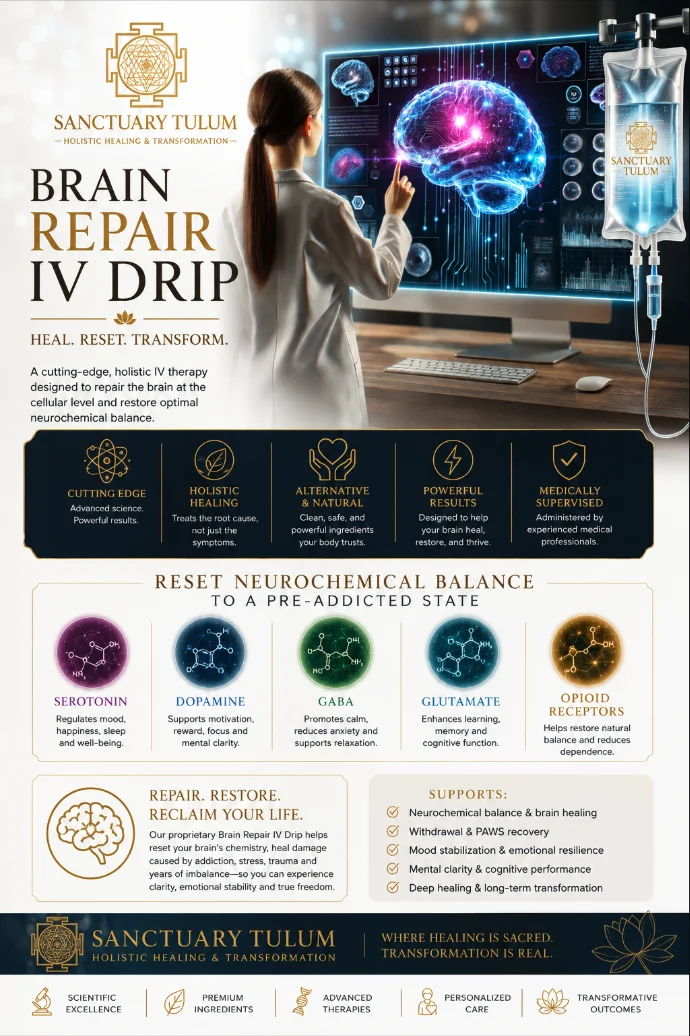
Typical components include intravenous nutrient and amino-compound protocols; NAD+ IV therapy; glutathione and vitamin C IVs; chelation where a documented heavy-metal burden exists; hyperbaric oxygen therapy; ozone and blood-oxygenation therapies; an organic, non-GMO nutrition program built around inflammation and repletion; and daily bodywork, meditation, and movement. Our proprietary Brain Repair Protocol is a nature-derived IV formula of natural alkaloids, peptides, and amino compounds, and is distinct from the standalone NAD+, amino acid, glutathione, vitamin C, and chelation IVs offered alongside it.
The reasonable expectation to hold is this: these therapies aim to support recovery of function during the restoration phase, they are delivered under medical supervision, the evidence base varies considerably from one modality to the next, and no responsible program will promise you a result from any of them. The full list of what we offer is on the treatments page.
Length of Stay: Why 28 Days Became the Default, and Why It Often Isn't Enough
The 28-day residential stay is one of the most widely recognized conventions in addiction treatment, and it did not emerge from clinical evidence about how long recovery takes. It emerged from administrative and reimbursement history. The research literature, by contrast, consistently associates longer retention in treatment with more durable outcomes rather than identifying a month as a clinically sufficient threshold.
This matters most for the presentations that arrive most often at this tier. A supervised benzodiazepine taper frequently cannot be completed safely inside a month at all. Long-term antidepressant discontinuation follows its own protracted timeline. A client with significant trauma underneath a substance problem is often only reaching the point of being able to do that work at the moment a 28-day program would be discharging them. Programs structured in four-to-sixteen-week bands, adjusted to the actual presentation, are responding to that reality rather than to a billing convention.
The practical question to ask an admissions team is not "how long is your program" but "how do you decide how long this person should stay, and what happens if the plan needs to change in week five?" A program with a real answer has thought about the arc. A program that quotes a fixed number has thought about the calendar.

Discretion, and Who Needs It Clinically
For a substantial share of clients at this tier, confidentiality is not an amenity — it is the precondition for treatment happening at all. Founders whose companies would be materially affected by disclosure, licensed professionals answerable to boards, public figures, and people in industries where a documented treatment episode carries lasting professional cost frequently delay care for years rather than accept an environment where their presence becomes known.
A program built for that reality looks different in specific, verifiable ways: single-occupancy accommodation, no group sessions in which a client's identity and history are disclosed to peers, controlled admissions, staff bound by confidentiality agreements, and discreet arrival logistics. Ask about each of those individually. "We're very private" is not an answer; a description of how admissions and accommodation are actually structured is.
There is a clinical dividend here too, not just a reputational one. Treatment depends on candor, and candor is expensive for someone who must simultaneously manage how they are perceived by a room of peers. Removing the audience removes that tax. Our executive rehab program is built entirely around one-on-one care for this reason, with no group therapy and no 12-step programming.

A Short Checklist Before You Commit
Families making this decision are usually doing it quickly, under strain, and with more marketing material than facts in front of them. This is the shortest list that still covers what matters.
- Current census, and individual clinical hours scheduled per client per day.
- Supervising physician by name and credential; overnight coverage; hospital escalation pathway and distance.
- Licensing authority, named.
- Stated position on maintenance and replacement prescriptions, and on tapering existing psychiatric medication.
- Whether the program is one-on-one, group-based, or a mix — and in what proportion.
- Recommended length of stay for this specific presentation, and how the plan can change mid-stay.
- A real week's schedule, with clinical hours and wellness hours counted separately.
- Included aftercare: who, how long, at what additional cost.
- Written breakdown of what the rate includes and what is billed separately.
If a program answers these nine points with numbers and names, you can evaluate it. If it answers with adjectives, you have learned something important anyway.
A Closing Note
The strongest luxury recovery centers are not distinguished by their setting, and the weakest are rarely distinguished by anything else. What separates them is whether the program is staffed for individual attention, medically capable of managing the phase that carries actual danger, honest about what its therapies are designed to do, and built to stay in relationship with a client after they leave. Ask for those facts directly. If you want help thinking through a specific situation, you can speak with our clinical team, read about our luxury rehab program, compare the most expensive luxury rehabs in the world, or start with what separates the top luxury rehab centers.
Editorial note: This article is educational and does not constitute medical advice, diagnosis, or a treatment recommendation, and makes no claims about outcomes for any individual. Withdrawal from alcohol, benzodiazepines, and other substances can be medically dangerous and requires physician management. Anyone with questions about their own health should consult a licensed clinician.
References
- National Institute on Drug Abuse. Principles of Drug Addiction Treatment: A Research-Based Guide (Third Edition) — on length of stay, retention, and individualized treatment planning.
- Substance Abuse and Mental Health Services Administration. TIP 45: Detoxification and Substance Abuse Treatment.
- StatPearls / NCBI Bookshelf. Alcohol Withdrawal — clinical course, seizure and delirium tremens risk.
- Clinical reviews of benzodiazepine discontinuation, protracted withdrawal symptoms, and supervised tapering. PubMed.
- COFEPRIS (Comisión Federal para la Protección contra Riesgos Sanitarios) — Mexico's federal health regulatory agency.