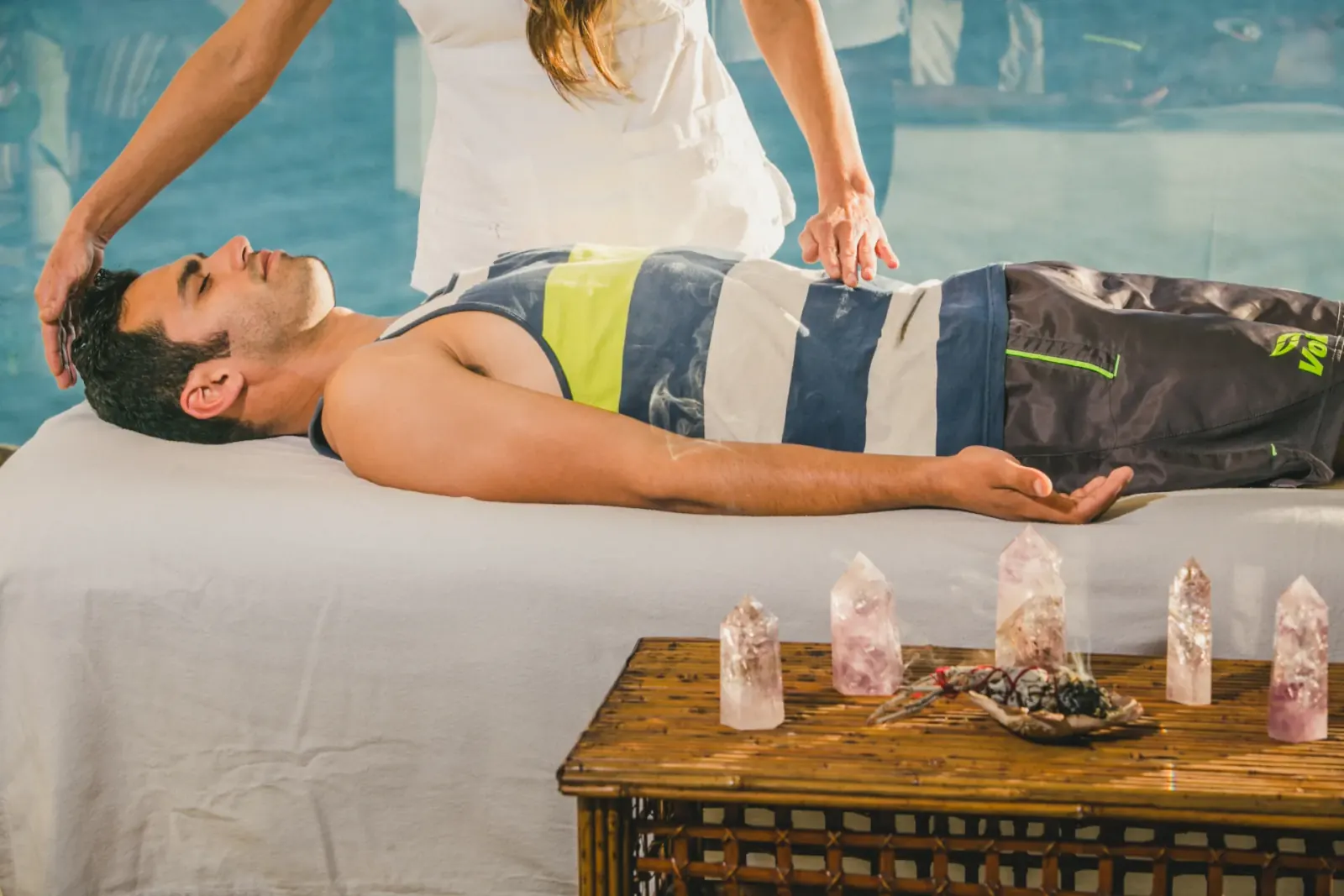
The Usui Lineage — A Short, Factual History
Reiki (霊気) as it is practiced today was systematized by Mikao Usui in early twentieth-century Japan. Usui, a lay teacher with a background in Tendai Buddhism and Shintō, founded his teaching society — the Usui Reiki Ryōhō Gakkai — in Tokyo in 1922, and taught until his death in 1926. One of his senior students, the naval physician Chūjirō Hayashi, refined the hand-position sequence still used in most modern lineages. Hayashi in turn trained Hawayo Takata, a Japanese-American woman who carried the practice to Hawai'i in the 1930s and, from there, to the wider English-speaking world. Nearly every certified Reiki practitioner working today can trace their attunement lineage back through one of these three teachers.
Sanctuary Tulum's practitioners are trained in the Usui tradition and are transparent about what that means: the technique is a defined sequence of light-touch or near-touch hand positions accompanied by a quiet, meditative frame — not a medical procedure, not a diagnostic tool, and not a modality that has been shown to modify disease. The classical description references "ki" (life energy); we do not present that framing as a proven mechanism. What we present as proven is that a defined subset of guests find the sessions genuinely settling, and the peer-reviewed literature is broadly consistent with that subjective effect.
Honest Evidence Framing
The 2015 Cochrane review by Joyce and Herbison — the most rigorous synthesis of Reiki research to date — examined randomized trials of Reiki for anxiety and depression and concluded that the existing evidence base was insufficient to draw firm conclusions, with the authors calling for larger, better-designed trials.1 That is the honest scientific position, and it is the position Sanctuary Tulum works from.
Smaller randomized and controlled studies in oncology, pre-surgical, and chronic-pain populations do report short-term reductions in self-rated anxiety and pain following Reiki sessions compared with sham or standard care.2,3 The reproducible finding across these studies is on subjective distress — self-rated anxiety, pain, and stress — rather than on disease-specific biomarkers or long-term outcomes. There is no rigorous evidence that Reiki treats depression, PTSD, addiction, or any other diagnosable condition as a stand-alone therapy, and we do not present it as such. What the literature supports is a modest short-term relaxation effect in some patients; that is exactly the role it plays inside a Sanctuary Tulum stay.
A Complementary, Never a Primary, Practice
Because the evidence base is modest, Reiki at Sanctuary Tulum sits firmly in the complementary tier of the program. It is never the reason a guest comes to the sanctuary, and it is never used as a substitute for medical or psychiatric care. The primary clinical work — physician-led detox, Brain Repair IV therapy, plant-medicine ceremonies within the Pouyan Method™, and long-arc integration — happens under medical supervision. Reiki is one of several gentle add-ons that a guest can opt into on lighter days.
Its most common clinical uses within a stay are narrow and specific:
- • Pre-ceremony grounding the day before an ayahuasca ceremony or ibogaine session, when a guest needs quiet contact without further verbal processing.
- • Post-ceremony integration in the 48 hours after a session, when the nervous system is still down-regulating and deeper bodywork would be too stimulating.
- • Gentle support during early detox or medication tapering, where guests often cannot tolerate strong touch, sound, or heat but still benefit from calm presence.
- • An opt-in alternative for guests who find silent sitting or meditation difficult and prefer a contact-based, guided form of stillness.
- • A lighter complement to massage therapy and yoga on rest days scheduled between intensive protocol days.
Guests who are skeptical of biofield practices are welcome to skip Reiki entirely and substitute additional meditation, massage, or rest — no framework is imposed and nothing about the wider Sanctuary Tulum protocol depends on Reiki being part of a given guest's stay.
How a Session Actually Runs
Sessions are 45–60 minutes, in a quiet private room, fully clothed. The practitioner opens with a brief conversation — the guest names the intention in their own terms (settling before a ceremony, integrating after one, easing a rough patch during a taper) — and explicit consent for light touch is discussed before anything begins. Guests choose whether the practitioner works with hands resting lightly on the body or hovering just above it; both are valid within the Usui tradition.
The practitioner then moves through the classical sequence of hand positions — head, shoulders, chest, abdomen, legs, feet — with quiet music or silence in the background. Guests are encouraged to notice sensations without needing to interpret them; warmth, tingling, drowsiness, emotional release, or nothing at all are all valid experiences, and the practitioner does not diagnose or claim to detect specific pathologies. Afterwards a short debrief lets the guest talk through anything that arose, and notes are logged in the guest's daily record so the clinical and integration teams see the full arc of how a guest is responding across modalities.
Related Resources
References
- 1. Joyce J, Herbison GP. Reiki for depression and anxiety. Cochrane Database Syst Rev. 2015;(4):CD006833.
- 2. Thrane S, Cohen SM. Effect of Reiki therapy on pain and anxiety in adults: an in-depth literature review of randomized trials with effect size calculations. Pain Manag Nurs. 2014;15(4):897-908.
- 3. Baldwin AL, Vitale A, Brownell E, Kryak E, Rand W. Effects of Reiki on pain, anxiety, and blood pressure in patients undergoing knee replacement: a pilot study. Holist Nurs Pract. 2017;31(2):80-89.
- 4. McManus DE. Reiki is better than placebo and has broad potential as a complementary health therapy. J Evid Based Complementary Altern Med. 2017;22(4):1051-1057.