Root-Cause Medicine
Functional Medicine Retreat: Treating the Cause, Not the Signal
Laboratory-informed, physician-supervised integrative care in a five-client oceanfront setting — built around what your biology is actually doing.
Starting From the Data, Not the Diagnosis Code
Most people arrive here having already been through the standard sequence: a symptom, a fifteen-minute appointment, a prescription, and a follow-up six weeks later that changes the dose rather than the question. Functional medicine begins somewhere else. It treats fatigue, low mood, brain fog, poor sleep, and unexplained inflammation as signals produced by systems that are not working — and then goes looking for which systems, with laboratory testing rather than guesswork.
A retreat format suits that work unusually well. Testing, intervention, and reassessment happen over weeks in one place, under continuous supervision, instead of being spread across months of appointments with different providers. Sanctuary Tulum, operating since 2011, caps the property at five clients so that this level of individual attention is structurally possible. That said, root-cause work has real limits: it is not a diagnostic service, it does not replace a physician, and it is not built to manage acute medical emergencies. Those belong in conventional care, and we say so plainly at intake.

What an Intake and Biomarker Baseline Actually Covers
The first days of a stay are largely information-gathering, not diagnosis. Bloodwork typically covers inflammatory markers such as C-reactive protein, a full thyroid panel rather than TSH alone, fasting insulin and glucose for metabolic function, iron studies, B12 and folate, and a broader micronutrient status. Gut health screening looks at digestive function and markers associated with intestinal permeability, and where history warrants it, toxic-burden screening looks at heavy metal and environmental exposure.
None of this constitutes a diagnosis on its own. It is a structured way of collecting enough data that a licensed clinician can stop guessing and start reasoning from evidence. Findings are reviewed against a detailed history of sleep, diet, medication exposure, past infections, and major life events, because a single lab value rarely tells the whole story.
Reading the Whole Panel, Not Just One Number
A single abnormal marker rarely tells the full story on its own, which is why baseline testing is read as a set rather than as isolated data points. Inflammatory markers are considered alongside metabolic indicators such as fasting insulin and glucose, because chronic low-grade inflammation and metabolic dysregulation frequently travel together and can each make the other worse. A thyroid panel that looks unremarkable on TSH alone can still show meaningful patterns once free T3, free T4, and relevant antibodies are added — one reason a full panel, rather than a single value, is standard here.
Micronutrient status is treated the same way. Low vitamin D, low B12, or low magnesium can each independently contribute to fatigue, low mood, and poor sleep, and correcting one without checking the others often leaves someone only partially improved. Gut health and toxic-burden screening round out the picture, particularly for clients whose history includes long-term antibiotic use, chronic digestive symptoms, mold exposure, or occupational chemical exposure. None of this is presented as a diagnosis; it is a way of narrowing down which systems deserve attention first.
Detoxification Pathway Support, Described Carefully
"Detox" is an overused word, so it is worth being precise. The body already runs its own clearance systems continuously: the liver performs phase I and phase II conjugation to convert fat-soluble compounds into water-soluble ones the body can excrete, bile carries some of that material into the digestive tract, the kidneys filter the bloodstream around the clock, and the lymphatic system moves fluid and metabolic waste back toward circulation. Sweat is a minor, supportive elimination route alongside those primary pathways, not a replacement for them.
Supportive practices at the retreat — hydration protocols, targeted nutrition, movement, and sauna-based sweating — are designed to support those existing pathways rather than to force or accelerate them artificially. We do not claim to "flush toxins" in a way the body's own organs are not already doing; the honest framing is support, not replacement, of physiological function.
Nutrition as a Clinical Intervention, Not a Wellness Add-On
Food is treated here as an active part of the protocol, not a garnish around it. The kitchen runs an organic, non-GMO, allergen-conscious program built around whole, nutrient-dense ingredients. For clients whose labs point to reactive foods or gut irritation, an elimination phase removes common triggers — typically gluten, dairy, refined sugar, and specific allergens identified in testing or history — followed by a structured reintroduction that tracks symptoms as foods are added back one at a time.
Blood-sugar stability runs underneath all of it. Meals are sequenced and composed to reduce sharp glucose swings, which in turn tends to support steadier energy and mood across the day. Where micronutrient testing shows deficiencies — vitamin D, B12, magnesium, or others — repletion is handled through food first and targeted supplementation second, reviewed against repeat labs rather than continued indefinitely on assumption.
Why Blood-Sugar Stability Matters Beyond Weight
Blood-sugar swings are often discussed only in the context of weight or diabetes risk, but their reach is broader than that. Sharp glucose spikes followed by crashes can produce irritability, afternoon energy collapse, disrupted sleep onset, and cravings that make an elimination phase feel far harder than it needs to be. Meals at the retreat are composed with protein, fiber, and healthy fats sequenced to blunt those swings, and clients are shown, in practical terms, how plate composition and meal timing affect how they feel hours later — not as an abstract nutrition lecture, but as something they can observe in their own data across the stay.
Reintroduction after an elimination phase is handled one food at a time, with a short observation window between additions, because reactions to reintroduced foods are sometimes delayed rather than immediate. The goal of the whole nutrition arc is a sustainable, personalized way of eating that a client can reasonably continue at home — not a restrictive protocol designed only to work inside the retreat's kitchen.
The Regenerative Therapy Stack, Named Separately and Precisely
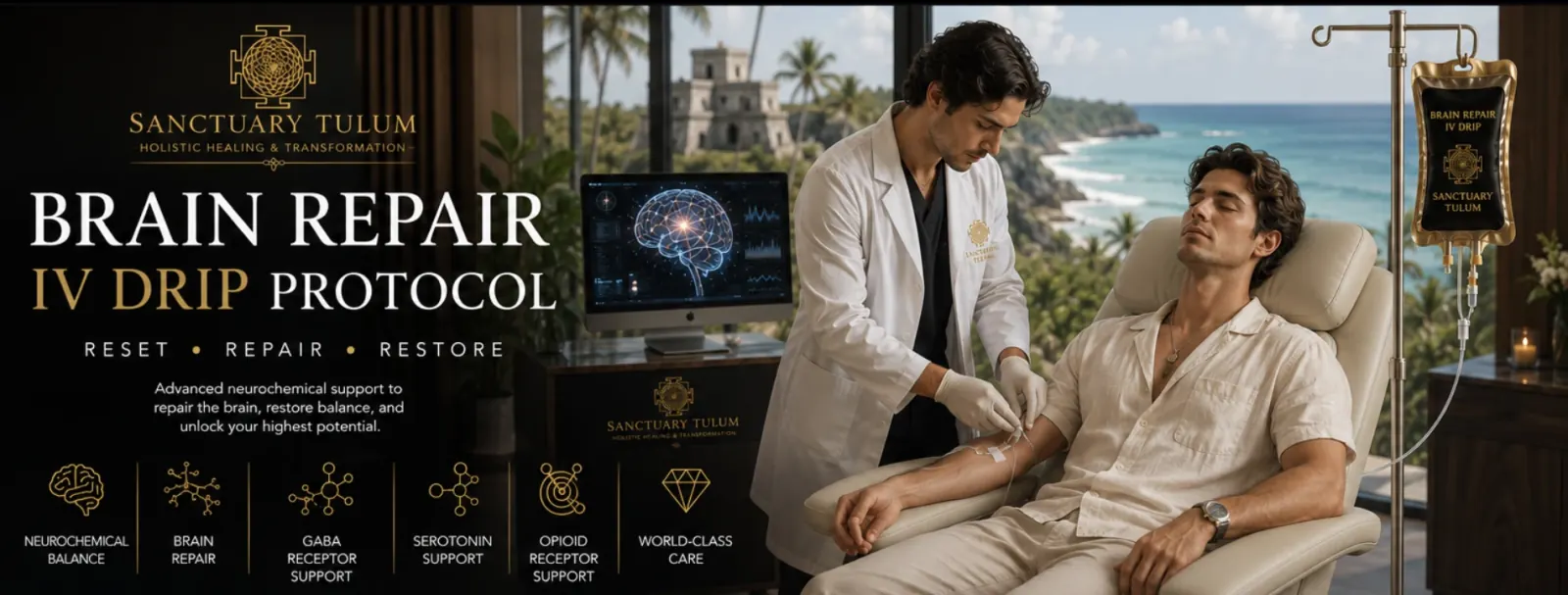
One point we are careful about: these are distinct therapies, not interchangeable versions of each other, and not every client receives every one. The Brain Repair Protocol IV is a proprietary, nature-derived intravenous formula developed for the program — it does not contain NAD+. Separately, NAD+ IV therapy is offered on its own for cellular energy and mitochondrial support, alongside standalone glutathione IV, vitamin C IV, amino acid IV, and chelation IV protocols for heavy-metal support — each selected individually when testing indicates it, never bundled by default.
Beyond IV work, the toolkit includes hyperbaric oxygen therapy, which the FDA has cleared for a defined set of conditions and warns against for unapproved uses; EBOO blood ozonation and plasmapheresis where clinically indicated; stem cell therapy for regenerative support; and recovery-adjacent modalities including red light therapy, infrared sauna, and cold plunge therapy. Each is described to clients by what the evidence for it actually shows, and none is presented as a cure.
What the Regenerative Stack Is Designed to Support
It helps to be specific about intent rather than outcome. Hyperbaric oxygen therapy increases the amount of oxygen dissolved in plasma under pressure, which is why it has FDA clearance for conditions involving impaired healing and tissue oxygenation; here it is used as a supportive modality within a broader plan, not as a stand-alone cure for anything beyond its cleared uses. EBOO blood ozonation and plasmapheresis are used selectively, typically where testing or history points to a specific inflammatory or toxic-burden pattern that a clinician judges may benefit from them, and both require careful screening before use.
Red light therapy and infrared sauna are lower-intensity supportive tools, generally used for circulation, muscle recovery, and relaxation rather than as primary interventions, and cold plunge therapy is offered for its effects on alertness and stress-response regulation. Stem cell therapy sits at the more advanced end of the stack and is discussed individually with a physician, with expectations set around what current evidence for regenerative approaches actually supports rather than around hoped-for results. None of these therapies is described as guaranteed, and stacking several of them does not mean stacking their claims.
A lab value is information, not a verdict — the work is deciding what to do with it, in the right order, for one person at a time.
Sanctuary Tulum Clinical Team
Sleep, Circadian Rhythm, and Nervous-System Regulation
Chronic sleep disruption and nervous-system dysregulation are frequent upstream contributors to the fatigue, brain fog, and low mood that bring people to this kind of work in the first place. The daily structure at the retreat is built to support circadian rhythm directly: consistent light exposure in the morning, reduced stimulation in the evening, structured wind-down routines, and daily practices — breathwork, movement, bodywork — aimed at shifting the nervous system out of a chronically activated state.
This is not framed as a quick fix. Sleep architecture that has been disrupted for years does not reliably normalize in days, and we tell clients that directly rather than promising otherwise. What we can offer is a structured, monitored environment in which the conditions for better sleep are consistently in place, with progress tracked rather than assumed.
How a Multi-Week Residency Is Sequenced
Stays are structured in phases rather than as a single undifferentiated block of time. An initial baseline period covers intake, laboratory work, and history-taking, and nothing is started before that picture is reasonably complete. A clearance phase follows, focused on supporting the body's own detoxification pathways and stabilizing nutrition and sleep before more intensive interventions begin. A rebuilding phase introduces the specific IV, oxygen, or regenerative therapies that intake findings support, sequenced deliberately rather than delivered all at once.
The final phase is integration and return planning: consolidating what has changed, documenting it clearly, and building a plan for sustaining progress once someone is back in their normal environment. Stays run from several weeks to several months depending on how long the underlying pattern has been in place, and every client's sequence is different — this is a description of the general shape, not a fixed calendar applied uniformly.

What Functional Medicine Cannot Do — and When Conventional Care Is Right
Functional medicine is not a substitute for emergency care, for the ongoing management of conditions that require it, or for medications a client should not stop without medical guidance. The US National Center for Complementary and Integrative Health draws a distinction we apply directly: integrative care means combining conventional and complementary approaches in a coordinated way, not replacing medical care with alternatives to it. Some conditions and presentations are simply outside what this model is built to address, and part of screening is identifying that honestly before someone travels.
A personal physician remains central to the process. Where a client has an existing doctor, we encourage involving them from the outset and, with written consent, share intake findings, protocols delivered, and repeat labs so that care can continue on return. This is a concentrated period of focused work, not a closed system meant to operate apart from the rest of someone's medical life.
Medical Oversight and Honest Limits
Sanctuary Tulum operates as a licensed facility, and all clinical care is delivered by licensed medical staff. Founder Johnny Tabaie is an educator and self-taught practitioner who spent more than twenty years researching integrative and psychedelic medicine after losing his brother David in 2001; he built the program framework and the Pouyan Method™, but he does not practise medicine and does not present himself as a doctor or scientist.
We do not publish success-rate percentages, and we do not promise reversal, cure, or permanent outcomes. What we can commit to is a plan built from your own laboratory data, delivered under physician supervision, adjusted as results come in, and explained to you in terms of what the evidence does and does not show.
Hormonal and Adrenal Patterns We Look For
A large share of the people who arrive describing fatigue, low motivation, and poor stress tolerance have never had their endocrine picture examined beyond a single thyroid value. Where history warrants it, testing extends to cortisol patterning across the day, DHEA, and sex hormone levels appropriate to age and sex, because a flattened or inverted cortisol curve produces a recognisable experience: waking unrefreshed, functioning on stimulants by mid-morning, crashing in the afternoon, and then feeling artificially alert late at night. That pattern is a signal about how long the stress-response system has been running without recovery, not a diagnosis in itself.
What we do with that information is deliberately conservative. Sleep timing, light exposure, training load, caffeine and alcohol intake, and blood-sugar stability are addressed first, because each of them measurably influences the same axis and none of them carries the risk profile of hormonal intervention. Repeat testing later in the stay shows whether those changes are moving the numbers. Anything beyond that is a physician conversation held individually, with the limits of current evidence stated plainly rather than glossed over.
Movement, Breathwork, and Load Management
Exercise is one of the most robustly evidenced interventions in the whole programme, which is exactly why it is prescribed rather than assumed. Many clients arrive either sedentary or over-training — and over-training, in someone already running a depleted stress-response system, tends to make fatigue and sleep worse rather than better. The daily structure therefore starts with low-intensity aerobic work, mobility, and breathwork, then adds resistance training and higher-intensity sessions only as sleep quality and daytime energy indicate the body can absorb them.
Breathwork sits alongside movement as a nervous-system tool rather than a spiritual one in this context. Slow nasal breathing with extended exhalation is used before sleep and after intensive sessions because of its effect on vagal tone and subjective calm; more activating protocols are used sparingly and never with clients whose cardiac or psychiatric screening flags caution. Bodywork and therapeutic massage are scheduled through the week for the same reason — recovery capacity is treated as a variable to be built, not a luxury bolted onto the plan.
How We Decide What Not to Do
Deciding against a therapy is as much a part of this work as selecting one. A client whose cardiac screening raises concerns is not a candidate for certain protocols regardless of how much they want them. Someone currently tapering a prescribed medication under another physician's care has that taper respected, not overridden. Where laboratory findings point to something outside our scope — a suspected malignancy, an unmanaged cardiac or endocrine condition, an acute psychiatric risk — the appropriate response is referral into conventional medical care, and we say that directly rather than absorbing the case.
Stacking more interventions is also not automatically better. Running several therapies simultaneously makes it impossible to know which one produced a change, so protocols are introduced in sequence with enough interval to observe an effect. That discipline is why the plan you leave with is usually shorter than the one you imagined arriving — the goal is a defensible, reproducible set of interventions with observable results, not the longest possible list.
Documentation That Travels Home With You
Every phase generates a written record: baseline labs, the reasoning behind each therapy chosen, repeat labs taken during the stay, and the nutrition and supplementation plan in its final form. This is assembled deliberately so that a physician at home — the person who will actually manage long-term care — can see exactly what was done, why it was chosen, and what changed on repeat testing, rather than receiving a vague summary after the fact.
That handover matters because a retreat, however well run, is a concentrated period of change rather than a permanent care relationship. The value of the weeks spent here is largely determined by what happens in the months after, and clear documentation is what allows a client's own medical team to pick the thread back up with confidence instead of starting from nothing.
Admissions and Personalization
Every client's plan is different by design, because it is built from that client's own data rather than from a standard checklist. Admission begins with a medical intake — a full medication review, relevant laboratory work, and cardiac screening where a proposed therapy calls for it — before any protocol is confirmed. The functional medicine track can also sit alongside other areas of the program depending on need, including the wider wellness center, natural biohacking and mental health detox track, executive rehab, trauma retreat, or holistic addiction treatment. Full cost and stay-length detail is on the packages and pricing page, and any specific question about fit is best answered directly through contact before travel is booked.