Privacy-First Care
Executive Rehab for Burnout and Chronic Stress
A discreet, one-to-one program for senior leaders whose performance, sleep, and mental health have been eroded by sustained pressure — with a hard cap of five clients at any time.

Most facilities that market "executive rehab" are conventional residential centers with a nicer wing and Wi-Fi in the rooms. The clinical model underneath is unchanged: group therapy, a shared timetable, and a substance-detox framework built primarily around opioid or alcohol withdrawal. Sanctuary Tulum, operating since 2011, is built differently. This is a mental health and behavioral health program for burnout, chronic stress, anxiety, depression, trauma, and process addictions. It is not an opioid or heroin detox service, and we do not pretend otherwise. If acute substance withdrawal is the primary concern, our benzodiazepine withdrawal page or a facility built specifically for medical detox is the more appropriate starting point.
The people who come here are usually still functioning — often visibly succeeding. They are closing rounds, running P&Ls, and holding organizations together while sleeping four hours a night, self-medicating in ways they would never disclose, and quietly losing the capacity to feel anything about work they used to love. The World Health Organization classifies burnout in ICD-11 as an occupational phenomenon characterized by energy depletion, mental distance from one's job, and reduced professional efficacy — a description most of our executive clients recognize immediately. It is worth being precise about what that classification does and does not say: burnout is described as an occupational phenomenon affecting health, not itself a medical diagnosis, which is part of why it so often goes unaddressed until it resembles clinical depression or anxiety.

Five Clients. That Is the Whole Privacy Model.
Discretion at most centers is a paperwork exercise: you sign a confidentiality form and then walk into a room with twenty other people. Our privacy protection is architectural. We accept a maximum of five clients at any one time. There is no residential crowd, no communal group room, no cafeteria seating chart, and no shared van to appointments. Arrivals are staggered. Suites are private and oceanfront. The staff who know your name are the licensed clinicians and therapists directly responsible for your care.
That cap has a clinical function as well as a reputational one. It is what makes genuinely individualized scheduling possible. Sessions are arranged around your constraints rather than a fixed institutional timetable, which is why some clients maintain limited work contact during their stay. Every client's plan is different; the balance between rest and continued responsibility is negotiated with your care team rather than imposed by a program template. Clients who need additional protection can request a written confidentiality agreement covering staff and contractors before arrival — a detail worth confirming directly during admissions.
What Sustained Stress Actually Does
Burnout is not simply tiredness, and treating it like ordinary fatigue is one reason it persists for years in high performers. Chronic activation of the body's stress response keeps cortisol elevated well past the point where it is useful, and prolonged elevation is associated with disrupted sleep architecture, impaired memory consolidation, suppressed immune function, and blunted emotional range — the flatness many executives describe as no longer caring about work they once loved. The American Psychological Association's guidance on chronic work stress is blunt about the pattern we see most: prolonged stress reliably degrades sleep, concentration, immune function, and mood, and the people most exposed to it are the least likely to step back.
The Mayo Clinic's overview of job burnout makes a related point — untreated burnout tends to escalate into diagnosable depression, anxiety, and substance misuse rather than resolving on its own once the underlying triggers stay in place. The National Institute of Mental Health's material on chronic stress describes similar downstream effects on cardiovascular and metabolic health, which is part of why a program addressing burnout has to be medical in structure, not just a retreat with a nice view. Clients arriving here often present with overlapping patterns — unrelenting anxiety, a depressive flatness, unresolved trauma from earlier in a career, or a process addiction such as compulsive work, alcohol use, or stimulant reliance used to manage the load. Our depression treatment, trauma and PTSD care, and holistic addiction treatment pages describe those clinical tracks in more depth; in an executive stay they are usually addressed together rather than as separate programs.
The Physiology of Chronic Stress
The mechanism worth understanding is the HPA axis — the signaling loop between the hypothalamus, the pituitary gland, and the adrenal glands that governs cortisol release. Under normal conditions cortisol follows a daily rhythm: high on waking, tapering through the day, low at night so sleep can consolidate. Under sustained occupational stress that rhythm flattens. Cortisol stays elevated into the evening and fails to peak properly in the morning, which is part of why so many executives describe being simultaneously wired and exhausted — unable to switch off at midnight, unable to feel rested at six. The American Psychological Association's overview of stress effects on the body notes that this kind of dysregulation touches nearly every system at once — musculoskeletal, cardiovascular, gastrointestinal, endocrine, and nervous — rather than showing up as a single isolated symptom.
Sleep is usually the clearest casualty. Elevated evening cortisol interferes with the transition into deep, slow-wave sleep and shortens REM cycles, and both stages do specific work: slow-wave sleep clears metabolic waste and restores the body physically, while REM sleep consolidates memory and regulates emotion. The National Institute of Neurological Disorders and Stroke's Brain Basics overview of sleep describes this directly — without adequate deep and REM sleep, the brain struggles to form and hold new memories and loses some capacity to regulate mood. Clients often arrive having treated four or five hours of fragmented sleep as an acceptable trade for another productive hour, without registering that the trade has been compounding for years.
The cognitive effects follow predictably from that sleep debt and from the elevated cortisol itself: working memory narrows, so holding several variables in mind at once during a negotiation or a board discussion becomes harder; decision fatigue sets in earlier in the day, and choices that used to be quick — a hire, a term sheet, a difficult conversation — start to feel disproportionately heavy. None of this is a character failing. It is a predictable output of a stress response that was built for short bursts of danger and is instead running continuously for years. Longer term, the same dysregulation is linked to elevated blood pressure, disrupted glucose metabolism, and changes in gut motility and immune signaling, which is why clients frequently arrive with a cluster of seemingly unrelated complaints — reflux, poor digestion, recurring minor illness, tension headaches — that resolve only when the underlying stress load is addressed rather than treated symptom by symptom.

One-to-One Care, No Group Therapy, No 12-Step
Two things run in parallel here. The first is clinical: licensed medical staff oversee assessment, physiological recovery, and integrative therapies, with one-to-one therapeutic work replacing group sessions entirely. There is no shared confession circle, no mandatory step work, and no cohort you are grouped with by intake date. The second is closer to executive coaching — structured work on decision fatigue, boundary architecture, delegation, and the identity questions that surface when a high performer stops performing for a few weeks. Founder Johnny Tabaie is an educator and self-taught practitioner, not a physician; all medical care is delivered by licensed staff, and the broader clinical philosophy behind that structure is described on our Pouyan Method™ page.
Decision fatigue is a real and measurable phenomenon in people who make dozens of consequential calls a day for years without pause, and it compounds the same nervous-system depletion that chronic stress produces. Work here often includes examining where boundaries have eroded — the inbox that never closes, the assistant who is never told no, the team that has learned to escalate everything because delegation was never modeled clearly. None of that is separate from clinical recovery; it is frequently the mechanism keeping the stress response switched on.
The Therapy Stack, Explained
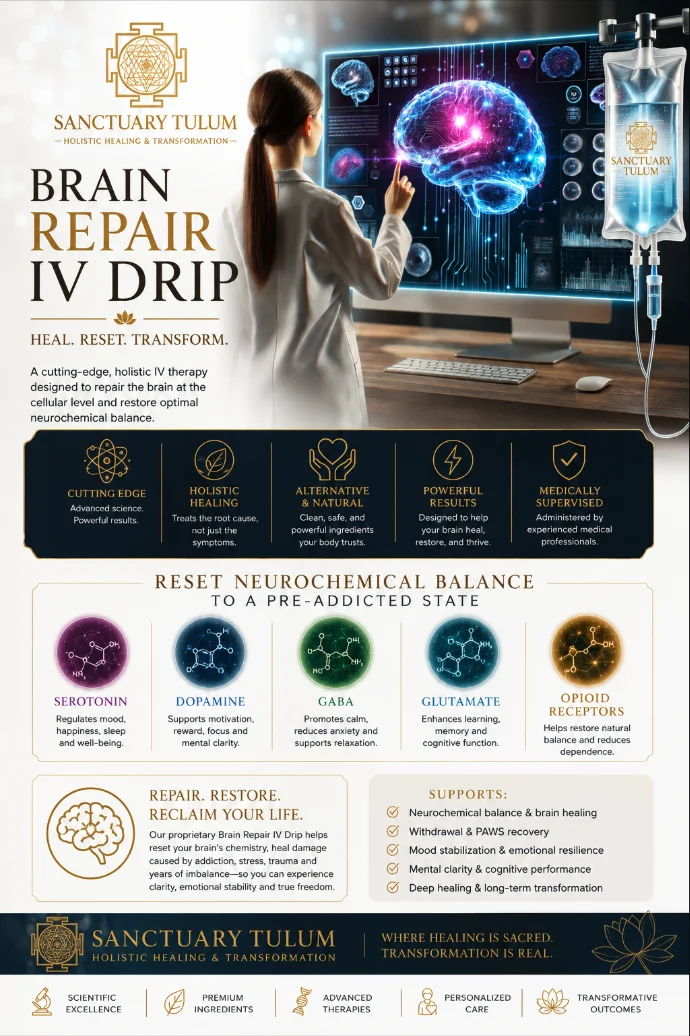
Each modality is chosen for what it is designed to support, not for what it promises to fix, and the clinical team combines them individually rather than issuing a fixed package to every client.Brain Repair Protocol IV is a proprietary, nature-derived intravenous formula developed by Sanctuary Tulum's clinical team to support nervous-system function during the acute stabilization period; it is a distinct formula and does not contain NAD+. NAD+ IV therapy is offered separately, on its own protocol, aimed at supporting cellular energy metabolism. The two are sometimes used in the same stay and sometimes not, depending on presentation.
Hyperbaric oxygen therapy is administered under physician supervision to support tissue oxygenation; ozone therapy is offered as a further integrative option within the same physician-supervised framework. Cold plunge and contrast exposure are used alongside movement work to support circulation and to give clients a structured, repeatable practice in tolerating short-term physical discomfort — a skill several clients say transfers directly back to high-stakes professional situations. Infrared sauna sessions and daily massage or bodywork address the physical toll that years of tension and poor sleep leave in the body, independent of anything happening in a therapy session.
Yoga, meditation, and guided breathwork are used specifically for nervous-system regulation — slow, repeatable practices that give the body cues it is safe to downshift out of a sustained stress response, rather than one more skill to master and perform well at. The superfood nutrition program removes the inflammatory, high-sugar, high-caffeine pattern that often accompanies years of grazing between meetings, replacing it with whole-food meals built around each client's needs. None of these modalities is presented as a guaranteed fix on its own; the clinical value comes from how the team sequences them against each person's specific physiology and history.
The Therapy Stack
Modalities are selected individually by the clinical team, not applied as a fixed package. Each is described factually below, without invented outcome claims.
Brain Repair Protocol IV
A proprietary, nature-derived intravenous formula developed for nervous-system support.
NAD+ IV Therapy
A separate intravenous protocol used to support cellular energy and recovery.
Hyperbaric Oxygen Therapy
Physician-supervised HBOT sessions used to support oxygenation and recovery.
Ozone Therapy
An integrative therapy offered as part of a broader physiological recovery plan.
Stem Cell Therapy
An advanced integrative option considered case by case with the clinical team.
Cold Plunge & Contrast Therapy
Structured cold exposure used alongside movement and bodywork.
Therapeutic Massage & Bodywork
Daily bodywork addressing the physical toll of chronic tension and poor sleep.
Yoga & Meditation
Guided sessions supporting nervous-system regulation and sleep.
Superfood Nutrition Program
A clean, whole-food nutrition plan built around each client's needs.
We would rather someone complete a full course of treatment with two protected hours a day for work than leave in week three because the program refused to accommodate reality.
Sanctuary Tulum

What a Stay Looks Like, Week by Week
Arrival and baseline come first: a full clinical intake, a physical workup by licensed medical staff, bloodwork, and a candid conversation about sleep, substance use, work patterns, and history. Nothing therapeutic is scheduled on day one beyond settling in — the point is an accurate baseline, not momentum for its own sake. Mornings begin slowly from the start. Sleep is usually the first system to repair, so early hours are protected: no alarms tied to someone else's calendar, light exposure on the beach, breathwork or a guided meditation before food.
The stabilization phase that follows, typically the first week to ten days, is where physician-supervised integrative therapies begin — intravenous protocols, hyperbaric oxygen sessions, bodywork — scheduled around each client rather than a facility timetable. The goal in this window is narrow and physiological: restore some sleep continuity, bring the cortisol rhythm back toward a normal curve, and let the nervous system come down from constant activation before asking it to do harder psychological work.
Deepening usually begins once sleep and basic regulation have improved. This is where the one-to-one clinical sessions carry more weight — somatic work, trauma processing where relevant, and the coaching-adjacent conversation about the working patterns that produced the collapse. Sessions shift from stabilization toward identity and behavioral work: what specifically has to be different when the role that produced the burnout is still waiting on return. Evenings stay unstructured on purpose throughout, because recovery from chronic stress requires genuine unstructured time, not another block on a schedule.
The final stretch is integration and return planning — deliberately building the calendar, the boundaries, and the support structure a client will actually live inside once they leave, rather than ending treatment at the point of feeling better and hoping the improvement holds on contact with the old environment. Duration overall ranges from a few weeks to several months depending on severity and history, and is reassessed with your care team rather than fixed at intake. Clients considering a longer, multi-modality stay sometimes look first at our functional medicine retreat track, which folds physiological workup into the same one-to-one structure.
What the Executive Version Changes
What makes the executive version of this different is not a different clinical model but a different relationship to time and access. Clients who need a window each day for a board call, a fund matter, or a family business decision get that window built into the plan rather than fought for. That said, we are direct about the trade-off: the more work stays in the picture, the slower nervous-system recovery tends to be, and we will say so plainly rather than quietly accept a plan we do not think will work. Part of the clinical conversation, usually in the second or third week, is examining the relationship between constant availability and the symptoms that brought someone here — most clients gradually reduce work contact once that connection is clear to them, not because it is mandated.
For clients whose primary concern is trauma from earlier in a career — a hostile boardroom departure, a public failure, a period of acute crisis — the work often draws on the same approaches used in our dedicated trauma retreat track, applied within the same five-client structure.
Returning to Work Without Returning to the Pattern
The honest risk in any executive stay is that a client leaves regulated, rested, and clear-headed, and slides back into the exact schedule that produced the burnout within a few months. Improvement achieved here does not transfer automatically; without deliberate structural change on the other end, relapse into the old pattern is common, and we would rather say that plainly than let anyone assume a few weeks of recovery rewires a decade of habits by itself.
The integration work in the final phase of a stay is built around that risk directly. Calendar design is treated as a clinical matter, not an administrative afterthought — deciding in advance which hours are genuinely protected, which meetings require a body in the room versus a message, and where the day's first and last hour are spent away from a screen. Delegation is addressed the same way: identifying the decisions a client has been making personally out of habit rather than necessity, and building the reporting structure that lets someone else make them competently. Boundaries are rehearsed, not just discussed — what a client will actually say when an old pattern reasserts itself, before the moment arrives rather than in the middle of it.
Underneath the logistics sits a harder question many clients have not asked directly in years: who they are when they are not producing. For people whose identity has been built almost entirely around performance and output, unstructured recovery time can itself feel destabilizing, and part of the clinical work is building a sense of self that does not collapse the moment the results stop coming in. None of this is presented as solved by the time a client leaves; it is presented as the work that continues afterward, ideally with the same care team available for follow-up rather than a clean handoff to nothing.

Who This Is Not For
This page describes care for burnout, chronic stress, anxiety, depression, and process addictions. It is not an emergency medical detox service, and it is not a substitute for a physician managing an acute or unstable medical condition. If you are in acute crisis, contact local emergency services first; our admissions team can discuss whether a stay is appropriate afterward. If acute medical withdrawal from opioids or another substance is the primary need, a facility built specifically for that is the right call, and we will say so on an intake call rather than take an admission we are not the correct setting for.
It is also not group programming of any kind — there is no cohort, no shared circle, and no curriculum delivered to a room. And it is not a spa week dressed up in clinical language: the integrative therapies, bodywork, and nutrition support sit alongside licensed medical oversight and structured behavioral work, not in place of it. Clients looking for a wellness break without a clinical framework underneath it are better served elsewhere, and we would rather say so at intake than let expectations mismatch the actual model.
No outcome is guaranteed, and we do not publish success-rate figures we cannot substantiate. What we can describe honestly is the structure: small, individualized, medically supervised, and private by design. Every client's plan is different, and part of building one honestly is being clear about what falls outside it.
Admissions
Admissions begins with a confidential conversation, not a form. Our team reviews your history, current pressures, and any prior treatment, and discusses candidly whether the one-to-one, no-group-therapy model here is the right fit — or whether another setting, including acute medical detox elsewhere, would serve you better. If it is a fit, staggered arrival, suite assignment, and an initial clinical plan are arranged before you travel. To start that conversation, reach our team directly through admissions, or review the broader luxury rehab overview and the luxury wellness center for the full picture of the property and program tiers. If your primary concern is depression, anxiety, or trauma rather than work-related burnout specifically, the luxury treatment for anxiety page covers that side of the clinical model in more depth. You can also read more about the people behind the program on About Us, or return to the Sanctuary Tulum homepage for the full index of programs and therapies. For a closer look at the research and clinical reasoning behind this program, read our article on what executive rehab actually means.