Bufo Alvarius toad medicine — the vapor of 5-MeO-DMT secretion from the Sonoran Desert toad — has moved from underground ceremony to mainstream conversation faster than the safety protocols have caught up. That gap is dangerous. Understanding contraindications, drug interactions, and sourcing ethics is the difference between transformative work and preventable harm.
The Absolute Contraindications
5-MeO-DMT is absolutely contraindicated in guests taking MAOIs, SSRIs, SNRIs, tricyclic antidepressants, lithium, tramadol, or other serotonergic agents. The interaction risk includes serotonin syndrome, which can be fatal. It is also contraindicated in guests with a personal or first-degree family history of psychosis or schizophrenia, in guests with uncontrolled hypertension or significant cardiovascular disease, and in guests currently pregnant. These are hard clinical stops, not preferences.
The Relative Contraindications and Screening Requirements
Guests with a history of severe trauma without prior therapeutic support, guests with dissociative disorders, and guests in acute crisis states require additional preparation and often should not proceed until stability is established. A responsible program conducts a full psychiatric intake, medication reconciliation, and medical workup before any 5-MeO-DMT session — and declines guests who do not clear that workup.
Sourcing: Synthetic vs Natural, and Why It Matters
The Sonoran Desert toad (Incilius alvarius) is under significant ecological pressure from the ceremonial demand. Ethical practitioners increasingly favor synthetic 5-MeO-DMT — pharmacologically identical to the natural molecule, produced without harming the toad population, and available in precisely-titrated doses. Sanctuary Tulum's position on this is explicit: sustainable practice matters. Guests interested in the specifically natural, ceremonial toad tradition should engage with practitioners with direct lineage relationships; guests focused on the therapeutic molecule and its clinical properties are generally best served by synthetic sourcing.
What Actually Happens During and After a Session
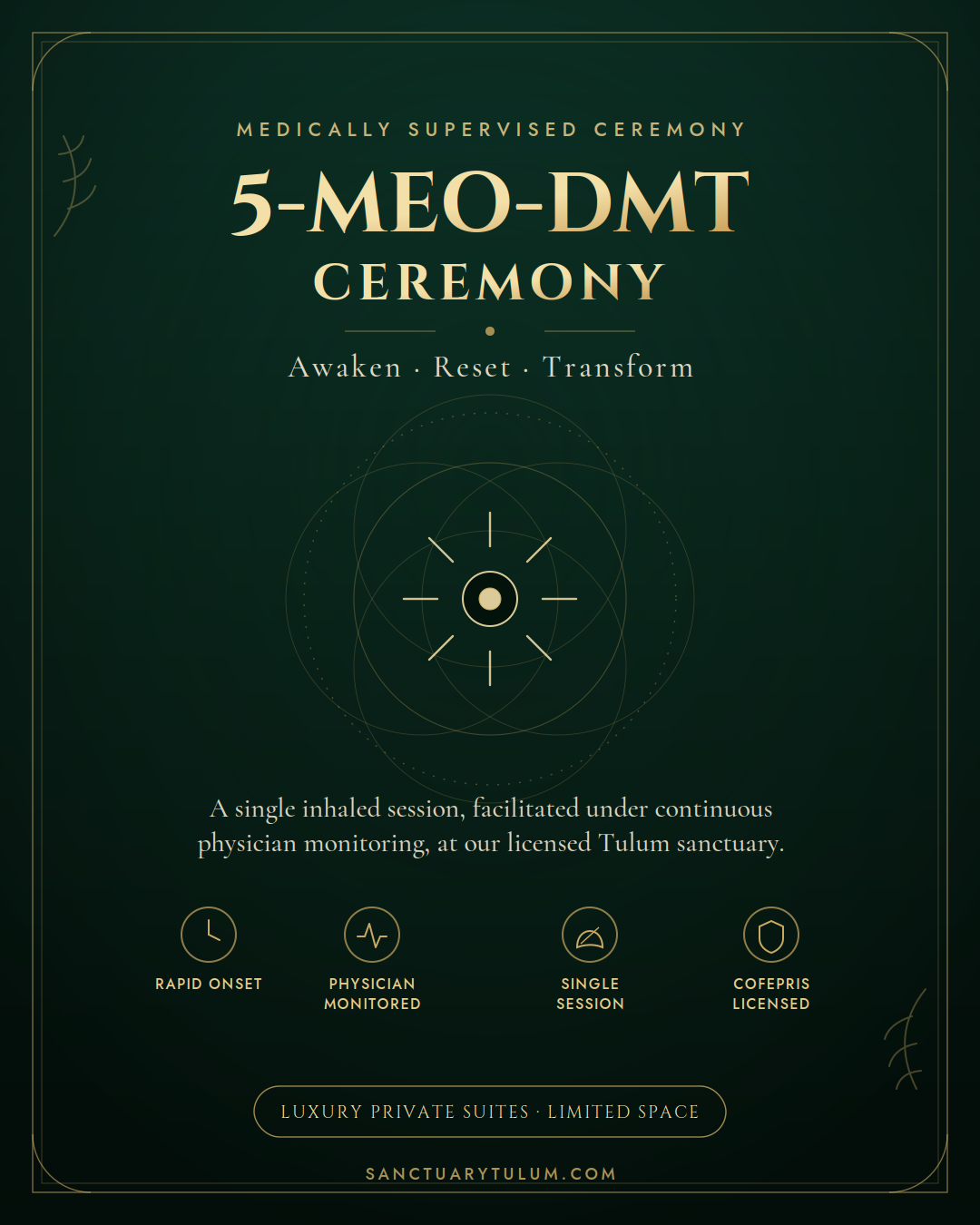
The vapor is inhaled; onset is within seconds; the peak experience lasts roughly 15-20 minutes; return to baseline is typically complete within 40-60 minutes. During the session guests may become physically unresponsive, may vocalize, may have dramatic somatic releases. This is why sessions require an experienced facilitator with hands-on trauma-informed training, a physical setting that allows safe lying-down, and often a sitter present throughout. Integration begins immediately afterward. See our 5-MeO-DMT vs ayahuasca comparison and 5-MeO-DMT ceremony program.
Why Weekend Bufo Retreats Concern Us
The pattern of one-off, single-session Bufo experiences without medication screening, without medical backup, and without integration is the pattern most likely to produce adverse outcomes — both acute (serotonin syndrome in unscreened SSRI users, cardiac events in unscreened cardiovascular disease) and longer-term (destabilization without integration support). Every credible practitioner in this space is aligned on this: the molecule is powerful enough that the protocol around it matters as much as the molecule itself. Explore our safety and screening standards.
Drug Interactions Beyond Antidepressants
A systematic review of drug-drug interactions involving classic psychedelics catalogued the serotonergic and pharmacokinetic risks that apply to 5-MeO-DMT alongside other tryptamines, underscoring that antidepressants are not the only medication class of concern — MAOIs, certain migraine medications, and some supplements carrying serotonergic activity all raise the same interaction risk profile. This is why a full medication reconciliation, not just an antidepressant check, is part of a responsible intake.
Cardiovascular and Thermoregulatory Considerations
5-MeO-DMT reliably produces a transient rise in heart rate and blood pressure, and preclinical pharmacology work has documented that certain serotonergic co-exposures can potentiate 5-MeO-DMT-related hyperthermia. This is one of the mechanistic reasons uncontrolled cardiovascular disease and current use of serotonergic or MAOI medications are treated as hard contraindications rather than soft cautions in a well-run screening protocol.
Integration: The Work That Happens After
A single 5-MeO-DMT session can surface material — grief, unresolved trauma, identity questions — that takes weeks or months to metabolize. Programs that treat the session itself as the endpoint, without structured integration support afterward, are missing the piece of the work most associated with durable change. At Sanctuary Tulum, integration sessions with a member of the clinical team are scheduled in the days following ceremony, and guests leave with a concrete plan for continued integration once they return home. Learn more about how this fits into the broader 5-MeO-DMT ceremony program.
Questions to Ask Any Facilitator Before You Say Yes
Before any 5-MeO-DMT session, ask whether a licensed medical professional conducts the intake, whether cardiac history and current medications are reviewed in writing, what the plan is if a medical event occurs during a session, and what integration support is offered afterward. A facilitator who cannot answer these questions directly, or who waves away medication screening as unnecessary, is not operating at the standard this medicine warrants. Our own approach to these standards is outlined on the safety and screening standards page.
Cardiovascular and Thermoregulatory Considerations, Restated
5-MeO-DMT reliably produces a transient rise in heart rate and blood pressure. This is precisely why uncontrolled hypertension and significant cardiovascular disease are treated as hard contraindications in a well-run screening protocol rather than soft cautions — a facilitator without medical training has no reliable way to judge who is carrying undiagnosed cardiac risk. A pre-session medical intake that includes blood pressure measurement and a cardiac history review is the minimum standard, not an optional extra.
Conservation: The Cost of Wild Toad Sourcing
The Sonoran Desert toad (Incilius alvarius) has come under real ecological pressure as ceremonial demand for its secretion has grown, with reports of overharvesting and habitat disruption in parts of its range. Milking a wild toad for its secretion is also stressful and potentially harmful to the animal, and repeated harvesting from the same individuals raises welfare concerns independent of any human safety question. Synthetic 5-MeO-DMT is pharmacologically equivalent to the molecule found in toad secretion, is produced without harming a wild animal population, and allows a precisely titrated dose rather than the variable potency of dried secretion. This is not a minor footnote — sourcing choices have a real conservation cost, and Sanctuary Tulum's position is that guests should know this before choosing a modality, not after.
Being Honest About What This Medicine Does Not Do
A single 5-MeO-DMT session is not a cure for any psychiatric condition, and no responsible facilitator should present it as one. The naturalistic studies available describe self-reported improvements in life satisfaction and reductions in depression and anxiety symptoms in surveyed users (Uthaug et al., 2019; Davis et al., 2018), which is meaningfully different from a placebo-controlled clinical trial demonstrating a treatment effect. Guests should weigh this molecule as one part of a broader, individualized care plan — not as a stand-alone answer to a complex psychiatric history.
References
- Uthaug MV, et al. A single inhalation of vapor from dried toad secretion containing 5-MeO-DMT in a naturalistic setting. Psychopharmacology (Berl). 2019;236(9):2653-2666.
- Davis AK, et al. The epidemiology of 5-MeO-DMT use: benefits, consequences, patterns of use, subjective effects, and reasons for consumption. J Psychopharmacol. 2018;32(7):779-792.
- Tap SC. Concomitant use of antidepressants and classic psychedelics: a scoping review. J Psychopharmacol. 2025;39(10):1072-1088.
- Ly C, et al. Psychedelics promote structural and functional neural plasticity. Cell Rep. 2018;23(11):3170-3182.
- Weiss F, et al. Psychedelic-induced neural plasticity: a comprehensive review and a discussion of clinical implications. Brain Sci. 2025;15(2).
For the full program overview, read about our 5-MeO-DMT retreat.