If you live in New York and you've been searching for a legitimate ayahuasca retreat, this guide is written directly for you. It covers the honest legal picture in NYC, the flight and transfer logistics from JFK, LGA, and EWR to Sanctuary Tulum, the medical and safety contrast between an underground ceremony in Brooklyn and a licensed facility in Mexico, and what an NYC guest's actual itinerary looks like from wheels-up to wheels-down.
Why New York Has No Legal Ayahuasca Option
Ayahuasca is a plant-medicine brew whose active ingredient is DMT (N,N-dimethyltryptamine). DMT is a Schedule I controlled substance under the federal Controlled Substances Act, which applies in every US state, including New York. New York State has not created any state-level exception, decriminalization framework, or regulated therapeutic pathway for ayahuasca. As of 2026, the only US-wide carve-out remains the religious exemption granted by the Supreme Court in Gonzales v. O Centro Espírita Beneficente União do Vegetal (2006), which applies to specific religious congregations — not secular retreats, wellness events, or ticketed ceremonies in Manhattan or Brooklyn.
That is the entire reason NYC seekers travel. It is not preference. It is not aesthetics. It is that no licensed, medically supervised ayahuasca option exists inside the five boroughs, or upstate, or anywhere in the tri-state area. The "ayahuasca retreats near me" search returns underground gatherings dressed as boutique wellness events — because that's all there is to return.
The Underground NYC Ceremony — What It Actually Is
A typical NYC underground ceremony is held in a Brooklyn loft, an Airbnb in Bushwick or Long Island City, a rented yoga studio, or a private home in the Hudson Valley. The organizer is often a facilitator with training from a South American lineage but no US medical credential. Participants pay in cash or via a third-party payment app. There is no written medical intake beyond a short questionnaire, no physician on site, no MAOI-drug-interaction review of your current prescriptions, no cardiac clearance, no IV access, no emergency medications, and no clear plan if a participant has a serotonergic reaction or a psychiatric crisis in the middle of the night.
This is not a character judgment of the facilitators. Many are sincere. It is a structural description of what the format cannot provide, because the format is not licensed and not medical. The most common serious adverse events in ceremony settings involve SSRI-MAOI interactions and undiagnosed cardiovascular conditions — both of which require clinical screening to prevent, not sincerity.
Flight Logistics From JFK, LGA, and EWR
JFK to CUN. The highest daily direct-flight volume to Cancún runs out of JFK — JetBlue, Delta, and American all fly the route multiple times per day. Flight time is roughly 4 to 4.5 hours. JFK is the natural choice for Brooklyn, Queens, and Long Island guests.
EWR to CUN. United runs frequent direct service from Newark to Cancún. Flight time is comparable. EWR is often the shortest overall trip for Manhattan (via NJ Transit or a car service), northern New Jersey, and Westchester.
LGA to CUN. LaGuardia is typically routed through connections — direct service is limited. Most NYC guests flying from LGA end up connecting through CLT, ATL, or IAH. If your schedule allows, JFK or EWR is usually faster overall.
CUN to Tulum. Sanctuary Tulum arranges a private ground transfer from Cancún International Airport directly to the campus. The drive is approximately 90 minutes south along a paved federal highway. Total door-to-door time from most NYC boroughs is 7 to 9 hours — roughly the same as flying to Los Angeles.
A New Yorker's Actual Itinerary
A realistic 7-day itinerary for a guest flying from NYC looks something like this. Day 1: Fly JFK or EWR to CUN. Ground transfer to Sanctuary Tulum. Check-in, intake vitals, physician review of your medications and pre-arrival paperwork, dietary orientation, campus tour. Day 2: Rest, hydration, IV nutrient support if indicated, first meeting with the medical team, review of ceremony format and expectations. Day 3: First medically supervised ayahuasca ceremony — private, with physician on site, facilitator, and integration lead. Day 4: Integration morning, journaling, one-to-one session, restorative day. Days 5–6: Second ceremony followed by integration, plus optional complementary work — bodywork, ocean time, nutrition, guided reflection. Day 7: Final integration session, discharge review, transfer back to CUN, direct flight home.
Guests dealing with deeper material — long-term SSRI dependence, complex trauma, treatment-resistant depression — typically extend to a 14 or 21-day arc. That decision is made clinically during intake, not up-sold at arrival.
The Clinical Contrast Written Out
Side by side, the two options a New Yorker is actually choosing between look like this. An unlicensed Brooklyn ceremony: no written intake, no physician, no cardiac clearance, no medication-interaction review, no emergency protocol, no IV access, group setting, cash payment, no license to verify, no accountability if something goes wrong. A licensed retreat at Sanctuary Tulum: written medical intake weeks before arrival, on-site physicians, cardiac clearance where indicated, full SSRI and MAOI review, private ceremony, IV access and emergency medications on hand, a federal health license verifiable with the issuing authority, and a documented protocol reviewed by our Medical Review Board.
This is not a marketing contrast. It is what the medical literature on ayahuasca safety actually calls for. Adverse events tracked in reviews of ceremonial ayahuasca use are concentrated in unscreened participants and in settings without on-site clinical support — the exact profile of an underground NYC gathering.
The Broader Model — Not Just Ayahuasca
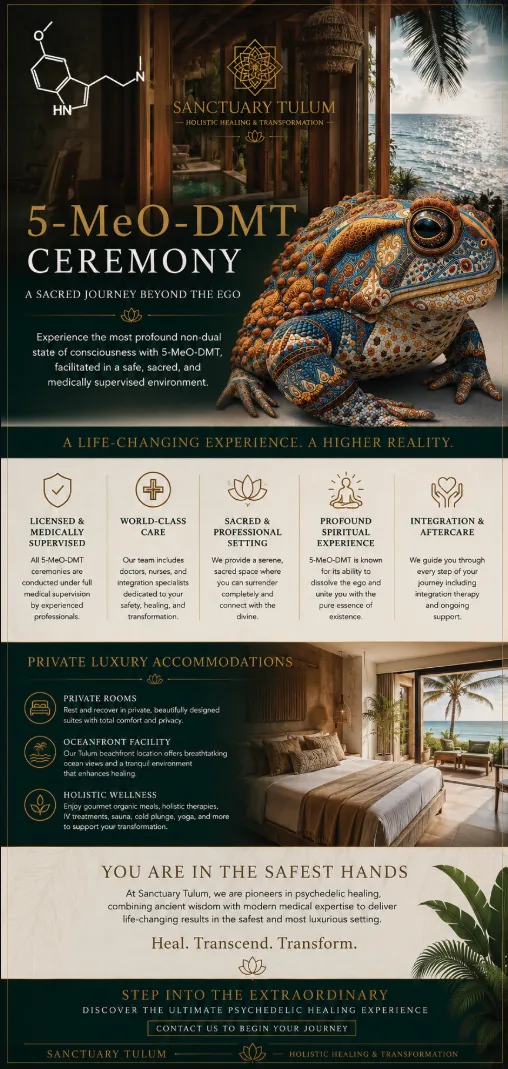
Many NYC guests arrive with a specific interest in ayahuasca and discover during intake that the clinical picture points to a broader arc. Sanctuary Tulum is a licensed luxury psychedelic retreat that sequences ibogaine treatment, ayahuasca, 5-MeO-DMT, and psilocybin ceremonies inside a single medically supervised program — not as a menu, but as a clinical sequence matched to the guest. Some guests complete a single ayahuasca arc. Others complete a broader program over 2 to 4 weeks. Those decisions are made in intake, before arrival, in writing.
How to Evaluate Any Facility From New York
Whether you consider Sanctuary Tulum or another option, ask the same questions before you book a flight. What is the health-authority license number, and can it be verified with the issuing agency? Is a licensed physician present during ceremony, or on call? What is the pre-arrival medical screening process, and is it in writing? What is the group size? What is the emergency protocol, and what emergency equipment is on site? Will the facility say no to a guest who cannot be safely cleared? A retreat that cannot answer these clearly, in writing, is a retreat to walk away from — full stop. Read more on what defines a safe psychedelic facility.
Bottom Line for New Yorkers
There is no legal, licensed, medically supervised ayahuasca retreat in New York City or anywhere in the United States for the general public. The real choice is between an unregulated ceremony in a Brooklyn loft with no clinical support, or a licensed medical facility one direct flight away. Neither decision is trivial. Both deserve to be made with the actual facts on the table.
Practical Notes for NYC Guests
Passport. A US passport valid for the full duration of travel is required for entry to Mexico. Renew early if yours is within six months of expiration — Cancún immigration has turned travellers away for less. Currency. The campus operates in USD and MXN; most guests bring a small amount of USD cash for tips and rely on card for everything else. Weather. Tulum runs 75 to 90°F year-round. Hurricane season peaks August through October; ceremonies continue regardless, but flight disruption is worth planning around. Time zone. Tulum is on Eastern Standard Time year-round (no daylight saving) — for most of the year it matches NYC exactly, which reduces jet lag to zero and makes coordination with family or work simple during the arc.
Insurance. Medical treatment abroad is generally not covered by US domestic health insurance. Sanctuary Tulum's programs are self-pay, and many guests use HSA or FSA funds where their plan allows for out-of-country medical care. Time off work. NYC-based guests typically frame a 7-day program as a standard PTO block; longer arcs are usually structured as a formal medical leave. The intake team can provide documentation on request for FMLA or short-term-disability paperwork where indicated.
Why the Setting Itself Matters
Removing a New Yorker from the physical environment of the city is not incidental to the work — it is part of what makes deep integration possible. The nervous system of a long-term NYC resident is calibrated to sirens, subway noise, screen light, and social density. A weekend ceremony in a Brooklyn loft asks the same nervous system to open completely and then step back into the same environment the following morning. The physiological ask is unreasonable, and the integration failure rate reflects that. An oceanfront campus, a walled and staffed 24/7 setting, and a paved 90-minute buffer from the airport allow the guest's system to actually stand down before medicine work begins.
This is not aesthetics. It is what integration research on set-and-setting has consistently shown for over two decades — the environment surrounding the medicine is not decoration, it is a clinical variable.
References
- Gonzales v. O Centro Espírita Beneficente União do Vegetal, 546 U.S. 418 (2006).
- Riba J, et al. Subjective effects and tolerability of the South American psychoactive beverage ayahuasca in healthy volunteers. Psychopharmacology. 2001;154(1):85-95.
- dos Santos RG, et al. Antidepressive, anxiolytic, and antiaddictive effects of ayahuasca, psilocybin and LSD: a systematic review of clinical trials. Ther Adv Psychopharmacol. 2016;6(3):193-213.
US-based readers evaluating travel logistics can also review our detailed guide on ayahuasca ceremonies near me for a NYC-focused breakdown of the legal landscape and licensed Mexico alternative.