The short answer: the questions worth asking about 5-MeO-DMT ceremony safety concentrate in three places — who screens you medically before you are ever offered the medicine, who is physically present with you during an extremely intense but very brief experience, and what structured support exists once the acute effects pass. This article is educational and is not medical advice; any decision about whether 5-MeO-DMT is appropriate for you belongs with a qualified physician who knows your full history.
1–3: Screening Before Anything Else
1. Who conducts my medical and psychiatric screening, and how thorough is it? Ask whether screening includes a cardiovascular history, current medications, and questions about personal or family history of psychosis or bipolar disorder. A brief intake questionnaire is not the same as a physician review.
2. How is cardiovascular risk specifically assessed? 5-MeO-DMT can produce a rapid, intense physiological response. Ask whether blood pressure, heart rate, and relevant cardiac history are reviewed before you are cleared, and what would disqualify someone from proceeding.
Ask whether this review happens once at intake or is repeated closer to the ceremony date, since health status can change in the weeks between an initial application and the day itself. A program that rechecks relevant history shortly before the ceremony, rather than relying entirely on information gathered weeks earlier, is treating cardiovascular safety as an ongoing concern rather than a box checked once and set aside.
3. What medications disqualify a participant, and who checks? MAOIs, SSRIs and other antidepressants, lithium, and stimulant medications are the categories that most often matter. Ask whether a physician, not only a coordinator, reviews your medication list against these categories.
A thorough screening process typically takes place over more than one conversation, spread out over days or weeks rather than compressed into a single intake call the day before a ceremony. Ask how far in advance screening begins, and what happens if a concern is identified partway through — does the program simply decline, or does it work with you and, where appropriate, your own physician to understand the concern more fully before making a final decision? A program willing to describe this process in detail, including what has led it to decline someone in the past, is generally taking the screening seriously rather than treating it as a formality standing between you and the ceremony itself.
4–6: Who Is In the Room, and How They Are Trained
4. Who is physically present with me during the experience? Because the acute period is short and intense, the people in the room matter enormously. Ask how many trained sitters are present per participant, and what their training actually consists of.
5. What is the sitter-to-participant ratio? A ceremony run for a group with one sitter watching several people is a different safety profile than an individually supervised session. Ask directly, and ask what happens if more than one person needs attention at the same time.
This question is worth pressing on, since some programs advertise "individual attention" while actually running group formats with limited staff. Ask for the actual number of participants scheduled for the same session as you, and the actual number of trained sitters present, rather than accepting a general description of the program's philosophy on supervision.
6. Is the physical space designed for safety during an intense reaction? Ask about padded or low surfaces, whether participants are seated or lying down, and how the space is arranged to prevent falls or injury during a period when someone may move suddenly or lose typical coordination.
Ask, too, about temperature, lighting, and noise in the space, since sensory conditions can meaningfully affect comfort and safety during an experience this intense. A thoughtfully designed space accounts for practical details like these rather than simply reusing a room built for another purpose, and a program that can describe these choices specifically is showing that safety has been considered at the level of physical detail, not only in general policy.
7–8: Emergency Readiness and Physician Involvement
7. What happens if something goes wrong during the ceremony? Ask about on-site emergency equipment, whether a physician is present or immediately reachable, and the distance to the nearest hospital. This question deserves a specific, rehearsed answer, not a general reassurance.
Ask the program to walk through an actual scenario with you — who is called first, what equipment is used in the meantime, and how long it typically takes to reach a hospital-capable facility from the ceremony location. A program that can answer this concretely, rather than deflecting to a general statement that "safety is our top priority," has clearly rehearsed this plan rather than simply written it down.
8. Is a physician actually involved before, during, and after — not just at intake? Ask whether a physician signs off on your clearance to participate, is reachable during the ceremony window, and reviews how you are doing afterward. Programs differ widely here, and the difference is significant.
Some programs bring a physician in only for the initial paperwork review, while others keep a physician genuinely present or immediately reachable throughout the ceremony itself. Ask which model a program follows, and ask what "reachable" actually means in practice — physically present in the building, on call nearby, or available only by phone. Given how quickly the acute effects of 5-MeO-DMT can arise and pass, the practical distance between you and a physician matters more here than it might for a longer, slower-onset experience.
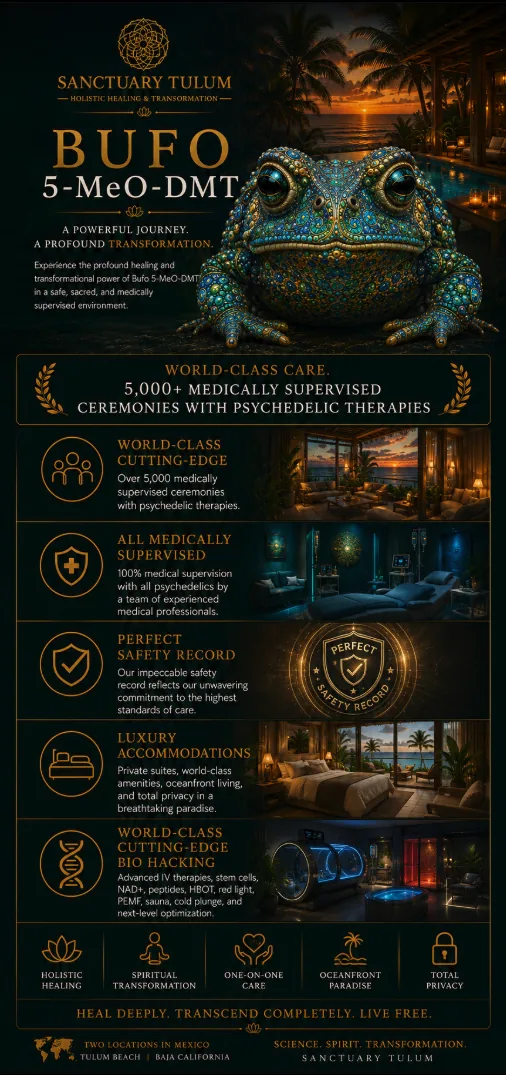
9–10: Sourcing and Integration
9. Is the material synthetic or toad-derived, and why? This is a legitimate question that touches both safety and conservation. Toad-derived material draws on wild Bufo alvarius populations, which has raised conservation concerns among researchers and advocates; synthetic material sidesteps that question but is a distinct substance. Ask which a program uses and what informed their choice. For background, see our overview of what Bufo 5-MeO-DMT actually is.
10. What structured integration support follows the ceremony? Because the experience is intense and can surface strong emotional material quickly, ask what integration looks like in the days and weeks afterward, who provides it, and whether it is included. Our safety overview of Bufo Alvarius medicine covers this in more depth, and our article on 5-MeO-DMT and PTSD discusses how integration connects to longer-term work.
Weighing the Answers Together
No single answer to these ten questions should be treated in isolation. A program might have an excellent screening process but a thin emergency plan, or strong sitter training but vague answers about sourcing. Look at the pattern across all of your questions rather than being reassured or alarmed by any one answer alone. A program that is strong in some areas and honest about being weaker in others is often more trustworthy than one that claims to have every answer perfectly covered.
It is also reasonable to ask these questions of more than one program before deciding, since comparing specific answers side by side tends to reveal differences that are hard to notice when you only hear one program's account. Take your time with this decision. A program confident in its own safety practices will not pressure you to skip this step.
A Short Checklist Before You Say Yes
- A physician, not only a coordinator, conducts and signs off on screening
- Cardiovascular history and current medications are specifically reviewed
- MAOIs, SSRIs, lithium, and stimulants are explicitly addressed
- A clear sitter-to-participant ratio and description of sitter training
- A physically safe, purpose-designed ceremonial space
- A rehearsed emergency plan and nearby medical facility
- A stated position on synthetic versus toad-derived material
- Structured integration support after the ceremony
If a program can answer each of these specifically, you are dealing with people who take the medical realities of 5-MeO-DMT ceremony seriously. If you want to discuss your own history before deciding, reach our team through the contact page.
Educational content only. This article does not diagnose, treat, or replace care from a licensed physician, and nothing here is a promise of any particular outcome. Never start, stop, or change a prescribed medication without medical supervision.