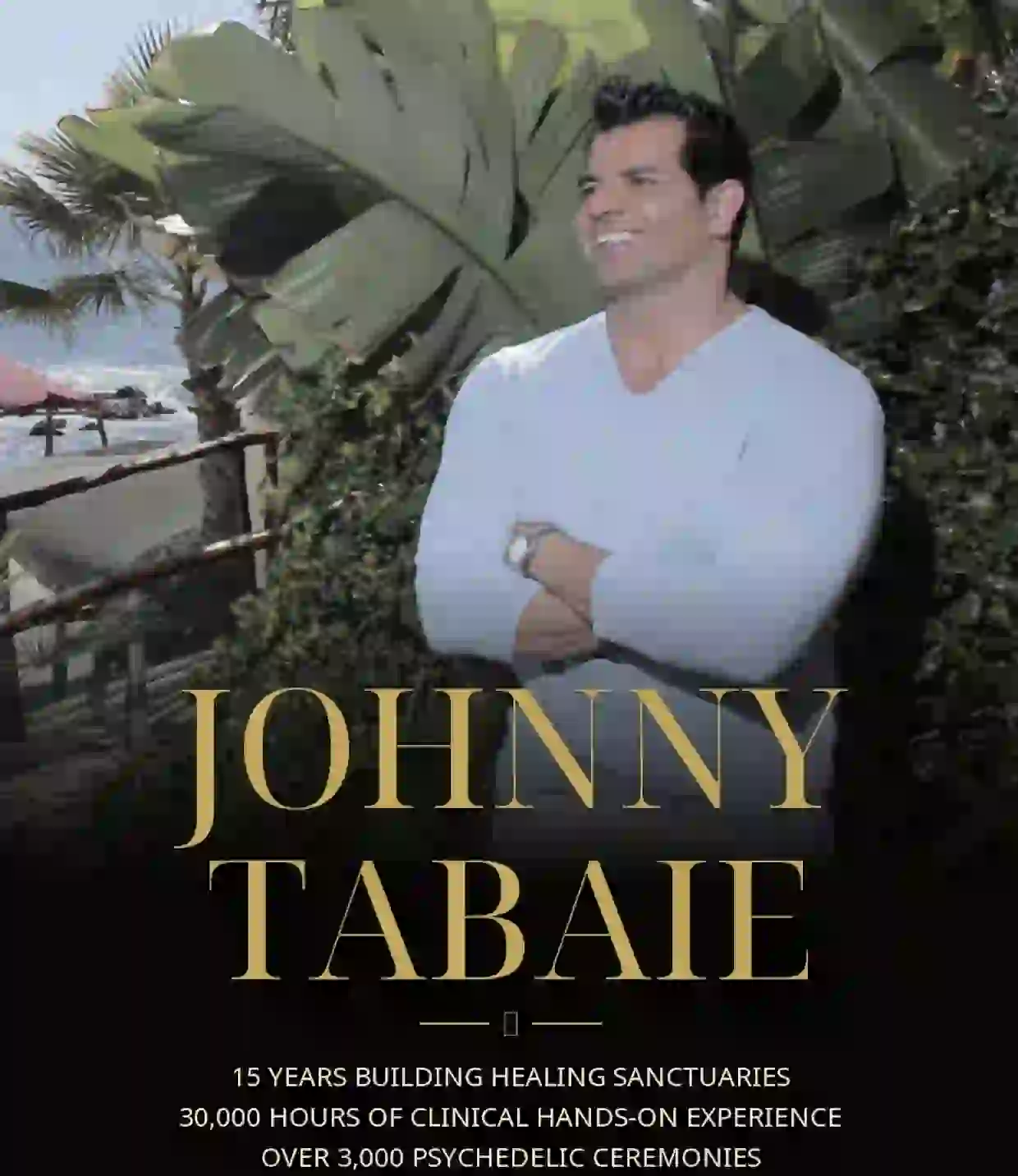
Johnny Tabaie — Founder & CEO
I Am Not Going to Tell You I Have All the Answers
I have been in this world long enough — and lost enough — to know that healing is far too complex for guarantees. I will not stand here and promise you that everyone who walks through our doors will be permanently healed.
What I will tell you is this: I spent more than twenty years inside this world — not studying it, but living it. I was not a researcher who discovered addiction. I was an addict who became a researcher because the system failed me — and failed the people I loved most.
"I can't claim to cure everyone. But if there's a cure in the world, this is it."
Where I Came From
From the age of 13, I was prescribed pharmaceutical medications. What followed was two decades I would not wish on anyone — rehabs, group homes, treatment programs of every kind. Luxury. Non-luxury. 12-step. Medication-based. Holistic. Religious. Institutional. Custodial. I tried them all. Not as a researcher — as a patient desperate for something that actually worked.
My mother lost her life to crack cocaine. I experienced homelessness. I endured suicidal ideation, relapse, and the particular despair of watching the system tell you — again and again — that your condition required lifelong management. That the best you could hope for was maintenance on medication.
I refused to accept that. Not out of arrogance — but because I had seen what actually happened to people who did.
My Brother David
In 2001, during a rare window of sobriety, I found my brother David living beneath a bridge. I persuaded him to accept help. On January 31, 2001, David entered a licensed residential dual-diagnosis treatment facility in Santa Cruz, California.
Fourteen days later, on February 14, 2001, David took his own life. He had been prescribed a pharmaceutical drug with known, documented suicidality risks. He died inside a licensed facility — one that was supposed to save him.
I am not going to dress that up. I am not going to use David's death as a marketing story. I am telling you because you deserve to know why this work exists — and why I have never been able to walk away from it, no matter how hard or how costly it has been.
David's death was not an accident. It was the predictable outcome of a system that prioritizes pharmaceutical compliance over human physiology. I made a decision then that I have never reversed: I will spend the rest of my life building something different. Not perfect — but different. Safer. More honest. More human.
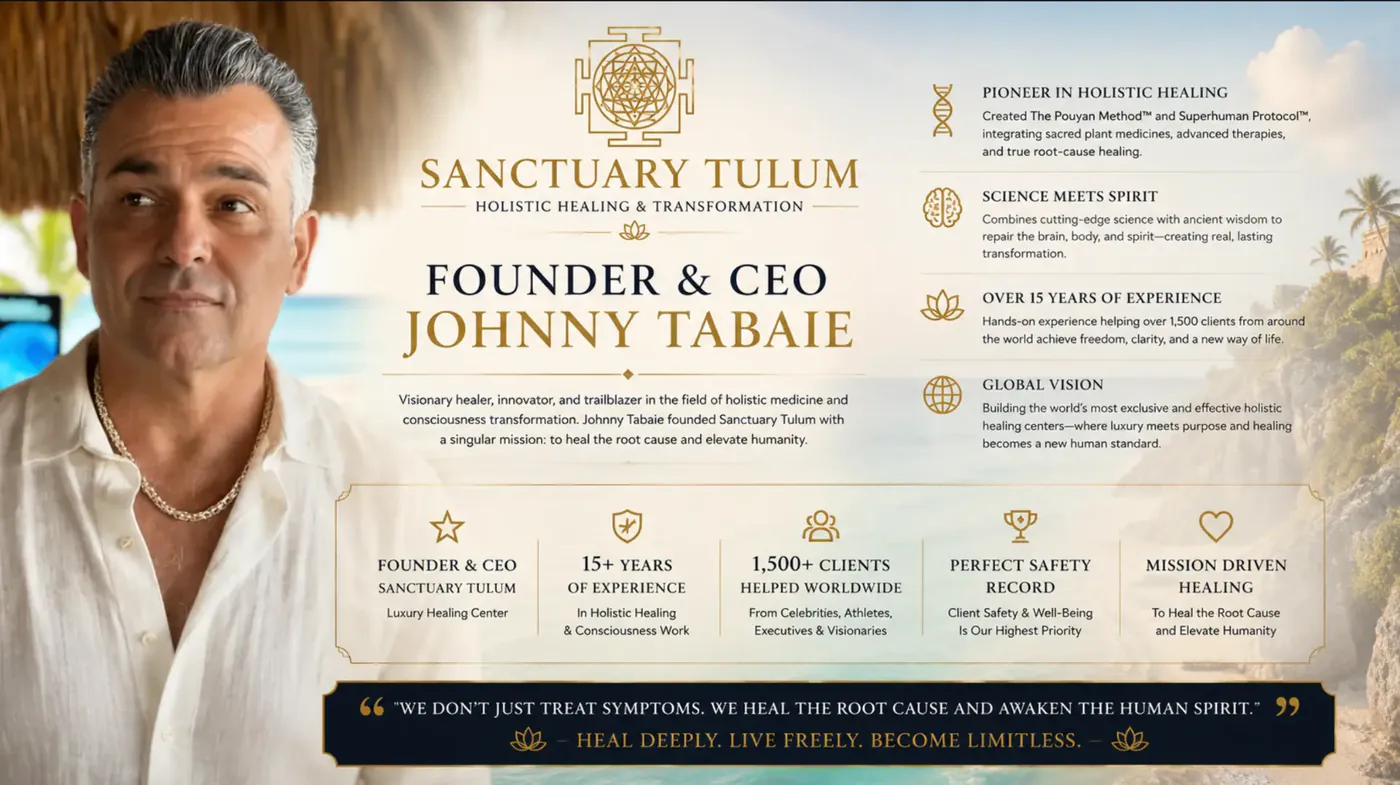
Johnny Tabaie — Founder & CEO, Sanctuary Tulum
The Covenant
After losing David, I descended further. Six more years of destruction — relapse, homelessness, the desperate attempt to outrun a grief I had no tools to process. I was not weak. I was broken in a way that no medication or group meeting could touch.
On May 15, 2007, something shifted. I reached a point where continuing simply stopped being an option. I made a covenant — call it prayer, call it surrender, call it whatever aligns with your own belief — that if I was given a way through, I would spend every remaining year of my life helping others find that same way.
That covenant is why I am here. It is not inspiration. It is obligation.
What I Built — and Why
I did not create ibogaine. I did not invent plant medicine. I did not discover neuroscience. What I did was this: I studied what already existed, observed its failures, identified its risks, and spent years — at my own expense, without investors, without institutional backing — refining protocols to maximize safety, stability, and long-term outcomes.
I do not believe in 7-day miracle fixes. I do not believe in gambling with fragile nervous systems. Every protocol we use has been built slowly, carefully, and with an unwillingness to cut corners — even when cutting corners would have been far more profitable.
The result: over 15 years of operation, thousands of clients, and zero deaths in any plant medicine ceremony. That outcome did not happen by accident. It happened because I refused to do this fast.
How I See This Work
I do not view addiction as a moral failing. I do not view mental illness as a life sentence. I approach human suffering as something that is simultaneously biological, neurological, immunological, environmental, psychological, emotional, and spiritual — and I built a protocol that addresses all seven dimensions, because addressing fewer than all of them is not enough.
The Pouyan Method™ is not a product. It is the distillation of everything I have learned — through my own suffering, through watching others suffer, and through years of careful observation of what actually works and what merely appears to work.
Why I Built the Program Around Plant Medicine and Regenerative Care
I am not a physician, and I do not present myself as one. What I have done is study, for more than a decade, the emerging clinical literature on ibogaine, ayahuasca, and psilocybin alongside conventional and regenerative medicine — and build a licensed program that puts a full-time medical team between a guest and any of these protocols. Ibogaine in particular carries documented cardiac risk, including QT-interval prolongation, which is exactly why our protocol requires cardiac screening and continuous medical monitoring rather than the unsupervised ceremonies that have led to deaths elsewhere.
The research on psilocybin for treatment-resistant depression, and on ibogaine for opioid use disorder, is genuinely promising but still early — randomized trials are still relatively small, and neither compound is FDA-approved for these uses in the United States. I say that plainly to guests before they arrive, because I built this place after watching what happens when people are sold certainty instead of an honest account of the evidence. Sanctuary Tulum operates as a licensed facility in Mexico, under COFEPRIS — Mexico's federal health regulator — precisely so that these protocols can be delivered with real medical infrastructure rather than in an unregulated retreat setting.
None of what I built is a cure, and I do not let our team describe it that way. What I can tell you, from personally sitting with thousands of guests through this process, is that a fully individualized, medically supervised protocol — built around a guest's actual history rather than a fixed calendar — gives people a fighting chance that the system I grew up in never gave David, and never gave me for the first twenty years.
I am not here to brag. I am not here to attack anyone. I am not here to claim perfection.
I am here because people are dying — inside conventional rehabs, on pharmaceutical medications that were never designed to heal them, alone on streets that never had to be their destination.
"I can't claim to cure everyone. But if there's a cure in the world, this is it. And I have given everything I have to making sure it exists."
— Johnny Tabaie, Founder & CEO, Sanctuary Tulum