Dubai · Evaluation & Logistics
Most Exclusive Luxury Rehabs Serving Dubai
For residents of Dubai and the wider Gulf, the decision is rarely about finding treatment nearby — it is about choosing, deliberately, where in the world to go.
Dubai's residents are, almost by definition, used to international travel as a normal part of life — for business, for medical care, for education. That familiarity changes how the decision to seek treatment gets made. Where a resident of a smaller market might default to "wherever is closest," Dubai residents typically start from "wherever is best suited," and then work out the logistics.
We covered the practical case for Tulum specifically in a companion piece, Luxury Rehab for Dubai and UAE Residents. This piece takes a different angle: how to evaluate and compare international treatment options rather than why one particular destination might suit a given case.
The World Health Organization notes that stigma around mental health and substance use remains a significant barrier to care globally, and that barrier is often heightened in tightly networked expatriate and business communities where discretion carries real professional weight — a dynamic that shapes how Gulf residents approach the search for treatment.

What discretion means for an international guest
For Dubai-based guests, discretion typically has two layers: privacy from their home community, and privacy during the journey itself — arrival, transfer and check-in. A program that only addresses the first is incomplete. Guests should ask how airport pickup is handled, whether transfer vehicles are private, and whether staff are briefed to manage arrival without drawing attention.
At Sanctuary Tulum, this extends into the stay itself: single-occupancy suites, no group programming, and a genuinely small number of guests in residence, described on the about us page.

Medical documentation and travel
International guests should confirm, in writing, what medical documentation a facility can provide — for visa purposes, for employer leave requests, and for continuity with a physician at home — without disclosing specific diagnoses. A reputable licensed facility can issue a general letter confirming medical treatment; guests should be wary of any program unwilling to put this in writing before arrival.
It is also worth confirming, ahead of travel, entry requirements for the destination country, any medical items being transported, and how prescription medications already in use will be reviewed on admission. These are logistics a facility's admissions team should walk through directly rather than leaving to the guest to research alone.
The right question for an international guest is not "how far is it" but "what does the arrival experience actually look like."
Sanctuary Tulum
Questions worth asking any facility considered from Dubai
A short checklist for evaluating international programs before committing.
Airport transfer
Whether pickup is private and how it is coordinated.
Documentation
What written confirmation of care can be provided for visa or employer purposes.
Physician oversight
Whether a licensed physician reviews medical history before arrival.
Census size
How many guests are in residence, and how privacy is maintained between them.
Communication home
How family or business contacts are kept informed, and how often.
Cultural and dietary needs
How specific dietary or cultural requirements are accommodated.
What Sanctuary Tulum offers international guests
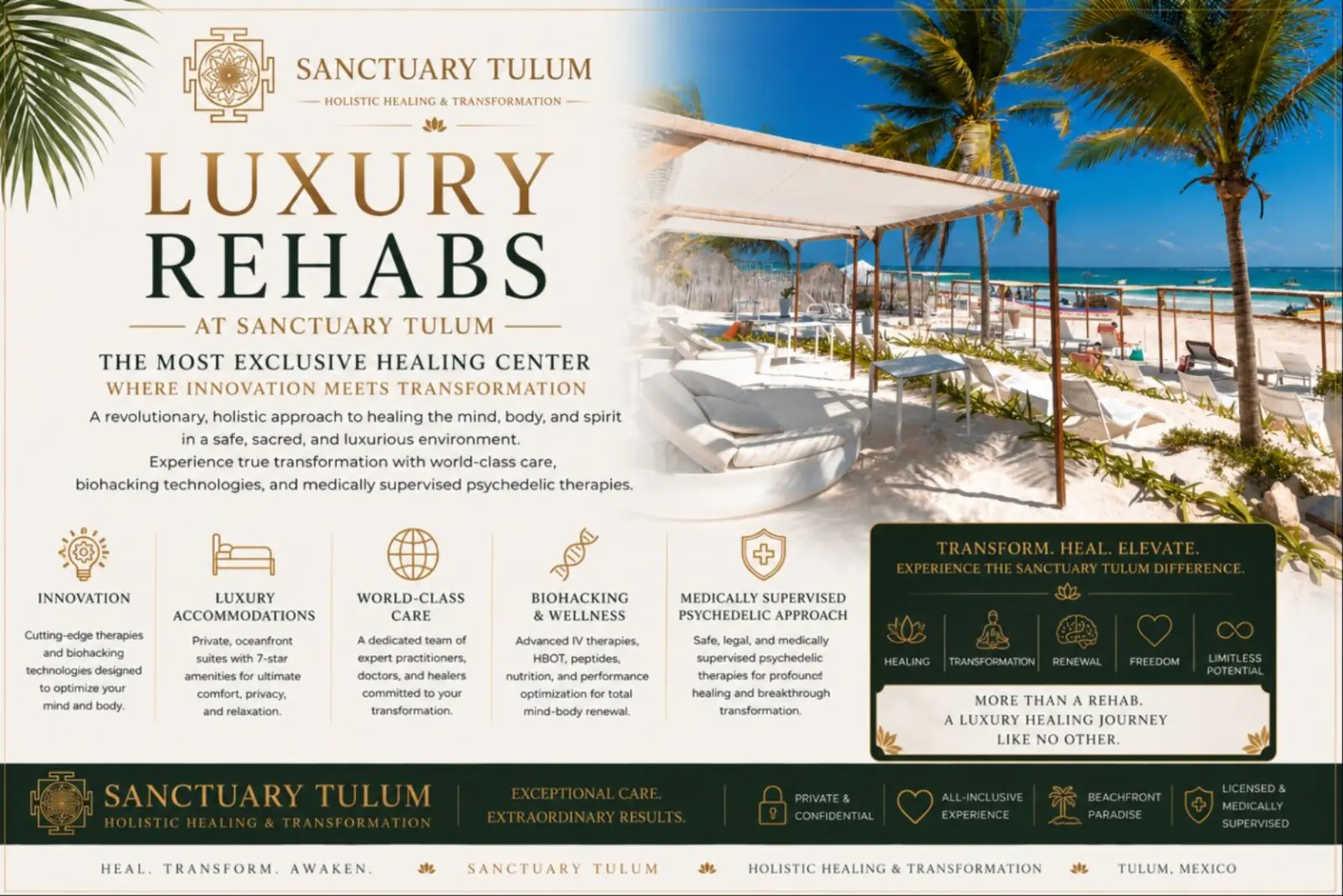
Sanctuary Tulum is a licensed oceanfront healing center built around the proprietary Pouyan Method™: 35+ hours of one-to-one clinical work each week, single-occupancy suites, and no group therapy, talk-therapy-style sessions, 12-step meetings or reliance on psychiatric medication. Clinical support includes Brain Repair IV therapy, NAD+ IV therapy, and hyperbaric oxygen therapy, alongside structured nutrition, movement and bodywork.
Programs run four to sixteen weeks across Gold, Platinum and Elite VIP tiers, outlined on programs and pricing. From Dubai, the journey typically involves a long-haul flight to a North American or European gateway and a connection to Cancún, with private transfer to Tulum taking roughly ninety minutes — a substantial trip, but one the admissions team plans in detail with each guest before departure.

Setting and pace after arrival
For guests accustomed to Dubai's density and pace, Tulum's quieter, jungle-and-ocean setting is itself part of the clinical intent — a genuine change of environment rather than a version of home relocated elsewhere. Days combine individual clinical sessions with infrared sauna, movement, and time outdoors, adjusted individually rather than run on a fixed group schedule.
Choosing carefully across borders
Comparing international treatment options is harder than comparing local ones — licensing standards, staff credentials and even basic definitions of "medical supervision" vary by country. Diligence matters more, not less, when the facility is thousands of miles away. Sanctuary Tulum is a luxury treatment for anxiety and licensed facility operating since 2011, and the contact page outlines how a confidential international enquiry begins, including documentation and travel planning specific to Gulf residents.
Dubai to Tulum: Frequently Asked Questions
Stigma, Distance, and Why Diligence Matters More Abroad
A systematic review of quantitative and qualitative research on mental-health-related stigma found it to be a consistent, well-documented deterrent to help-seeking across cultures, and evidence on medical tourism broadly confirms that most cross-border patients are motivated by a combination of privacy, access, and quality considerations rather than cost alone. For Gulf-region guests, these two dynamics compound: the same professional and social networks that make privacy valuable also make local, in-network treatment options feel exposed, which is part of why the search widens internationally.
Research reviewing the broader evidence base on medical travel has repeatedly noted that regulatory standards, credentialing, and continuity of care vary enormously by destination country, and that patients bear the responsibility for verifying licensing and physician oversight themselves rather than assuming any accredited-sounding name guarantees a consistent standard. That is precisely why the checklist above — census size, physician oversight, documentation, and transfer logistics — should be treated as due diligence rather than a courtesy.
Accreditation, Credentialing, and Why Names Alone Are Not Enough
One recurring theme in the medical-tourism literature is that "accreditation" is not a single, uniform standard — it is a patchwork of national licensing regimes, voluntary international certifications, and hospital-specific claims, and the strength of each varies considerably by country. A prospective guest evaluating options from Dubai should ask a facility directly which government body licenses it, what that license actually covers (medical treatment versus wellness or hospitality services), and whether a physician is on-site or on-call. Sanctuary Tulum is licensed by COFEPRIS, Mexico's federal health regulator, and guests are welcome to verify this directly with admissions before booking rather than relying on marketing language alone.
Research on ambulatory surgical center accreditation in the context of medical tourism has noted that accreditation bodies differ widely in rigor, scope, and enforcement, and that facility fees or reimbursement pressure — not necessarily patient-safety mandates — sometimes drive a center to pursue certification in the first place. That distinction matters for behavioral health and psychiatric care specifically, where "medical supervision" can mean anything from a physician reviewing charts remotely to daily in-person rounds. Guests should ask which model a given facility uses, and how often a physician is physically present during a stay, before assuming any two "medically supervised" programs are equivalent.
Government-level oversight of medical travel is itself an emerging area of health policy. A study examining government roles in regulating medical tourism found that national regulatory involvement ranges from minimal to comprehensive depending on the country, and that patients traveling internationally often carry more of the verification burden themselves than they would for domestic care, where regulatory oversight can typically be taken for granted. Broader proposals for international quality standards in medical travel have argued for common baseline benchmarks — credential verification, outcome transparency, and clear complaint or continuity-of-care pathways — precisely because no single global standard yet exists. Until such standards are universal, the practical answer for a Dubai-based guest is the same checklist outlined above: verify licensing directly, confirm physician oversight in writing, and treat any reluctance to answer these questions plainly as a warning sign rather than a formality to skip.
References
- Clement S, et al. What is the impact of mental health-related stigma on help-seeking? A systematic review of quantitative and qualitative studies. Psychol Med. 2015.
- Crooks VA, et al. Medical tourism: A snapshot of evidence on treatment abroad. Maturitas. 2016.
- Horowitz MD, Rosensweig JA, Jones CA. Medical tourism today: what is the state of existing knowledge? J Am Phys Surg. 2007.
- Reed CM. International accreditation of ambulatory surgical centers and medical tourism. AORN J. 2013;98(1):16-28.
- Turner L. An approach to establishing international quality standards for medical travel. Int J Health Serv. 2016.