Ketamine has moved rapidly from anesthesia into mainstream psychiatric care over the last decade. It is a legitimate, evidence-based tool for a defined subset of patients — and it is also frequently marketed in ways that overstate its role. This article compares ketamine-assisted therapy honestly to Sanctuary Tulum's amino acid-based Brain Repair IV protocol, so guests can understand what each is, what each isn't, and how the two fit into a broader recovery plan.
How Ketamine Works
Ketamine is a dissociative anesthetic that acts primarily as an NMDA glutamate receptor antagonist. At sub-anesthetic doses it produces rapid reductions in depressive symptoms — often within hours — that can last days to several weeks. A widely cited review in Neuron summarized the shift ketamine represented in depression research and treatment1. In 2019 the FDA approved intranasal esketamine (Spravato) for treatment-resistant depression, and a 2023 meta-analysis in The BMJ examined the efficacy of racemic ketamine and esketamine across the published trial base2.
The effect is real and, for patients who have not responded to first-line treatments, often meaningful. It is also not curative on its own: symptom reduction typically wanes over days to weeks, which is why clinical protocols involve a series of infusions and ongoing maintenance. Documented risks include acute dissociation, transient blood pressure elevation, and — with frequent, unmonitored use — urinary tract toxicity and cognitive effects. A safety review in Journal of Clinical Psychiatry catalogued these considerations in the psychiatric-use context3.

What the Brain Repair IV Is (and Isn't)
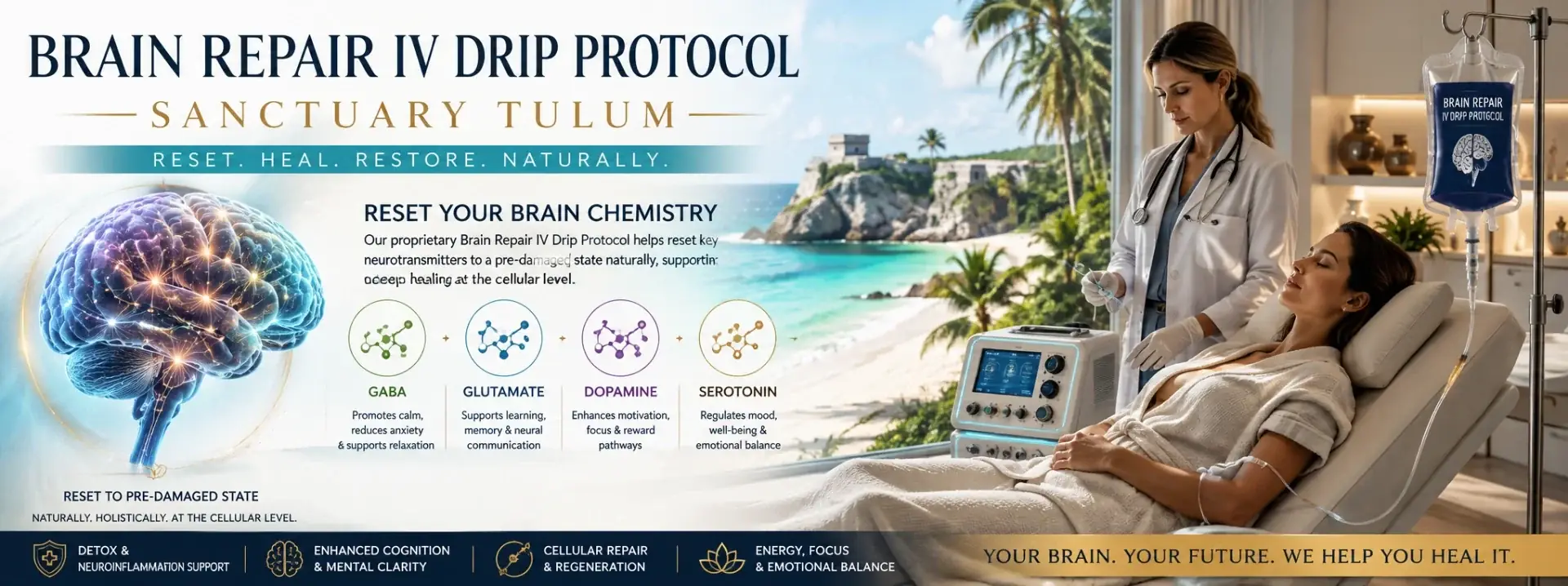
Sanctuary Tulum's Brain Repair IV is a different intervention with different goals. It delivers a concentrated blend of amino acids and cofactors intended to support neurotransmitter synthesis and cellular energy during and after a period of prolonged medication, substance, or stress exposure. It is used most often for guests tapering from long-term benzodiazepine, opioid, or stimulant exposure, and in the days surrounding medically supervised ayahuasca ceremonies or medically supervised ibogaine treatment. It is not a psychiatric medication, is not FDA-approved for the treatment of depression, and is not presented as an equivalent or a replacement for ketamine when ketamine is clinically indicated.
Used together with NAD+ IV therapy, which supports mitochondrial function and cellular repair, the intent of the Brain Repair IV protocol is to stabilize neurochemistry during a period of significant biological change — not to treat major depressive disorder as a standalone intervention.
Side-by-Side Comparison
| Factor | Ketamine / Esketamine | Brain Repair IV |
|---|---|---|
| Regulatory status | FDA-approved (esketamine) for TRD; racemic ketamine used off-label | Nutritional infusion; not a psychiatric drug |
| Primary mechanism | NMDA receptor antagonism | Amino acid / cofactor delivery for neurotransmitter synthesis |
| Onset of effect | Hours | Days, as part of a broader recovery protocol |
| Duration of a single dose | Days to weeks | Cumulative support across the stay |
| Known risks | Dissociation, BP changes, bladder toxicity with frequent use | Generally well tolerated; screened for allergies and interactions |
How to Think About the Two
Ketamine and the Brain Repair IV answer different clinical questions. Ketamine can produce rapid symptom reduction in treatment-resistant depression when delivered in a properly supervised setting. The Brain Repair IV is a supportive infusion intended to stabilize neurochemistry during a broader recovery process. Neither is a substitute for the other; both are tools with defined indications and defined limits.
Guests considering Sanctuary Tulum are screened by our medical team, and every current medication — including ketamine, SSRIs, MAOIs, and benzodiazepines — is reviewed before any protocol is scheduled. Changes to psychiatric medications are coordinated with the guest's prescribing physician, not made unilaterally. Learn more about our approach to integrative biohacking and the Pouyan Method™.
References
- Krystal JH, et al. "Ketamine: A Paradigm Shift for Depression Research and Treatment." Neuron. 2019;101(5):774-778.
- Nikayin S, et al. "Ketamine and esketamine in treatment-resistant depression: systematic review and meta-analysis." BMJ. 2023.
- Sanacora G, et al. "A Consensus Statement on the Use of Ketamine in the Treatment of Mood Disorders." JAMA Psychiatry. 2017;74(4):399-405.