Program Design
COFEPRIS-Licensed, One-to-One Care: What Sanctuary Tulum Actually Is
Not the ocean view. The license, the model, the method, and the story behind why it was built this way.
Luxury, in treatment, is often described in terms of amenities — the suite, the pool, the food. Those things matter, but they are not what a prospective guest or family should be evaluating first. The questions that actually matter are verifiable ones: is the facility licensed, who is delivering care, is it delivered one-to-one or in a group, and does the program rely on replacement medication or a coherent, drug-free clinical protocol.
Sanctuary Tulum is licensed by COFEPRIS, Mexico's federal health regulator, and built around a specific, falsifiable answer to those design questions. Rather than adapting a group-based, twelve-step model to a nicer building, the program is structured from the ground up around individual care: one guest, one plan, adjusted daily, with no group therapy sessions at any point in the schedule.

35+ hours of one-to-one care per week — no group therapy
The starting figure is clinical hours. Guests receive more than 35 hours of one-to-one therapeutic work each week — a volume that is only possible because there is no group therapy diluting staff time across a room of people with different histories and different needs. This is a structural choice, not a marketing description: the schedule contains no group sessions to point to.
Single-occupancy suites reinforce the same design principle: privacy is not an amenity here, it is a clinical condition. It removes the performance element that group settings can introduce and allows the work to be genuinely individual, with a small guest census kept intentionally low so the ratio remains real rather than aspirational.
The Pouyan Method™ — trademarked, not patented
Founder Johnny Tabaie developed the Pouyan Method™ — a trademarked framework, never a patented one — over more than a decade of clinical work, integrating medically supervised plant-medicine protocols, nervous-system focused bodywork, nutrition and structured one-to-one sessions into a single sequence rather than a menu of disconnected options.
The method deliberately excludes conventional group talk therapy, pharmaceutical replacement-drug protocols such as methadone or buprenorphine maintenance, and 12-step frameworks — not as a rejection of those approaches broadly, but as a considered design choice about what this particular program is built to do. No medication is used to substitute one dependency for another; clinical support is delivered through supervised protocols, IV therapies and one-to-one sessions instead.
A tiny census is not a marketing detail. It is the only way 35 hours of individual care per week is mathematically possible.
Johnny Tabaie, Founder
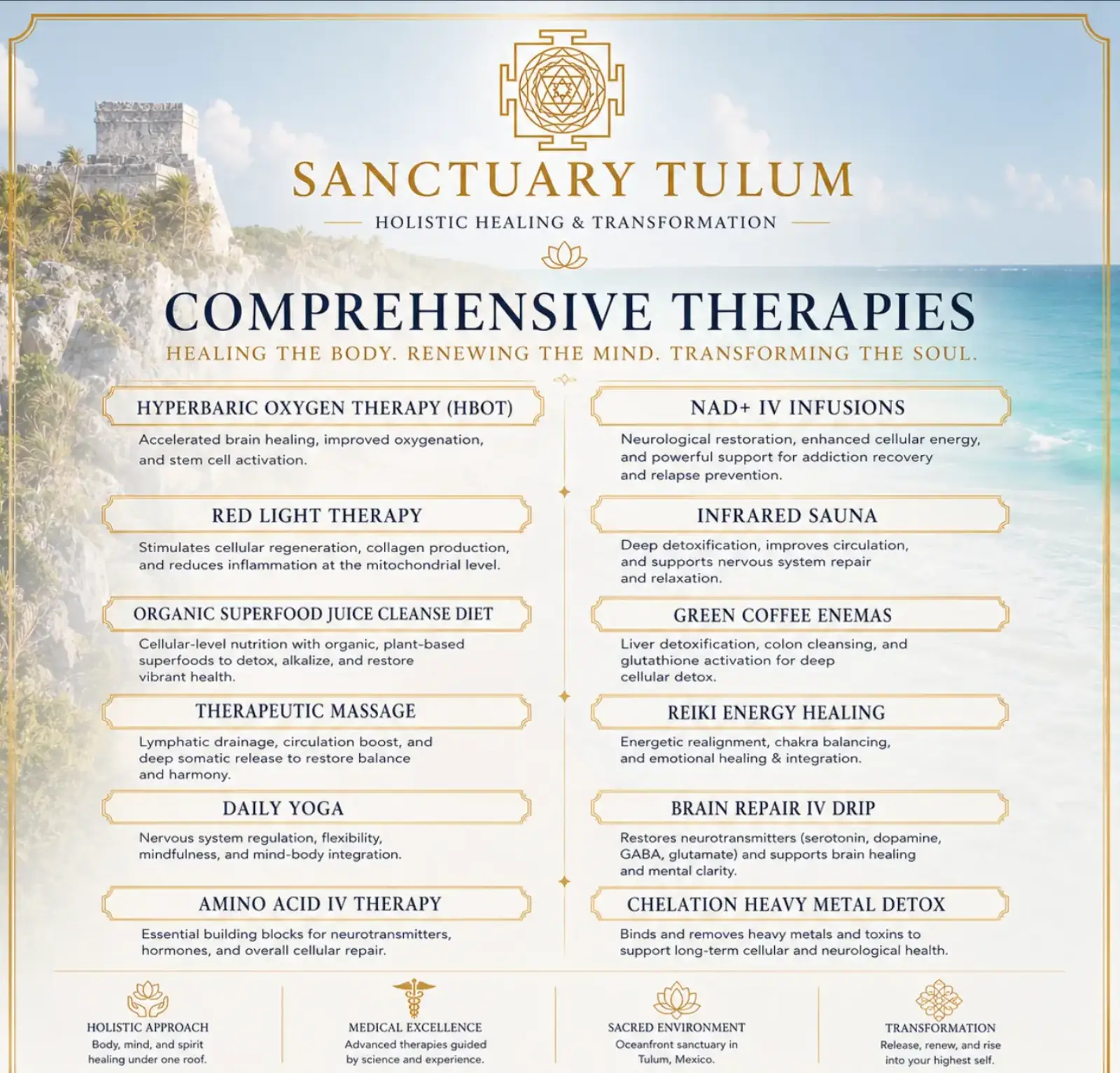
The elements that combine into a single day
Brain Repair IV
Nutrient and amino-acid protocols supporting neurological recovery.
NAD+ IV therapy
Cellular support alongside the clinical schedule.
HBOT
Hyperbaric oxygen sessions integrated into the weekly plan.
Stem cell therapy
Regenerative protocols where clinically indicated.
Infrared sauna
Daily detoxification and recovery support.
Massage and bodywork
Nervous-system regulation through touch.

Medical oversight and a documented safety record
Every guest is medically assessed before arrival and monitored throughout their stay, not simply cleared at intake and left to the therapeutic program. This matters especially where medically supervised plant medicine is part of the plan — ayahuasca, ibogaine, 5-MeO-DMT or psilocybin protocols are only appropriate for carefully screened guests, under direct physician supervision, given documented cardiac and other risks in unsupervised settings (Alper et al., 2012; Koenig & Hilber, 2015).
Over more than a decade of medically supervised ibogaine administration, Sanctuary Tulum has maintained a zero-fatality record — notable given documented deaths at unregulated clinics elsewhere. That record reflects screening, monitoring and physician oversight; it is a fact about this program's history, not a guarantee about any individual outcome.
Why the founder built it this way
Johnny Tabaie is self-taught — a founder and educator, not a doctor or scientist, and the program is explicit about that distinction. His authority rests on lived experience rather than a clinical degree: over two decades navigating addiction and mental health treatment himself, including stretches inside conventional facilities that did not work for him.
In 2001, Johnny's brother David checked into a licensed, residential treatment facility. Fourteen days later, David died there after being given a pharmaceutical drug inside that facility. That loss is the direct reason Sanctuary Tulum exists: Johnny built the program he wished had existed for his brother, built around one-to-one attention, physician oversight, and a deliberate refusal to substitute one drug dependency for another.
How this compares to a typical facility
A conventional residential program is usually built around a group schedule: shared therapy sessions, a communal dining hall, and a handful of individual sessions per week layered on top. That structure is cost-efficient and works for many people, but it is a different product from a genuinely individualized, no-group-therapy program, and it is worth being clear-eyed about the difference before choosing.
Sanctuary Tulum's packages — Gold, Platinum and Elite VIP — scale in length from four to sixteen weeks, with the difference between tiers reflecting depth of protocol and length of stay rather than a reduction in the underlying one-to-one model. Full detail is on the programs and pricing page.
Why individualized care design matters
Individualized, one-to-one treatment planning — rather than a fixed protocol applied uniformly across a group — is associated with stronger patient engagement and better matching of care to a person's actual clinical picture (Park et al., 2026). Design choices — licensing, hours, ratios, privacy — are the mechanism through which individualization actually happens; without them it remains an intention rather than a practice.
If you are comparing a luxury mental health treatment program against a broader field of options, ask each facility directly whether it is government-licensed, how many one-to-one hours a guest receives per week, whether any group therapy is scheduled, and whether replacement medications are part of the protocol. Those questions tell you more than any brochure. Learn more about our luxury rehab program, our story, or begin a confidential enquiry.
How ratios translate into a daily schedule
A staff-to-guest ratio only matters if it changes what a single day actually looks like. At Sanctuary Tulum, the 35-hour weekly figure is distributed across medical check-ins, IV and regenerative protocols, bodywork, structured reflection and — where clinically appropriate — ceremonial sessions, rather than compressed into a handful of long meetings. Each element is scheduled individually around the guest in front of the clinician, not a fixed cohort timetable, and no session is shared with another guest.
This matters most in the first week, when a new arrival's baseline is still being established. A low-census facility can adjust the schedule daily as new information comes in from labs, sleep tracking or simply a guest's stated experience. A higher-census program, by contrast, is often locked into a group timetable that cannot flex without disrupting everyone else on it.
What guests report changes first
Guests and families often ask what changes first in a program built this way. Anecdotally, sleep and appetite tend to stabilize earliest, often within the first one to two weeks, as the nervous system responds to consistent rest, nutrition and the removal of group-setting stimulation. Emotional processing and any ceremonial integration work generally follow once that physiological baseline is more stable — which is one reason the sequencing of a stay is treated as clinically significant rather than incidental.
None of this is promised as guaranteed or uniform; every guest's trajectory differs, and no responsible program quotes a fixed timeline or success rate. What can be described accurately is the structure — the license, the ratios, the method, and the absence of group therapy and replacement drugs — that makes individualized pacing possible in the first place.
Comparing programs on the questions that matter
When comparing an executive rehab option against a broader field, the questions worth asking directly are: is the facility licensed by a federal regulator, how many weekly one-to-one clinical hours does a guest actually receive, is any part of the schedule group-based, and does the protocol use replacement medication. A facility offering a beautiful setting but a large group schedule and maintenance medication is a different clinical product from one built around 35-plus individual hours a week and a drug-free protocol, regardless of how the two are marketed. The luxury detox center page describes how this same one-to-one, no-replacement-drug principle applies during the medically supervised withdrawal phase specifically. For more on the clinical framework itself, see the holistic addiction rehab overview.