Florida · Market & Quality
Luxury Rehabs Florida: A New Era of Healing
From Palm Beach to Brickell, Florida has more treatment centers per capita than almost anywhere in the country. Density is not the same thing as quality.
Florida has spent two decades building the largest concentration of addiction and mental health treatment centers in the United States. South Florida in particular — Delray Beach, West Palm Beach, Fort Lauderdale, Miami — is sometimes called the "recovery capital," and for legitimate reasons: warm weather, a large population of licensed clinicians, and an established sober-living infrastructure.
That density has a well-documented downside. Florida's own regulators have spent years addressing patient brokering and insurance fraud schemes that exploited the state's crowded treatment market, particularly around lower-cost outpatient and sober-living arrangements. The Substance Abuse and Mental Health Services Administration publishes guidance specifically on evaluating treatment quality because of how uneven the market has become nationally, and Florida's scale makes the problem more visible than most states.
None of this means luxury Florida programs are untrustworthy as a category. It means that in a market this large, marketing language has drifted well ahead of what any single center can substantiate, and a resident evaluating options needs sharper questions than "how nice are the rooms."

What crowding does to marketing claims
In a market with hundreds of competing facilities, superlative claims — "the best," "guaranteed results," "instant cure" — proliferate because they are cheap to print and hard to verify from outside. Legitimate clinical programs describe outcomes carefully, because no reputable provider can promise a cure, and the U.S. Food and Drug Administration and state licensing boards have both taken action against providers who overstate what a program can deliver.
A useful filter: ask what specific credentials and licensure the medical staff hold, ask for a straight answer about relapse and readmission rates rather than a marketing figure, and be wary of any facility unwilling to describe a typical day in concrete detail.

Why some Florida residents look beyond the state
For residents embedded in South Florida's own recovery and social circles — a genuinely large and interconnected community — anonymity within the state can be difficult. Sober-living networks, alumni groups and treatment staff overlap constantly across the same handful of towns, which is exactly the opposite of what some guests are looking for.
That is one reason a portion of Florida residents choose an oceanfront program outside the state entirely: not because Florida care is inadequate, but because leaving its ecosystem removes a layer of social exposure that no facility inside it can fully eliminate.
In the country's most crowded treatment market, the sharpest question is not "who is biggest" but "who can show their work."
Sanctuary Tulum
Quality signals worth checking before you commit
A short list that filters out most of the noise in a crowded market.
Physician-led care
Whether a licensed physician oversees the clinical plan directly, not by referral only.
Census size
How many guests are in residence at once, and how individual the schedule actually is.
Verifiable licensing
Whether the facility's medical licensing can be independently confirmed.
Transparent claims
Whether outcomes are described honestly rather than in absolute terms.
Aftercare plan
Whether discharge planning begins weeks before departure, in writing.
Staff-to-guest ratio
How much one-to-one clinical time is actually built into the week.
What a rigorous alternative looks like
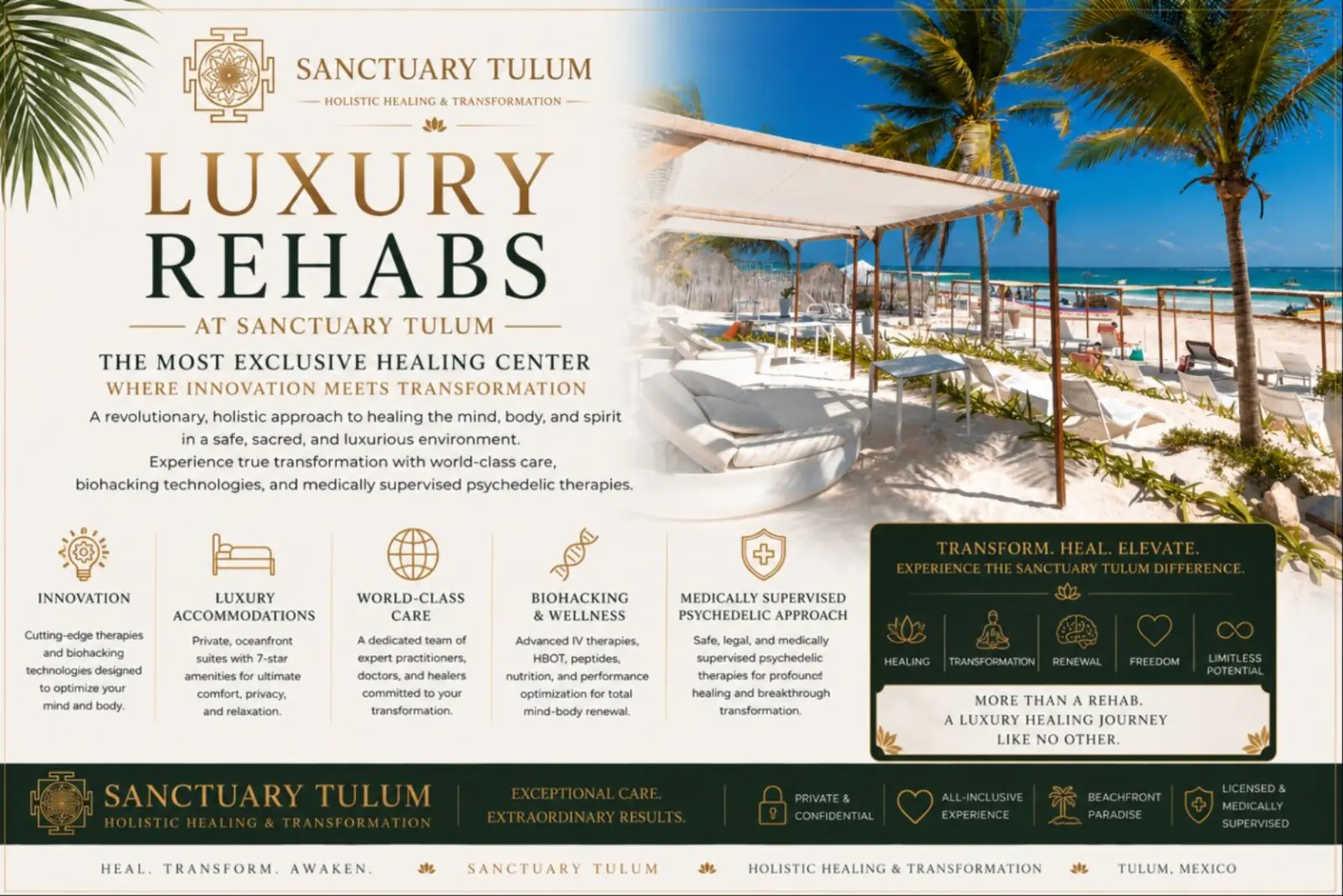
Sanctuary Tulum, an oceanfront facility in Tulum, Mexico, was built around the opposite of the volume model: single-occupancy suites, a genuinely small number of guests at any time, and 35+ hours of one-to-one clinical work per week under the proprietary Pouyan Method™, developed by founder Johnny Tabaie. There is no group therapy, no 12-step programming and no reliance on psychiatric medication as a first-line approach.
Clinical support includes Brain Repair IV therapy, hyperbaric oxygen therapy, and structured nutrition, movement and bodywork, detailed across the all treatments page. Programs run Gold, Platinum and Elite VIP tiers over four to sixteen weeks, described on programs and pricing.

Travel from Florida in practical terms
Direct flights connect Miami and other major Florida airports to Cancún in under two hours, with private transfer to Tulum adding roughly ninety minutes — often a shorter total journey than driving between South Florida's own treatment corridors during peak season traffic.
For residents who have already tried a well-known local address and found the environment too familiar, or too crowded with the same overlapping community, the distance itself becomes part of what makes a second attempt work.
A market that rewards careful evaluation
Florida will likely remain the country's largest luxury rehab market for the foreseeable future, and much of what it offers is genuinely excellent. The task for a prospective guest or their family is simply to evaluate claims with the same rigor they would apply to any major medical decision, rather than assuming scale equals quality. Sanctuary Tulum is a luxury depression clinic built on that evaluative standard, and the contact page outlines how a confidential clinical review begins.
Insurance, cash-pay, and what that changes
A large share of Florida's treatment market is built around insurance billing, which shapes everything from length of stay to which services are offered, since covered services are the ones that get built out at scale. That is not inherently a problem, but it does mean insurance-driven programs sometimes default to standardized lengths of stay — commonly 28 or 30 days — regardless of individual clinical need, because that is the billing cycle the model is built around.
Cash-pay and self-pay luxury programs, by contrast, are not bound by insurance authorization cycles, which allows length of stay to track clinical progress rather than a coverage period. That flexibility is one of the genuine advantages of the luxury category, though it only matters if the program actually uses it — some cash-pay facilities still default to a fixed 28-day track out of habit rather than clinical reasoning.