
On April 18, 2026, President Donald Trump signed Executive Order 14401, "Accelerating Medical Treatments for Serious Mental Illness." Six days later, on April 24, 2026, the U.S. Food and Drug Administration announced a coordinated set of regulatory actions on psychedelic-assisted therapies — including a specific action on ibogaine that has generated significant attention from patients, clinicians, and policymakers. This article explains what actually happened, what it does, and — importantly — what it does not do.
Executive Order 14401 in Plain Language
EO 14401 directs federal health agencies — HHS, FDA, NIH, and the VA — to accelerate the research, review, and development of promising treatments for serious mental illness, with explicit reference to psychedelic-assisted therapies. The order frames the veteran mental health crisis and rising overdose mortality as the driving policy rationale. It does not reschedule any controlled substance. It does not approve any psychedelic for medical use. It instructs agencies to move faster within existing regulatory frameworks.
FDA's April 24, 2026 Action
Six days after the EO, FDA issued an official press release describing the actions the agency was taking in response. Per FDA's own announcement, the agency:
- Issued Commissioner's National Priority Vouchers to Compass Pathways for its COMP360 psilocybin program and to the Usona Institute for its psilocybin program targeting major depressive disorder.
- Issued a Commissioner's National Priority Voucher to Transcend Therapeutics for methylone, being developed for post-traumatic stress disorder.
- Announced that FDA would allow noribogaine hydrochloride — an active metabolite/derivative of ibogaine — to proceed to human clinical trials under an Investigational New Drug (IND) application.
In the announcement, HHS Secretary Robert F. Kennedy Jr. named ibogaine specifically as a treatment being accelerated, framing it — in his words — as an option being pursued "especially for our veterans." The Commissioner's National Priority Voucher is an FDA program designed to shorten regulatory review timelines for treatments the agency judges to be of national priority.
What This Does — and Does Not — Change for Ibogaine
To be precise: ibogaine remains a Schedule I controlled substance in the United States. Nothing in the executive order or in FDA's April 24 action changes that scheduling status. What did change is that noribogaine hydrochloride — a related compound — now has an open regulatory pathway to human clinical trials in the U.S. under an IND. That is a meaningful step; it is not a legalization event, and it is not FDA approval of ibogaine for any indication.
This pattern — federal acceleration of research without rescheduling — is consistent with the broader institutional momentum documented in our post on the Eli Lilly acquisition of atai–Beckley, and with FDA's earlier use of Breakthrough Therapy Designations for psilocybin and MDMA programs. It is regulatory momentum, not regulatory arrival.
The Joe Rogan Angle — Reported, Not Verified
Forbes reported that podcaster Joe Rogan texted President Trump citing an ibogaine success-rate claim in the context of opioid addiction, and that this text reportedly contributed to the EO. That reporting should be treated as attributed journalism, not an official statement of the administration's rationale. The specific numeric success-rate figures circulated in that reporting are not clinically validated benchmarks — real-world ibogaine outcomes vary significantly by patient selection, protocol design, dose, and quality of medical supervision. Sanctuary Tulum's clinical guide on ibogaine and opioid addiction research reviews what the published literature does and does not support.
Why the Safety Story Now Matters More, Not Less
As federal attention to ibogaine grows, so does interest from patients — and so does the risk of underprepared clinics stepping in to meet demand. Ibogaine has documented cardiac risks (QT prolongation, bradyarrhythmias) that require pre-treatment 12-lead EKG screening, continuous cardiac monitoring during treatment, and on-site emergency capability. Our detailed review of ibogaine cardiac safety screening covers the current standard of care, and our page on the safest psychedelic facility criteria explains what to look for in a provider.
Sanctuary Tulum's 15 Years With Ibogaine
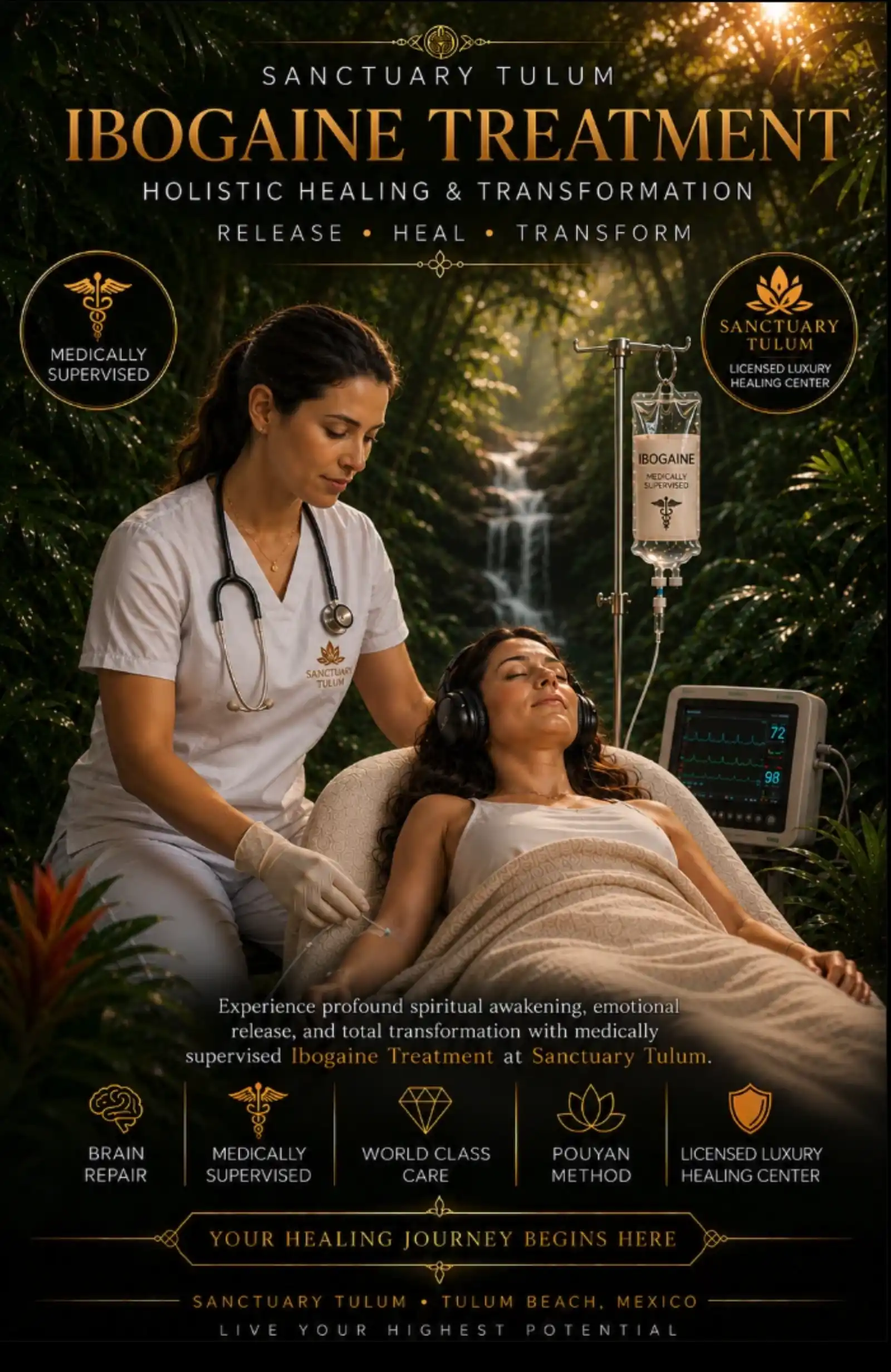
Sanctuary Tulum has operated a physician-supervised medically supervised ibogaine treatment program continuously since 2011 under a federal health license, with a documented, fatality-free safety record across 15 years of medically supervised sessions. Ibogaine remains investigational in the United States; treatment at Sanctuary Tulum takes place in Mexico under Mexican medical licensing. For those whose primary concern is opioid dependence, ibogaine is delivered within the broader Pouyan Method protocol alongside neuro-restorative IV therapy and integration support. For benzodiazepine-dependent patients, ibogaine is not first-line — see our benzo detox page for the appropriate pathway.
References
- U.S. Food and Drug Administration. FDA Accelerates Action on Treatments for Serious Mental Illness Following Executive Order (April 24, 2026). fda.gov.
- The White House. Executive Order 14401 — Accelerating Medical Treatments for Serious Mental Illness (April 18, 2026). federalregister.gov.
- Forbes. Reporting on Joe Rogan text message to President Trump referencing ibogaine (attributed reporting, not an official government statement). forbes.com.
Medical and policy disclaimer: This article summarizes public-domain regulatory actions and news reporting for educational purposes. It is not legal advice, medical advice, or a treatment recommendation. Ibogaine remains a Schedule I controlled substance in the United States. Regulatory status changes over time; always verify current federal and state law before making decisions.
Ready to take the next step? Learn about our psychedelic retreat program.