
Escitalopram — sold under the brand name Lexapro — is a selective serotonin reuptake inhibitor (SSRI) approved by the FDA for major depressive disorder and generalized anxiety disorder. Its discontinuation profile is documented in the FDA-approved prescribing information and reflects a longer elimination half-life than most other SSRIs and SNRIs. The information below is educational only. Never stop or change a prescribed antidepressant without consulting your prescriber.
The FDA Label on Escitalopram Discontinuation
The FDA-approved prescribing information for Lexapro lists discontinuation-associated adverse reactions occurring in at least 1% of patients and at a rate at least twice that of placebo: nausea (2%), insomnia (1%), and fatigue (1%). The label recommends a gradual reduction in dose rather than abrupt cessation whenever possible, and notes that if intolerable symptoms occur following a decrease in dose or upon discontinuation, resuming the previously prescribed dose may be considered, followed by a more gradual reduction. A 2025 reanalysis of the antidepressant discontinuation evidence base cautions against reading any single label's percentages as a ceiling on real-world severity, since trial designs vary widely in how they capture discontinuation symptoms (Moncrieff J, et al. Evidence on antidepressant withdrawal: an appraisal and reanalysis of a recent systematic review. Psychol Med. 2025;55:e191).
Why Escitalopram's Half-Life Matters
Escitalopram has an elimination half-life of approximately 27–32 hours. That is substantially longer than venlafaxine's parent-drug half-life of roughly 5–11 hours and duloxetine's ~12 hours. Longer half-lives produce more gradual plasma-level declines between doses and after cessation, which is the pharmacokinetic basis for a milder acute discontinuation profile. This is a factual contrast, not a value judgment — different antidepressants suit different clinical situations, and half-life alone does not guarantee a symptom-free taper for any individual patient.

The Mechanism Behind SSRI Discontinuation Syndrome
SSRI discontinuation syndrome is not a single receptor phenomenon; it is the nervous system's response to the rapid withdrawal of chronically elevated synaptic serotonin. During SSRI treatment, sustained serotonin reuptake blockade produces compensatory downregulation of post-synaptic 5-HT receptors, particularly the 5-HT1A autoreceptor, alongside changes in serotonergic tone across cortical, limbic, and brainstem circuits. When the drug is removed and synaptic serotonin drops back toward baseline, the previously adapted receptor landscape is temporarily mismatched to the available neurotransmitter, and symptoms emerge until receptor systems re-adapt.
Serotonin is not the only implicated system. Cholinergic rebound is one accepted explanation for the flu-like symptoms and GI upset commonly reported during SSRI withdrawal; secondary effects on norepinephrine and dopamine circuits are invoked to account for symptoms such as agitation, low mood, and difficulty concentrating. The characteristic "brain zap" sensation — brief electrical shivers, often provoked by lateral eye movement — is thought to involve transient dysregulation in cortical and cerebellar serotonergic and GABAergic circuits, though the exact neurophysiology remains an active area of investigation. Because multiple systems are involved and re-adapt at different rates, symptoms tend to be heterogeneous rather than a single stereotyped syndrome. Some patients also describe symptoms that persist well beyond the acute window; a 2025 systematic review of post-acute withdrawal syndrome (PAWS) after stopping antidepressants found that a subset of patients report protracted symptoms, underscoring that discontinuation effects are neither universal nor uniformly brief (Rennwald A, et al. Post-acute withdrawal syndrome (PAWS) after stopping antidepressants: a systematic review. Epidemiol Psychiatr Sci. 2025;34:e29).
The clinical implication is straightforward: the faster the serotonergic input is withdrawn, the more pronounced the transient mismatch. A short-half-life SSRI removes serotonergic input steeply; a long-half-life SSRI removes it gradually. The taper strategy in the label — reduce the dose progressively rather than stopping abruptly — is a direct application of this pharmacology.

Common Lexapro Withdrawal Symptoms
Drawing on the FDA label and the broader SSRI discontinuation literature, patients discontinuing escitalopram most commonly report:
- Nausea (most frequent FDA-labeled reaction at 2%)
- Insomnia and vivid or unusual dreams
- Fatigue
- Dizziness or light-headedness
- Headache
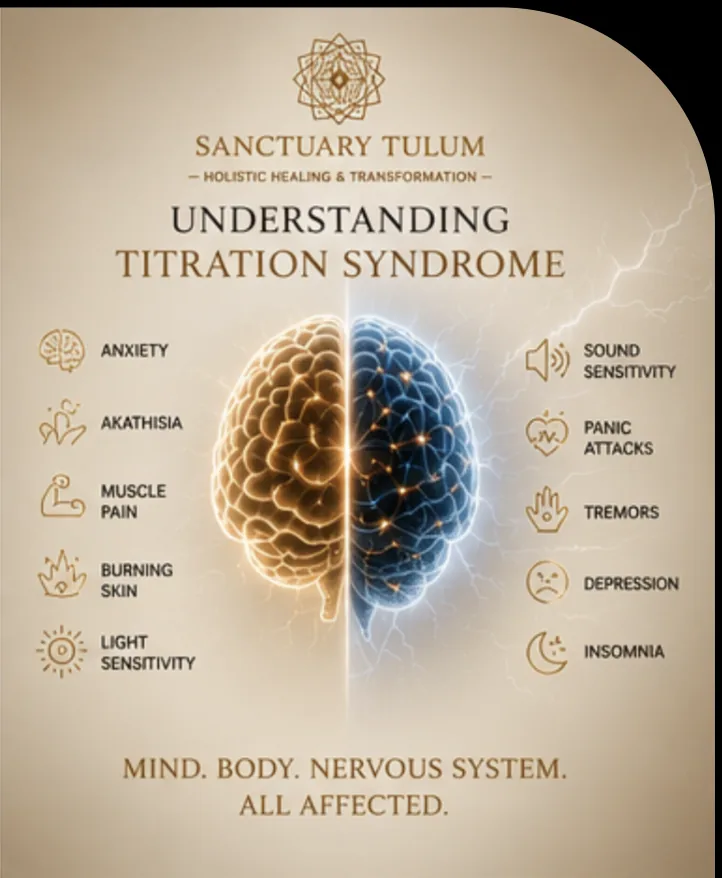
- Paresthesia — including "brain zap" sensations, though less frequent than with shorter-half-life agents
- Irritability, anxiety, or low mood
- Flu-like symptoms

Escitalopram Compared With Other SSRIs
Within the SSRI class, half-life is one of the most useful predictors of acute discontinuation severity, and the class covers a wide range. Fluoxetine sits at one extreme, with a parent-drug half-life of 1–3 days and an active metabolite (norfluoxetine) of 7–15 days; that long tail acts as a built-in self-taper and is one reason fluoxetine discontinuation symptoms are frequently reported as milder and more delayed than with shorter-half-life agents. This same pharmacokinetic property is why clinicians sometimes bridge a difficult taper from a shorter-half-life antidepressant by substituting a course of fluoxetine before the final wean (Shapiro B, et al. Fluoxetine substitution for deprescribing antidepressants: a technical approach. J Psychiatry Neurosci. 2025;50(4):E202-E209). At the other extreme, paroxetine has a half-life of roughly 21 hours with no long-lived active metabolite, and — together with its added anticholinergic activity — is repeatedly identified in the literature as one of the SSRIs most likely to produce discontinuation symptoms.
Sertraline (half-life ~26 hours) and citalopram (half-life ~35 hours) sit in the middle of the range and are generally reported to produce moderate discontinuation profiles — meaningfully less severe than paroxetine but not as gentle as fluoxetine. Escitalopram, the S-enantiomer of citalopram, has a similar half-life to citalopram (~27–32 hours) and a similar overall discontinuation footprint in comparative reviews. These are population-level generalizations, not predictions for individual patients: some patients tolerate paroxetine tapers well, and others report significant symptoms discontinuing fluoxetine despite its long half-life.
Escitalopram vs. Shorter-Half-Life SNRIs
The pharmacokinetic contrast with shorter-half-life antidepressants is one of the more clinically useful facts patients can carry into a taper conversation with their physician. Venlafaxine, in particular, is well-documented to produce more frequent and more intense acute discontinuation symptoms than escitalopram — a difference that is closely tied to its shorter half-life. For details on that end of the spectrum, see the companion post on Effexor (venlafaxine) withdrawal, and for the class-level overview see antidepressant discontinuation syndrome.
Tapering Considerations
Hyperbolic-tapering pharmacology — the principle that receptor occupancy falls off non-linearly as dose decreases, so equal milligram cuts produce progressively larger effects at low doses — was developed most extensively in the benzodiazepine and Z-drug literature but is now applied broadly across serotonergic and GABAergic medications when planning a physician-supervised wean (Horowitz M, et al. Pharmacological principles for safe benzodiazepine and Z-drug dose reduction. Psychol Med. 2026;56:e198). Applied to escitalopram, the practical takeaway is that the last small dose reductions are where discontinuation symptoms most commonly emerge, and that very slow, proportional reductions at the low end can meaningfully reduce risk. Because escitalopram's longer half-life produces a naturally gentler plasma decline, patients on it often tolerate straightforward physician-supervised tapers well, but a slow low-dose finish remains a reasonable option for anyone with a history of discontinuation-sensitive symptoms. No taper should be undertaken without the prescribing physician's guidance, and no one should stop escitalopram abruptly on their own.
Physician-Supervised Support at Sanctuary Tulum
Sanctuary Tulum coordinates escitalopram tapers with each guest's prescribing physician. On-site medical oversight, the neuro-restorative Brain Repair IV drip protocol, and integrative modalities are combined to support the nervous system during discontinuation. For the broader clinical context, see the page on SSRI and antidepressant treatment, the overview at holistic treatment center, and the companion posts on Effexor (venlafaxine) withdrawal, Cymbalta (duloxetine) withdrawal, Zoloft (sertraline) withdrawal, and Seroquel (quetiapine) withdrawal.
References
- Moncrieff J, et al. Evidence on antidepressant withdrawal: an appraisal and reanalysis of a recent systematic review. Psychol Med. 2025;55:e191.
- Shapiro B, et al. Fluoxetine substitution for deprescribing antidepressants: a technical approach. J Psychiatry Neurosci. 2025;50(4):E202-E209.
- Rennwald A, et al. Post-acute withdrawal syndrome (PAWS) after stopping antidepressants: a systematic review. Epidemiol Psychiatr Sci. 2025;34:e29.
- Horowitz M, et al. Pharmacological principles for safe benzodiazepine and Z-drug dose reduction. Psychol Med. 2026;56:e198.
- National Institute of Mental Health. Major depression statistics.
- National Institute of Mental Health. Any anxiety disorder.
- World Health Organization. Depressive disorder (depression) fact sheet.
Medical disclaimer: This article is for educational purposes only and does not constitute medical advice, diagnosis, or treatment. Never stop or change a prescribed antidepressant without consulting a qualified physician.