Depression rarely acts alone. It sits on top of neuroinflammation, disrupted sleep architecture, HPA-axis dysregulation, low-grade gut inflammation, and — for a large subset — unresolved trauma. A holistic treatment center for mental health works each of those layers rather than concentrating on a single neurotransmitter.
Depression as a Whole-Body Signal
The clinical picture that a guest brings to intake is rarely just "low mood." Sleep is usually broken, appetite and libido have shifted, cognition feels slower, and inflammatory markers are often elevated. Miller and Raison's 2016 review in Nature Reviews Immunology laid out the immune-inflammatory model of depression, showing that elevated cytokines correlate with both symptom severity and treatment resistance.1 That is why depression protocols at Sanctuary Tulum begin with inflammation, sleep, and metabolic labs, not with a diagnostic label.
The Serotonin Hypothesis Has Weakened
Moncrieff's 2022 umbrella review in Molecular Psychiatry examined the main lines of evidence for the serotonin theory of depression — CSF studies, receptor imaging, tryptophan-depletion trials, and genetic associations — and concluded that none of them provide consistent support.2 This does not mean SSRIs never help; some guests benefit from them, and no responsible clinician stops that conversation. It does mean the "chemical imbalance" framing that patients were taught for two decades was oversimplified, and it changes how integrative programs plan long-arc care.
A Depression-Specific Protocol at Sanctuary Tulum
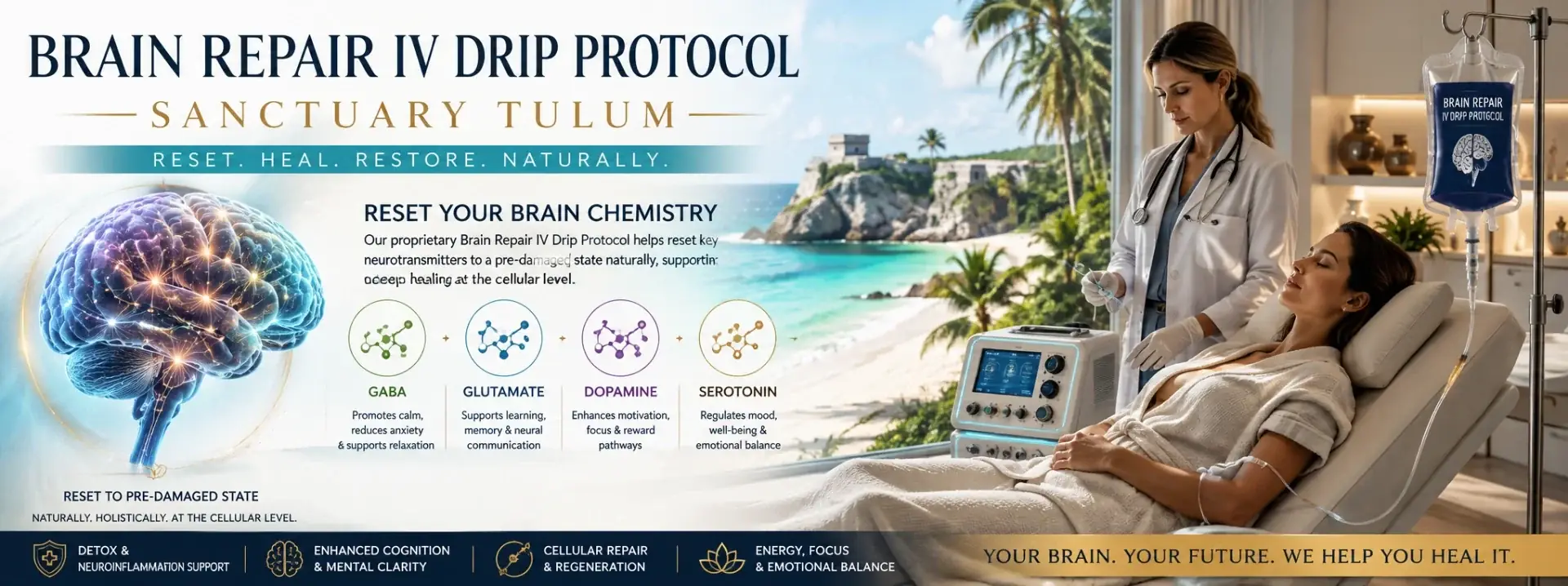
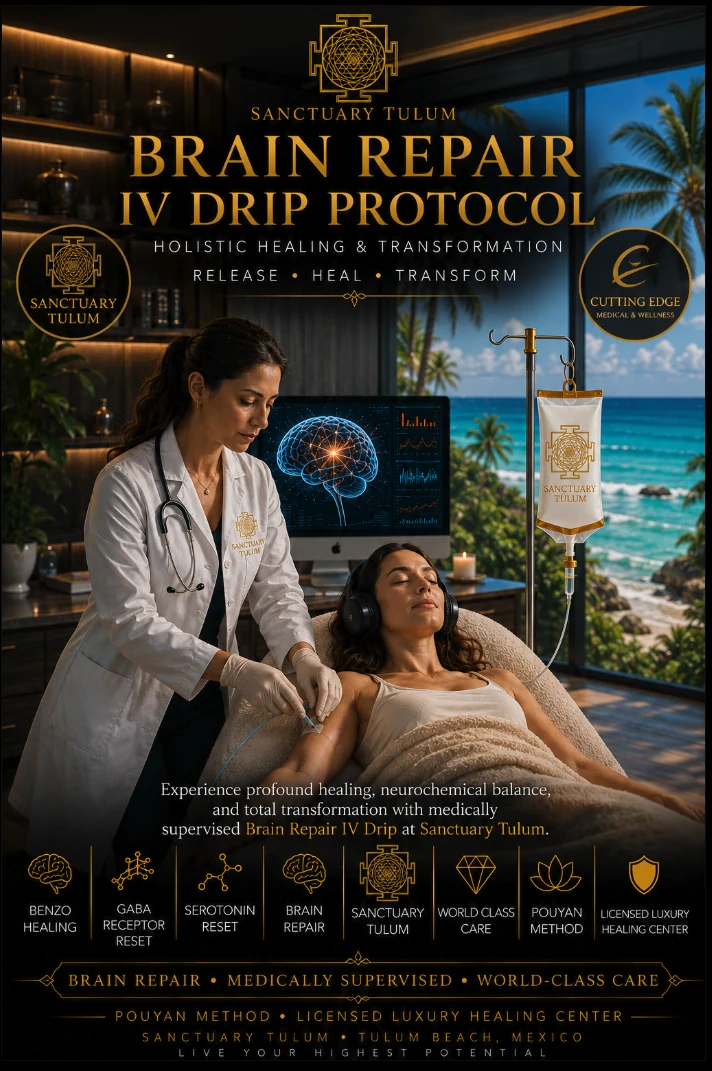
- Neurochemistry. Brain Repair IV with amino-acid precursors alongside NAD+ during the first two weeks.
- Neuroinflammation. HBOT, red-light exposure, and an anti-inflammatory diet built around omega-3s and polyphenols.
- Trauma layer. Where clinically appropriate, medically supervised psilocybin or ayahuasca.
- Nervous system. Breath practice, ocean cold exposure, and enforced sleep windows to restore circadian rhythm.
Psilocybin, Ayahuasca, and the Neuroplasticity Window
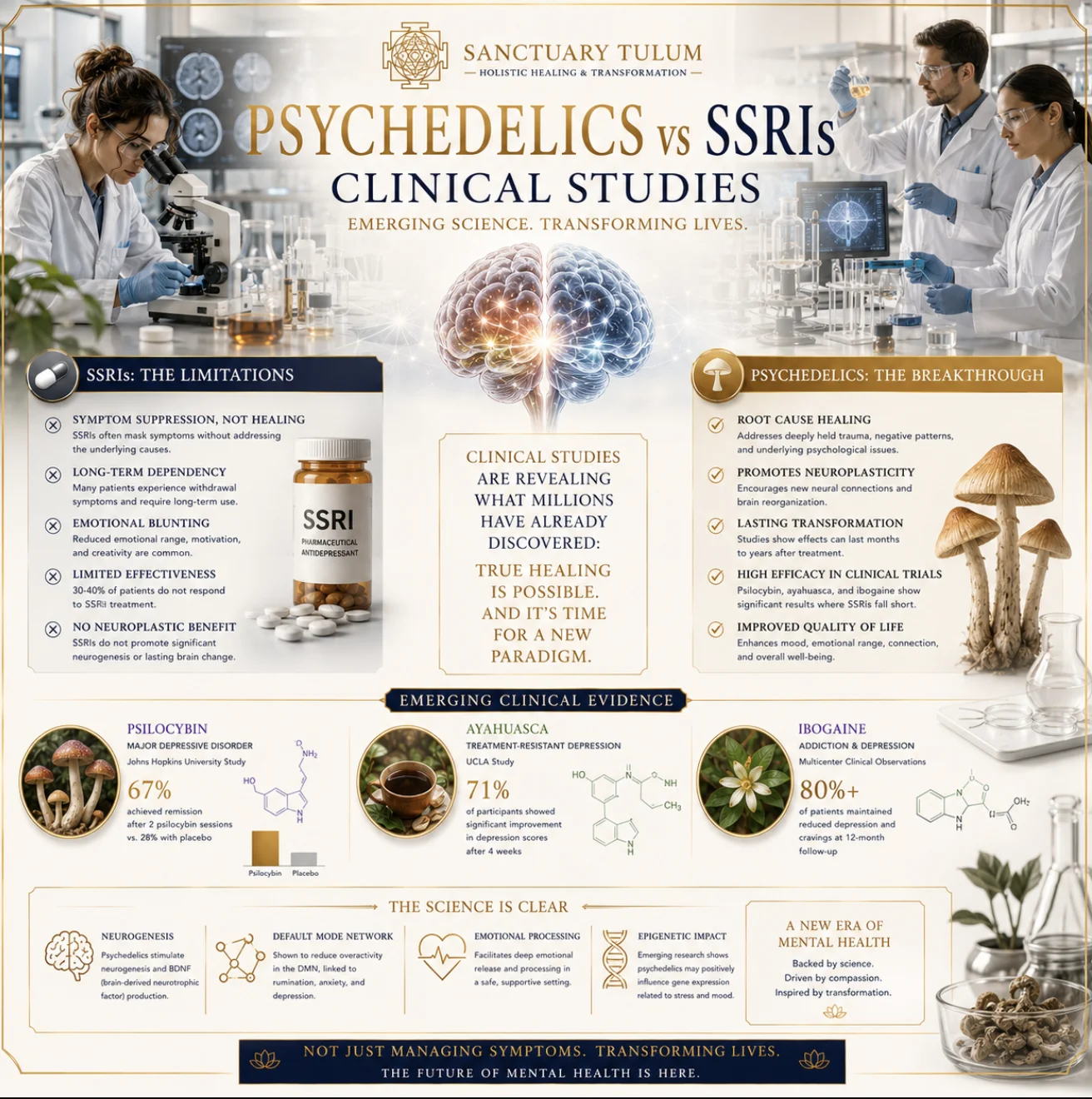
Two lines of research converge here. Davis et al. 2021 (JAMA Psychiatry) reported large effect sizes for psilocybin-assisted therapy in major depression, and Carhart-Harris's 2021 head-to-head against escitalopram (NEJM) found psilocybin non-inferior on the primary outcome with faster onset.34 Palhano-Fontes 2019 reported rapid antidepressant effects for ayahuasca in treatment-resistant depression seven days after a single ceremony.5 The mechanism most researchers point to is a several-week neuroplasticity window that opens after a session — where habitual thought patterns are more editable. That window is what the sanctuary's integration protocol is designed to hold open.
When SSRI Tapering Is Part of the Plan
A large share of guests arrive already on an SSRI or SNRI. Horowitz and Taylor's 2019 Lancet Psychiatry paper on hyperbolic tapering showed that receptor occupancy does not fall linearly with dose, which is why final-dose withdrawal is often the hardest phase and why compounded, hyperbolic reductions matter for anyone who has taken the medication more than a year.6 At Sanctuary Tulum the taper is planned in writing with the guest's treating physician before ceremony work begins, and any MAO-inhibiting agents are fully cleared before ayahuasca is considered. Sanctuary Tulum never advises a guest to stop prescribed medication independently. Further reading on this specific problem lives at SSRI antidepressant treatment.
Realistic Timelines and Milestones
Mood usually shifts within the first two to three weeks — better sleep, less rumination, appetite returning. The more durable change tends to arrive in the integration months, as the neurochemical work and the trauma work compound. Depression that has been present for a decade rarely fully resolves in a fortnight, and any program that promises otherwise is worth skepticism. What the sanctuary commits to is a licensed medical environment, individualized rather than templated protocols, and continued integration relationship for 90 days after discharge. Broader context lives on the Pouyan Method™ page and the Medical Review Board.
References
- Miller AH, Raison CL. "The role of inflammation in depression: from evolutionary imperative to modern treatment target." Nat Rev Immunol. 2016;16(1):22-34.
- Moncrieff J et al. "The serotonin theory of depression: a systematic umbrella review of the evidence." Mol Psychiatry. 2023;28(8):3243-3256.
- Davis AK et al. "Effects of Psilocybin-Assisted Therapy on Major Depressive Disorder." JAMA Psychiatry. 2021;78(5):481-489.
- Carhart-Harris R et al. "Trial of Psilocybin versus Escitalopram for Depression." N Engl J Med. 2021;384(15):1402-1411.
- Palhano-Fontes F et al. "Rapid antidepressant effects of the psychedelic ayahuasca in treatment-resistant depression: a randomized placebo-controlled trial." Psychol Med. 2019;49(4):655-663.
- Horowitz MA, Taylor D. "Tapering of SSRI treatment to mitigate withdrawal symptoms." Lancet Psychiatry. 2019;6(6):538-546.
For the full program overview, read about our holistic treatment center and one-on-one depression treatment.