For guests whose clinical picture would fit MDMA-assisted therapy but who cannot access a licensed program — either because of regulatory constraints, clinical contraindications, or geographic access — the question becomes which alternative pathways actually deliver comparable therapeutic value. There is no single answer, but there are meaningful, evidence-supported alternatives.
Why MDMA Access Is Currently Constrained
MDMA-assisted therapy holds FDA Breakthrough Therapy Designation for PTSD and generated large Phase 3 effect sizes (Mitchell et al., 2021, 2023). In August 2024 the FDA declined to approve the treatment on the initial application, requesting additional Phase 3 work. This means access outside of ongoing trials and expanded access programs is currently very limited in the US. Guests looking at their clinical timeline in 2026 cannot reliably plan around licensed MDMA availability.
Ayahuasca-Assisted Work as an Alternative
For trauma work specifically, ayahuasca ceremonies in a properly-structured residential container operate on overlapping but distinct mechanisms — 5-HT2A receptor agonism, default-mode-network disruption, access to somatically-stored and preverbal traumatic material. The evidence base is smaller and more observational than MDMA's but consistent (Inserra, 2018; Nielson & Megler, 2014). Suits guests whose trauma picture includes developmental or complex trauma alongside PTSD.
Psilocybin-Assisted Work
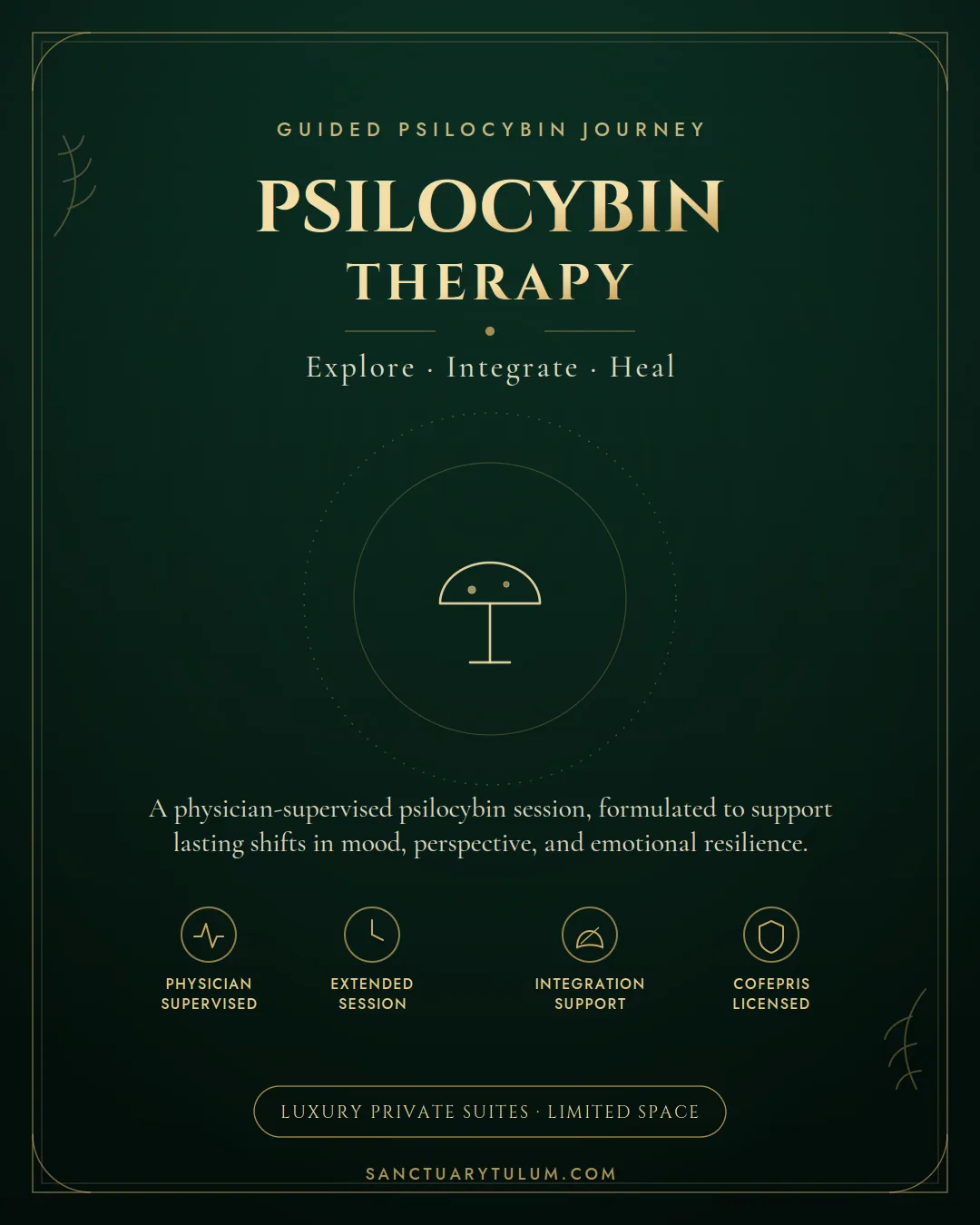
Psilocybin is the psychedelic with the largest current RCT evidence base for depression and, secondarily, PTSD-adjacent indications. Its longer, more narrative-and-imagistic profile compared to MDMA's entactogenic profile suits guests whose work involves accessing and reprocessing autobiographical material more than fear-reduced dyadic dialogue with a therapist. See our psilocybin TRD trials review.
Ketamine-Assisted Therapy: Available But Different
Ketamine-assisted therapy is legally available in the US and has an emerging evidence base for depression and, secondarily, PTSD. It is a genuinely different molecule mechanistically — NMDA receptor antagonism rather than serotonergic engagement — and produces a dissociative rather than psychedelic subjective experience. Some guests do well with ketamine work; others find the dissociative quality less integrable than the classical psychedelic experience. See our ketamine comparison and natural brain repair vs ketamine.
5-MeO-DMT as an Adjunct, Not a Substitute
5-MeO-DMT is not a direct MDMA alternative for narrative trauma work — the experience is too brief and too non-narrative. It has a place later in a comprehensive protocol for guests whose narrative processing has plateaued and who need non-verbal, unity-level work to complete the arc. Explore our 5-MeO-DMT vs psilocybin comparison.
The Comprehensive Protocol Approach
The most clinically robust alternative to MDMA-assisted therapy is not any single molecule but a properly-structured multi-week protocol that combines plant-medicine work, comprehensive biological support (NAD+ IV therapy, Brain Repair IV drips, HBOT), somatic work, and intensive integration. Sanctuary Tulum's Pouyan Method was designed around exactly this logic — no single tool is sufficient for complex trauma, and the stack matters more than any individual modality. Explore our PTSD treatment program.
References
- Mitchell JM, et al. "MDMA-assisted therapy for severe PTSD: a randomized, double-blind, placebo-controlled phase 3 study." Nat Med. 2021;27(6):1025-1033.
- Mitchell JM, et al. "MDMA-assisted therapy for moderate to severe PTSD: a randomized, placebo-controlled phase 3 trial." Nat Med. 2023;29(10):2473-2480.
- Carhart-Harris R, et al. "Trial of Psilocybin versus Escitalopram for Depression." N Engl J Med. 2021;384(15):1402-1411.
Ready to take the next step? Learn about our PTSD treatment program.