The healing benefits of ayahuasca are being validated by a growing body of scientific research. Here's what the evidence — and centuries of traditional use — tells us.
Depression and Anxiety
Clinical studies have shown rapid and sustained antidepressant effects from ayahuasca, even in treatment-resistant cases. The brew appears to promote neuroplasticity — helping the brain form new, healthier patterns of thinking and emotional processing.
PTSD and Trauma
Ayahuasca facilitates deep emotional processing, allowing participants to safely revisit and release stored traumatic memories. This makes it particularly powerful for PTSD, complex trauma, and grief.
Addiction Recovery
Research from observational studies suggests ayahuasca reduces substance use and cravings. When combined with ibogaine therapy program at our luxury rehab, the results for addiction are particularly powerful.
Spiritual Growth and Self-Discovery
Beyond clinical applications, ayahuasca is widely used for personal and spiritual development. Many participants report increased self-awareness, compassion, connection to nature, and a profound sense of purpose following ceremonies.
Maximizing Benefits with Integrated Treatment
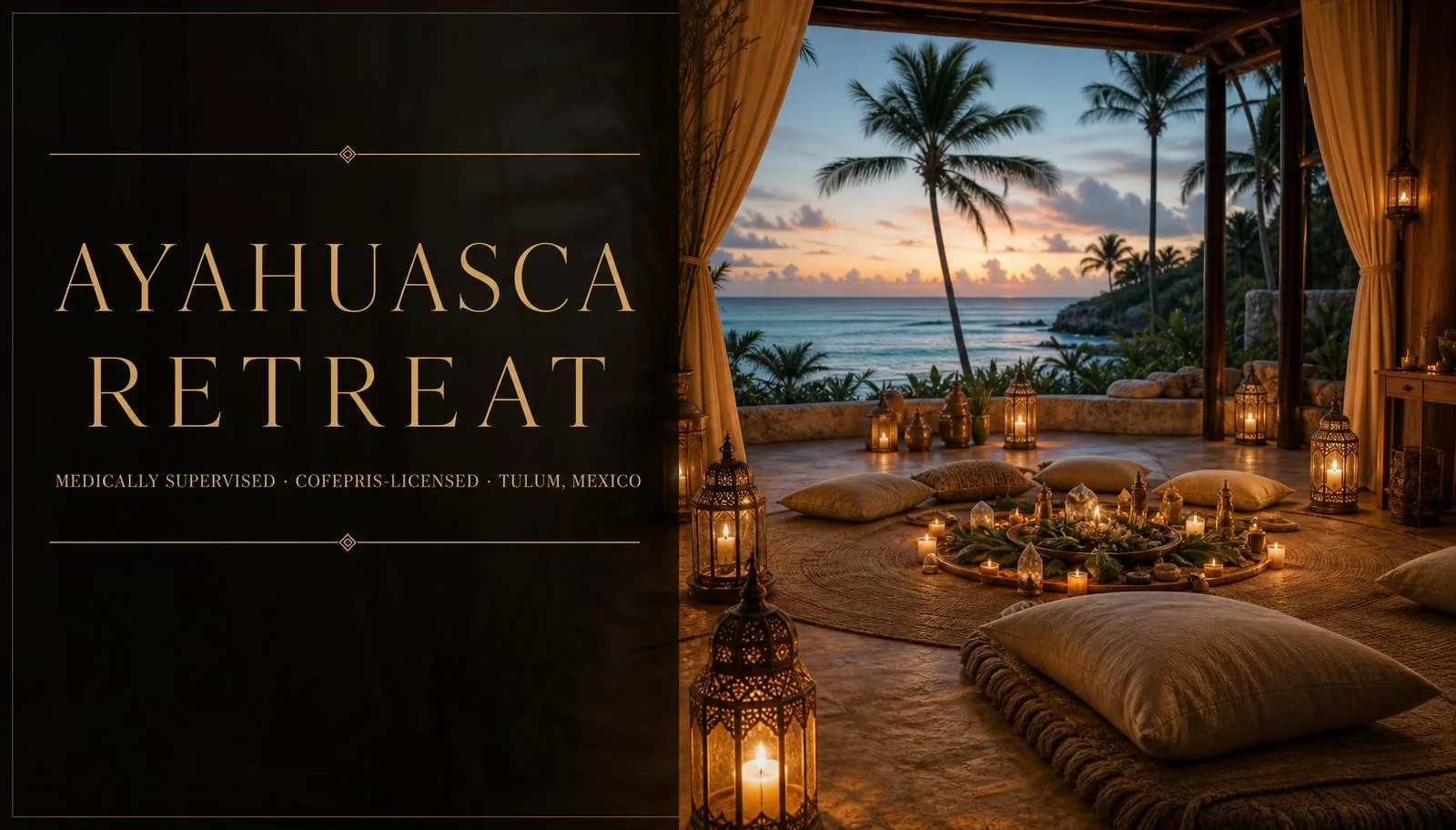
At Sanctuary Tulum, ayahuasca ceremony program are part of a comprehensive healing protocol. Combined with medical detox, NAD+ therapy, and integration support, the healing benefits are amplified and sustained.
What the Peer-Reviewed Trials Show
A 2019 double-blind, placebo-controlled trial in Psychological Medicine found rapid and significant antidepressant effects from a single ayahuasca session in patients with treatment-resistant depression, with response persisting at seven days.1 An earlier open-label pilot reported similar directional effects.2
A systematic review of clinical trials of ayahuasca, psilocybin, and LSD across 25 years concluded that the antidepressive, anxiolytic, and anti-addictive signals are consistent enough to justify continued controlled study, while flagging small sample sizes and heterogeneity of methods.3
Neurobiological Mechanisms Under Discussion
Proposed mechanisms include 5-HT2A receptor agonism, downstream effects on BDNF and neuroplasticity, changes in default mode network connectivity, and reduction of inflammatory cytokines linked to depression. Ayahuasca specifically also engages sigma-1 and TAAR1 receptors via its beta-carboline alkaloids. None of these mechanisms alone accounts for the clinical effect; the working hypothesis is that several converge.
How Sanctuary Tulum Treats the Evidence Honestly
Ayahuasca is not FDA-approved for any indication. Response is variable, and a portion of participants in every published trial did not improve. Our program presents ayahuasca as one carefully-supervised component of a broader clinical stay — not as a standalone cure. Guests interested in a fuller comparison should read our ayahuasca vs psilocybin and ayahuasca for depression pieces.
Who the Program Suits and Who It Does Not
Ayahuasca work at Sanctuary Tulum tends to fit guests with treatment-resistant depression, trauma history, or long-standing anxiety who have already tried conventional approaches and are seeking a different clinical model. It does not fit active psychosis, uncontrolled cardiovascular disease, or presentations requiring continuous serotonergic medication that cannot be safely tapered. Those exclusions are non-negotiable and are worked through candidly during intake.
Response is not uniform. Some guests report significant shifts after their first ceremony; others require the fuller arc of a longer stay before something integrates. Neither pattern is a failure — both are inside the range published trials describe.
What the Peer-Reviewed Literature Actually Shows
Published human research on ayahuasca is small compared to psilocybin or MDMA, but the signal is consistent. Palhano-Fontes et al. (2019) reported significant, rapid reductions in Hamilton depression scores in treatment-resistant patients after a single ayahuasca session versus placebo, with effect sizes larger than a standard 6-week SSRI course. Sanches et al. (2016), Osório et al. (2015), and subsequent open-label work show a similar rapid-onset pattern in depression and anxiety measures, holding at 21-day follow-up.
These are early-stage findings — sample sizes are small, follow-up is short by pharmaceutical standards, and none of this substitutes for a full Phase 3 program. But the pattern is real and it is why serious clinical interest in ayahuasca-assisted therapy exists at all.
Safety, Screening, and What Disqualifies a Guest
Cardiac contraindications, uncontrolled hypertension, personal or first-degree family history of psychotic disorder, active mania, current pregnancy, and inability to safely taper serotonergic medication are all reasons Sanctuary Tulum does not admit a guest to the plant medicine arc. Those exclusions are held firmly; they are the reason the safety record exists.
Guests who screen out of ceremony work are not turned away from healing — the non-ceremony arc of Pouyan Method™ (IV protocols, HBOT, bodywork, nutrition, one-to-one clinical hours) is offered in its own right and produces meaningful outcomes without introducing pharmacological risk.
References
- Palhano-Fontes F, et al. "Rapid antidepressant effects of the psychedelic ayahuasca in treatment-resistant depression: a randomized placebo-controlled trial." Psychol Med. 2019;49(4):655-663.
- Osório FL, et al. "Antidepressant effects of a single dose of ayahuasca in patients with recurrent depression: a preliminary report." Braz J Psychiatry. 2015;37(1):13-20.
- dos Santos RG, et al. "Antidepressive, anxiolytic, and antiaddictive effects of ayahuasca, psilocybin and lysergic acid diethylamide (LSD): a systematic review of clinical trials published in the last 25 years." Ther Adv Psychopharmacol. 2016;6(3):193-213.
US-based readers evaluating travel logistics can also review our detailed guide on Ayahuasca Retreats in NYC for a NYC-focused breakdown of the legal landscape and licensed Mexico alternative.