The short answer: a psychedelic treatment program is worth evaluating on licensing, medical screening rigor, staff qualifications, transparency about risks and limitations, and the quality of its aftercare — not on how the property photographs. This article is educational and is not medical advice; whether any specific program or medicine is appropriate for you is a decision to make with a qualified physician.

1–3: Licensing and Regulatory Standing
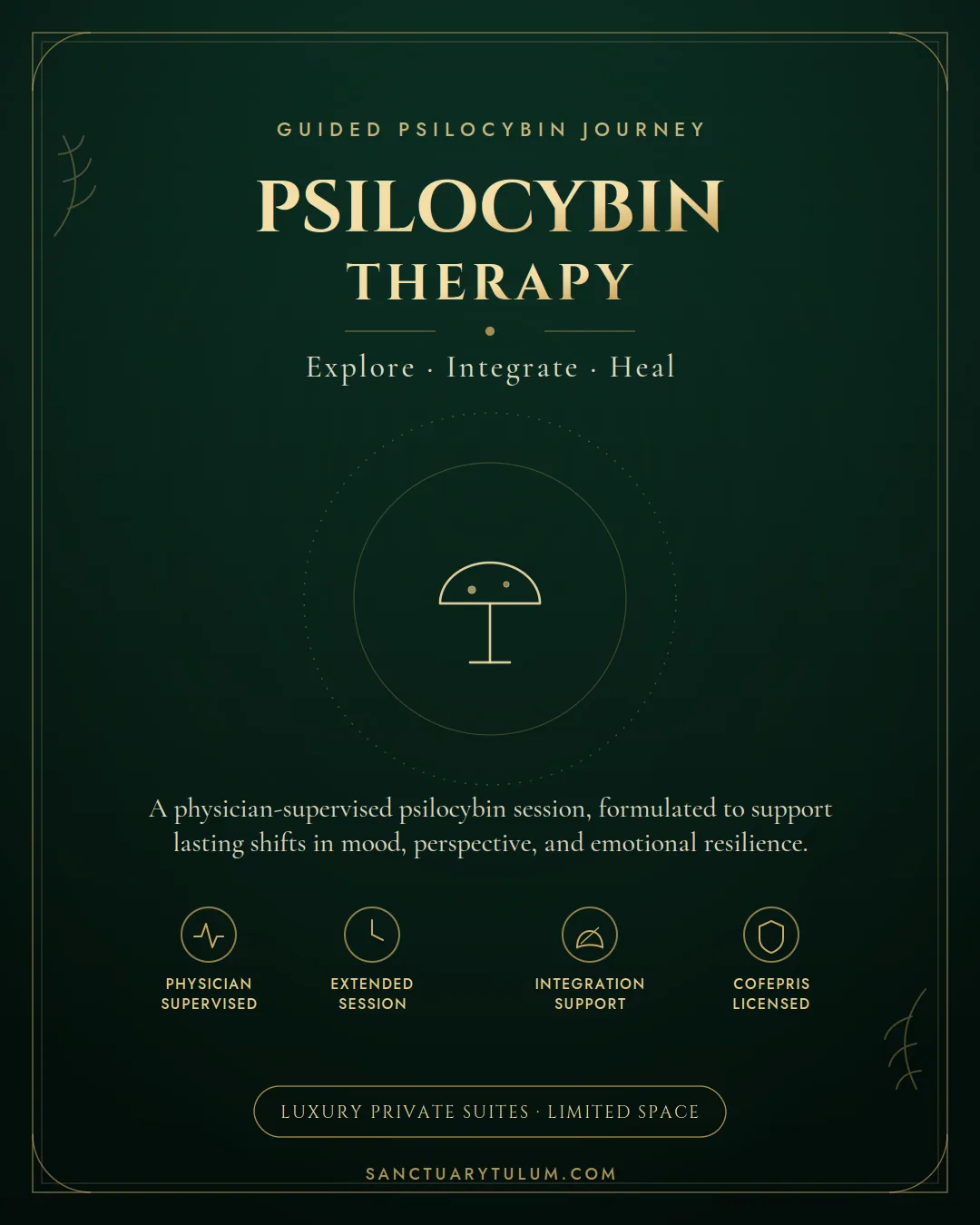
1. Ask which regulator licenses the facility, and verify it. "Licensed" alone means little without a named authority. Sanctuary Tulum is licensed by COFEPRIS, Mexico's federal health regulator, which is a claim you can check independently.
Regulatory oversight matters because it creates accountability beyond a program's own marketing claims. A facility answerable to a named health authority operates under external standards for things like sanitation, staffing, and recordkeeping, even if that authority does not specifically regulate a given medicine. A facility with no such oversight is, in effect, self-policing, and its claims about safety rest entirely on trust rather than any external check.
2. Ask what the license actually covers. A general facility license is different from specific authorization for the therapies being offered. Ask for specifics rather than accepting a general assurance.
This distinction trips up a lot of people evaluating programs, because a beautiful property with a valid business license can still be operating its clinical services without any specific oversight of those services. Ask the program to explain, in their own words, exactly what their license permits, and compare that explanation against what you can find independently from the regulator itself. A program that welcomes this scrutiny and can explain the distinction clearly has usually thought it through already; one that seems confused or evasive about the difference has probably not.
3. Ask about the legal status of the specific medicine in the country of operation. Legal status varies by jurisdiction and changes over time, so this should be addressed directly for whatever medicine is being offered.
A useful practice is to ask a program to walk you through, in plain language, how their license connects to the specific service you would be paying for. A general wellness or hospitality license is not the same thing as authorization tied to the therapies on offer, and a program that blurs this distinction in its marketing is not being fully transparent. It is reasonable to ask for the name of the license, the issuing body, and roughly when it was granted, and to independently look up whether that regulator exists and licenses facilities of that kind. This takes a few extra minutes, but it separates a program willing to be checked from one that is simply hoping you will not ask.
4–6: Medical Screening and Clinical Staffing
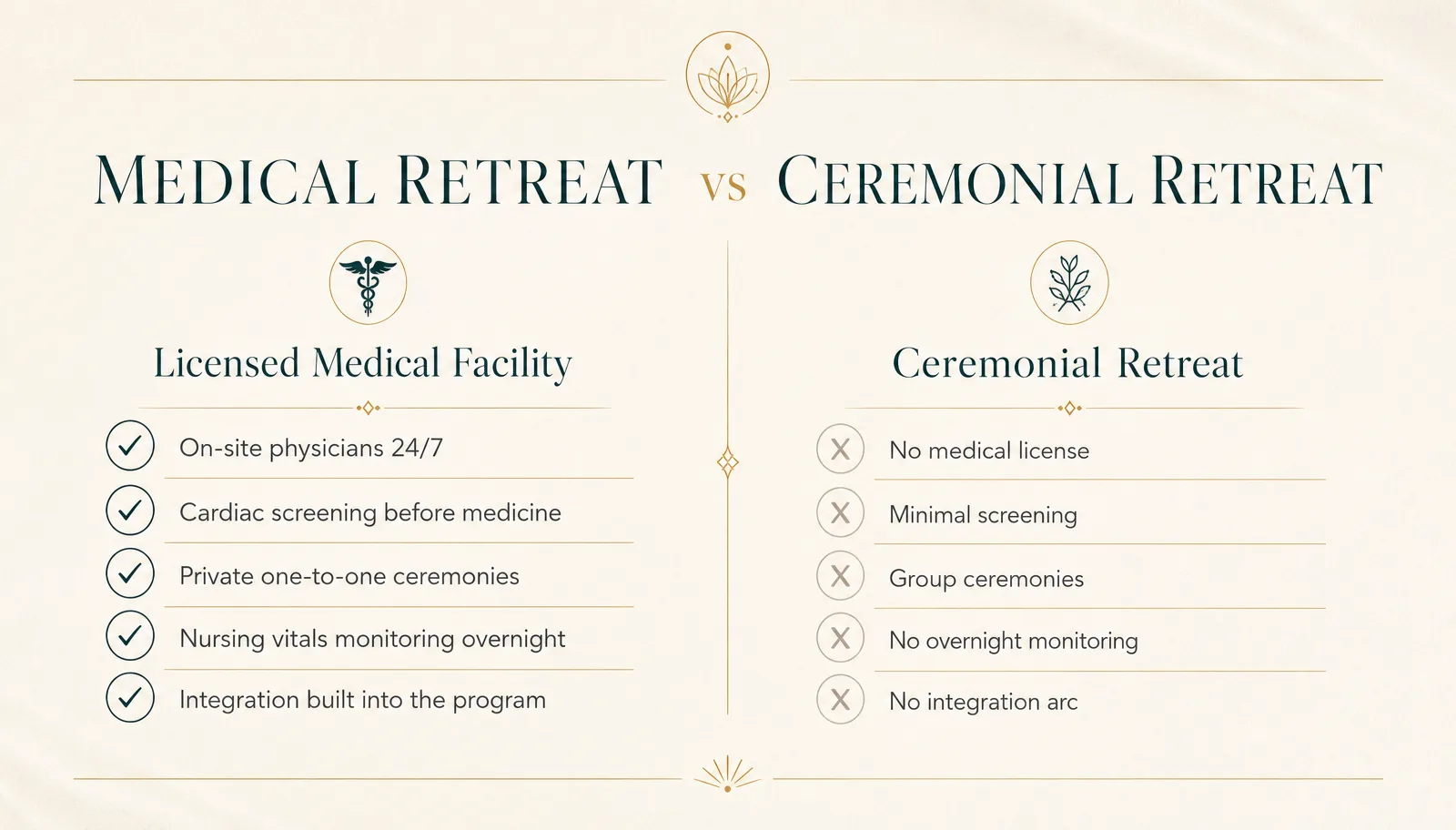
4. Ask how thorough the medical and psychiatric screening process is. A serious program screens for psychiatric history, cardiac considerations, and current medications, and has the authority to decline participants.
5. Ask about the qualifications of the clinical staff, by name and credential. Vague references to "our medical team" are less useful than specific credentials and roles you can verify.
It is reasonable to ask for the name and credentials of the physician who would be personally responsible for your care, not simply a general description of the medical team as a whole. A program willing to name this person, and to describe their specific involvement in your case, is treating your safety as an individual responsibility rather than a shared, diffuse one.
6. Ask about the staff-to-participant ratio during sessions. A program running large groups with minimal staff presence is a different safety profile from one built around close individual supervision.
7–8: Transparency and Honest Limits
7. Ask what the program declines to treat, and be wary of guarantees. A program willing to name its exclusions and avoid promising outcomes is more trustworthy than one that claims to help with everything. Language promising cures or guaranteed results is a warning sign in this field, not a credential.
8. Ask about emergency preparedness. Ask about on-site equipment, distance to the nearest hospital, and whether a physician is reachable throughout a session, not just during business hours. Our page on what makes a psychedelic facility safe outlines the standard we hold ourselves to.
Honest limits are just as telling as bold claims. A program that openly discusses who it declines to accept, and why, is generally more trustworthy than one that suggests everyone benefits equally. Ask directly what outcomes the program will and will not promise, and be skeptical of any answer that leans on emotionally compelling testimonials in place of a clear, honest account of risk and uncertainty. On emergency preparedness specifically, ask for a walkthrough of what actually happens if something goes wrong mid-session — who is called first, what equipment is on hand, and how far the nearest hospital-level facility actually is in travel time, not just distance on a map.
9–10: Aftercare and the Overall Experience
9. Ask what integration support looks like after the program ends. Ask how long it lasts, who provides it, and whether it is included in the price. A program that goes quiet after checkout has left out an important part of the process.
10. Ask for a full, itemized breakdown of what is included. Compare accommodation, meals, physician time, screening, sessions, and aftercare against price, rather than judging a program by its setting alone. Our overview of psilocybin therapy in Mexico is a useful point of comparison for one specific medicine.
Get the aftercare plan in writing before you enroll, not after. Ask how many follow-up sessions are included, over what period of time, and whether they happen by video call, phone, or in person. Ask what happens if you need support outside of the scheduled follow-ups — is there a way to reach someone, and how quickly do they typically respond? Price comparisons across programs are only meaningful once you know what is actually included on both sides; a lower headline price that excludes physician time or aftercare may end up costing more once you account for what you would need to arrange separately.
How to Actually Run This Conversation
Rather than sending these ten questions as a checklist over email, it is usually more revealing to ask them out loud on a call and pay attention to how confidently and specifically they are answered. A program that has genuinely built its clinical and safety infrastructure around careful practice will answer most of these without hesitation, often volunteering detail you did not ask for. A program that is mostly marketing will tend to answer in generalities, redirect toward the setting or amenities, or promise to "send more information" rather than answering directly. Neither reaction alone is proof of anything, but the pattern across several questions usually tells you something real.
It also helps to ask for names and documents where reasonable — the name of the medical director, the name of the licensing body, a written outline of what a typical week involves. A program confident in its own practices generally has no difficulty providing this. If you get pushback on requests that seem entirely reasonable given the seriousness of what you are considering, treat that as useful information in itself, and feel free to keep looking rather than assuming reluctance is simply a matter of privacy.
A Short Checklist to Bring Into Every Conversation
- A named, verifiable regulator and specific scope of licensing
- Clarity on the legal status of the specific medicine offered
- A thorough, documented medical and psychiatric screening process
- Named clinical staff with verifiable credentials
- A stated staff-to-participant ratio
- Honest disclosure of exclusions and no promise of guaranteed outcomes
- A rehearsed emergency plan reachable throughout every session
- A defined, itemized aftercare and integration plan
A program willing to answer each of these specifically has thought seriously about clinical responsibility. To discuss your own situation, explore our psychedelic retreat programs or reach our team through the contact page.
Educational content only. This article does not diagnose, treat, or replace care from a licensed physician, and nothing here is a promise of any particular outcome. Never start, stop, or change a prescribed medication without medical supervision.