People searching "ayahuasca bali" are usually asking two things at once: can I do this here, and can I do it safely? This short guide answers both plainly, then explains the supervised alternative most Bali seekers end up choosing.
The Legal Picture in Bali
Ayahuasca's active compound is DMT, controlled at the highest level in the United States under 21 U.S.C. § 812 and restricted under comparable statutes internationally. Indonesian Law No. 35 of 2009 treats Group I narcotics severely, and enforcement against foreigners is well documented. The legal exposure alone is disqualifying for most visitors. The narrow religious exemption recognized in Gonzales v. O Centro Espírita Beneficente União do Vegetal (2006) applies only to specific registered religious bodies — not to secular wellness ceremonies marketed to the public.
What the Local Scene Looks Like
Bali's Ubud and Canggu wellness corridors host discreet ceremonies, despite Indonesia holding among the harshest narcotics penalties in Asia. These gatherings vary enormously. Some facilitators are careful and experienced; others cannot tell you the alkaloid content of the brew they are pouring. Nobody in the room is licensed to manage a hypertensive episode, a seizure, or an acute psychiatric reaction.
- No pre-arrival medical screening for cardiac, seizure or psychiatric risk
- No physician on site and no written emergency protocol
- No MAOI interaction review against SSRIs, SNRIs or stimulants
- No verified potency or chain of custody for the brew
- Real legal exposure for participants and facilitators alike
The Supervised Alternative
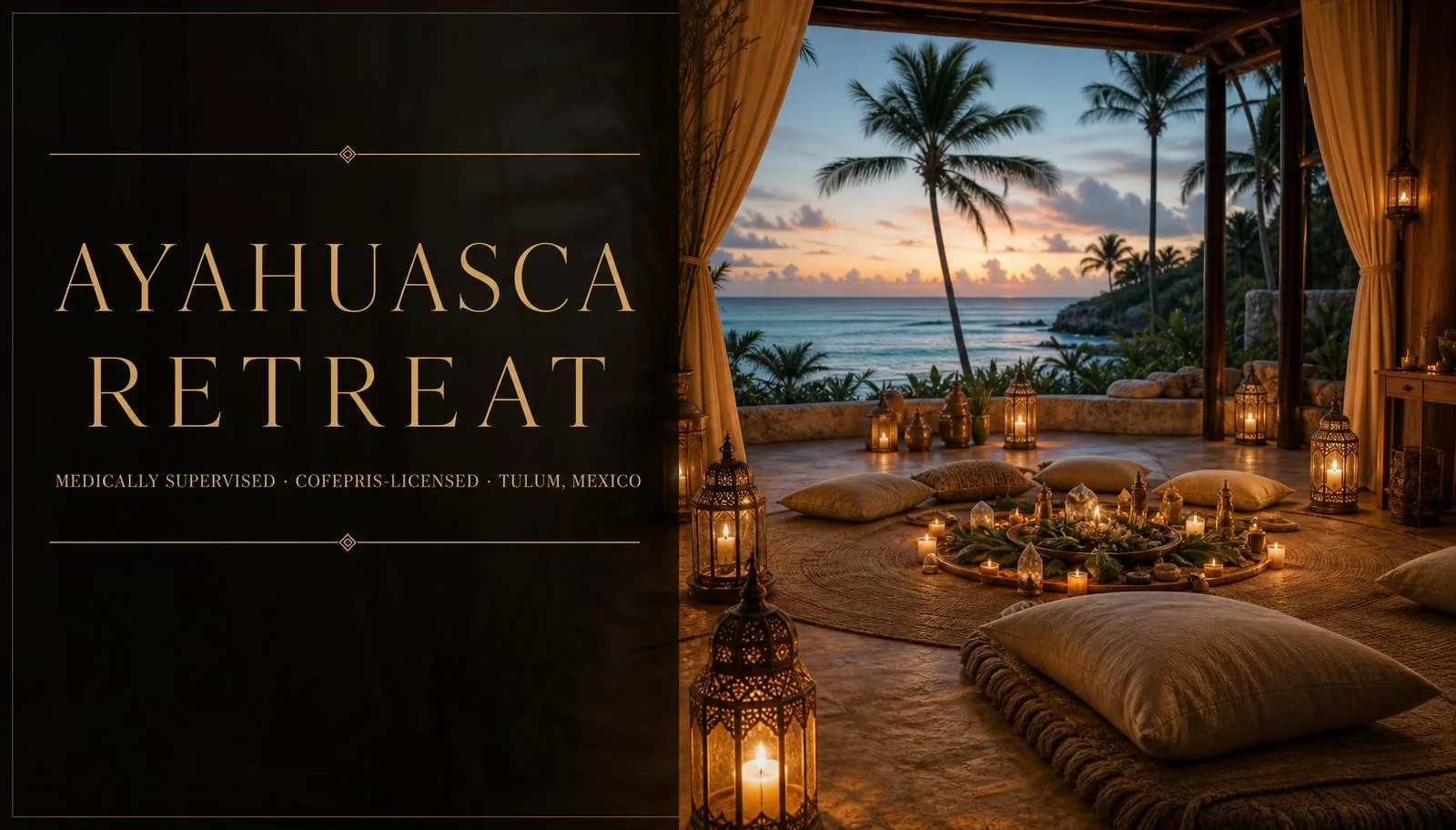
Sanctuary Tulum operates in Tulum, Mexico as a facility licensed by COFEPRIS, Mexico's federal health regulator. Every ayahuasca ceremony is one-on-one, physician-supervised, and preceded by medical screening and medication review. Where an underground circle offers atmosphere, a licensed facility offers accountability: named clinicians, documented protocols, and a plan for the night that does not go as expected.
Denpasar (DPS) to Cancún is a long multi-stop journey, typically 28 to 34 hours — a reason many travellers combine it with a longer stay. For most Bali seekers, the deciding factor is not distance — it is whether anyone in the room is qualified to intervene. Read more about the ayahuasca retreat structure, or start with our Sanctuary Tulum homepage.
Preparation Matters as Much as the Ceremony
Outcomes track preparation. A supervised program screens your medications weeks ahead, tapers where clinically appropriate under physician guidance, supports the nervous system before the first ceremony, and builds structured integration into the days after. That sequence is what a weekend circle in Bali cannot reproduce, regardless of intention.
Continue through this regional series with Ayahuasca Miami, or read the preceding guide on Ayahuasca Dubai. For a wider view, see ayahuasca retreats near me.
Why Bali Became a Destination for Plant Medicine Seekers
Bali's reputation as a wellness destination predates the current interest in ayahuasca specifically. Decades of yoga retreats, meditation centers and holistic healing tourism around Ubud built an infrastructure — and an audience — that some ceremony facilitators have since folded ayahuasca into, despite the plant having no traditional history on the island. Ayahuasca is native to the Amazon basin; its presence in Bali is a recent import layered onto an unrelated healing tradition, which is worth knowing before assuming any local lineage or regulatory tolerance.
This matters practically. A ceremony held in a converted villa outside Ubud carries none of the generations of accumulated safety practice that exists in parts of the Amazon, and none of the legal protection that a registered religious institution might have elsewhere. It is, functionally, an unregulated gathering serving a controlled substance, regardless of how the setting is styled.
What Bali Seekers Usually Get Wrong
The most common misconception is that discretion equals safety. A quiet villa, a respected-sounding facilitator and a beautiful setting say nothing about whether that person can recognize serotonin syndrome, manage a hypertensive crisis, or has ever reviewed a participant's cardiac history. Ayahuasca's MAOI content interacts dangerously with SSRIs, SNRIs, stimulants and some over-the-counter medications, and that interaction risk exists whether the ceremony is held in the Amazon, Ubud or anywhere else.
A second misconception is that a facilitator's years of "experience" substitute for medical training. Experience with ceremony logistics is not the same as the capacity to stabilize a person in a genuine medical emergency, and the honest answer from most underground facilitators, if asked directly, is that they would call for outside help — which in a remote Balinese setting can take a long time to arrive.
Medical & Educational Disclaimer
This page is educational and does not diagnose, treat or replace care from a licensed physician. Ayahuasca carries cardiovascular, psychiatric and drug-interaction risks and should only be considered within a medically supervised setting after a clinical evaluation.
References
- Controlled Substances Act, 21 U.S.C. § 812, Schedule I(c) (DMT).
- Gonzales v. O Centro Espírita Beneficente União do Vegetal, 546 U.S. 418 (2006).
- Callaway JC, et al. Pharmacokinetics of Hoasca alkaloids in healthy humans. J Ethnopharmacol. 1999;65(3):243-256.
- COFEPRIS — Mexico's federal health regulator.