Alcohol · Overview
Understanding Alcohol Abuse
A clear, non-judgemental overview of alcohol use disorder — how it is defined, what it does physically, and what treatment realistically involves.

"Alcohol abuse" is an older term. Current clinical practice uses alcohol use disorder, a diagnosis on a spectrum from mild to severe, based on criteria such as loss of control over intake, continued use despite consequences, tolerance and withdrawal. The National Institute on Alcohol Abuse and Alcoholism sets out those criteria and publishes NIAAA alcohol facts and statistics for anyone who wants the population-level picture.
The shift in language matters. It moves the conversation from character to condition, which is both more accurate and more useful, because shame is one of the strongest reasons people delay seeking help.
Severity is not the same as visible dysfunction. Many people meeting criteria for a moderate or severe disorder are working, parenting and functioning apparently well, which is precisely why the problem often runs for years before it is addressed.
What prolonged drinking does physically
The U.S. Centers for Disease Control and Prevention documents effects across nearly every organ system: liver, cardiovascular, gastrointestinal, immune and neurological, alongside sleep disruption and nutritional depletion. Some of this improves substantially with sustained abstinence; some does not, and the difference depends on duration and severity.
This is why treatment for a long-standing drinking pattern is not only psychological. Correcting nutritional deficiency, restoring sleep and rebuilding physical capacity are part of the clinical work, not extras.
Why withdrawal needs medical supervision
Alcohol sits with benzodiazepines and barbiturates in the small group of substances where unsupervised cessation can be dangerous. Severe withdrawal can involve seizures and delirium tremens, and risk is largely predicted by drinking history rather than by how well someone appears.
Anyone drinking heavily every day should speak to a clinician before stopping. The SAMHSA National Helpline is free, confidential and available around the clock for immediate direction.
Alcohol use disorder is a medical condition on a spectrum. Treating it as a character problem is both inaccurate and a barrier to care.
Sanctuary Tulum
Signs worth taking seriously
Not a diagnostic tool — a prompt to speak to a clinician.
Morning drinking
Or drinking to prevent shakes, sweating or anxiety.
Escalating tolerance
Needing more for the same effect over months or years.
Failed attempts
Repeated genuine efforts to cut down that have not held.
Sleep dependence
Being unable to sleep without alcohol.
Withdrawal symptoms
Tremor, nausea, agitation or sweating when not drinking.
Concealment
Hiding intake from people close to you.
What treatment involves
Treatment ranges from outpatient support and medication for alcohol use disorder — naltrexone, acamprosate and disulfiram are all established options — through to residential care. More intensive is not automatically better; the right level depends on withdrawal risk, physical health, previous attempts and what the home environment can support.
Where residential care is indicated, the sequence should be predictable: medical stabilisation, physical restoration, individual therapeutic work addressing what the drinking was doing, and a written plan for the return home.
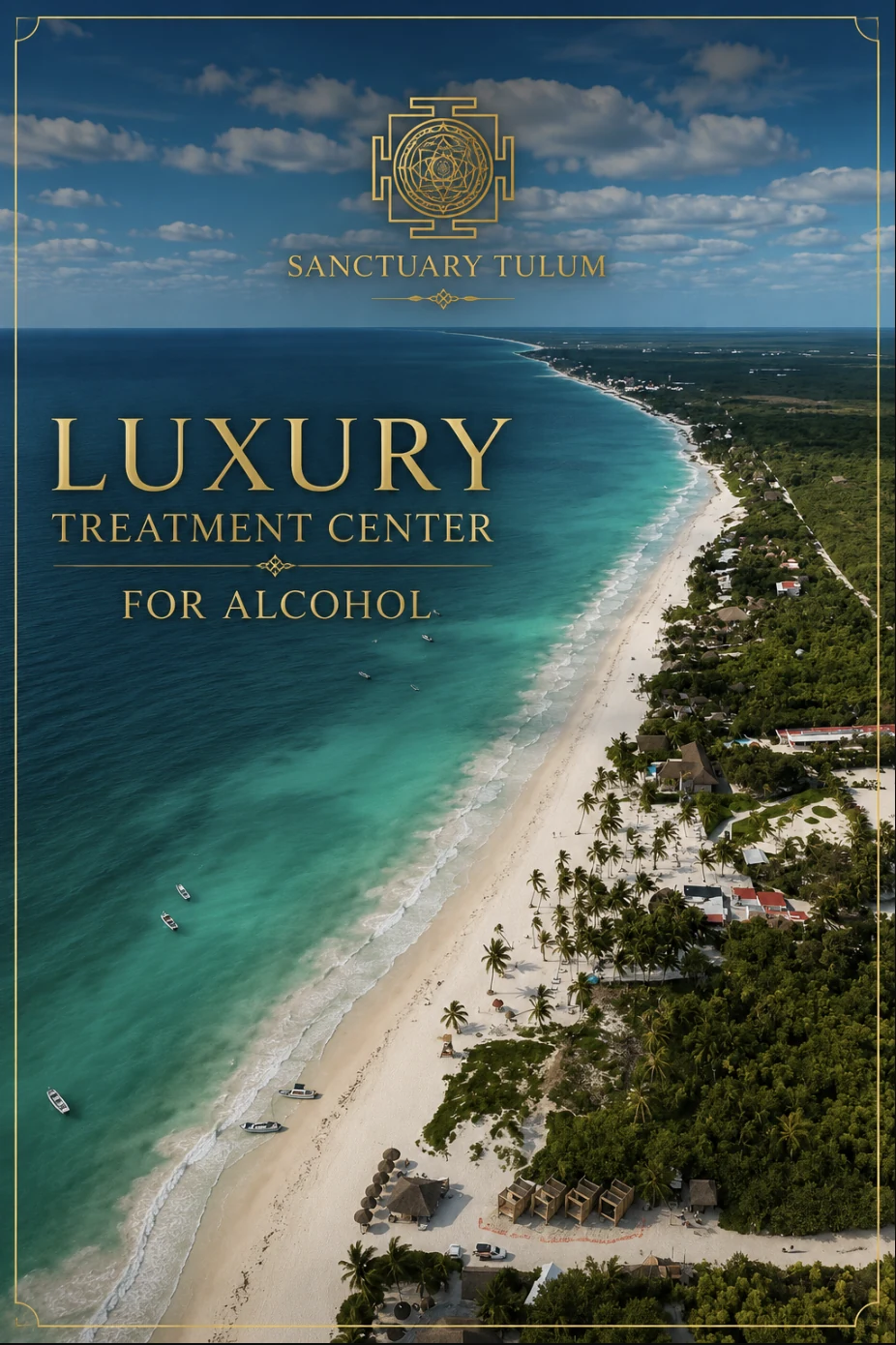
Sanctuary Tulum provides that as a licensed medical facility with physicians on site, one-to-one rather than group, since 2011. The luxury alcohol rehab program page sets out the program in detail, and our luxury alcohol treatment center page covers the facility, medical oversight and stay structure.
Where alcohol rarely travels alone
Alcohol frequently accompanies other conditions — anxiety, depression, PTSD, insomnia, and prescription sedative use. Addressing the drinking alone, without the rest, is a common reason recovery does not hold. See issues we treat, PTSD treatment and benzodiazepine withdrawal for those threads.
If you are researching options for yourself or someone else, our luxury mental health facility overview explains the wider model, and medical detox center covers the medical phase specifically. This page is educational and is not a diagnosis or a substitute for assessment by a physician.
If someone you love is drinking
The most common question families ask is what to do when the person drinking does not accept there is a problem. There is no reliable script, but a few things are more useful than others.
Specific observations work better than labels. Describing what you saw on a particular evening is harder to dismiss than a diagnosis you are not qualified to make. Ultimatums are occasionally necessary but should only be issued if you are prepared to follow through, because an unenforced one costs credibility you may need later.
It also helps to have a concrete option ready. "You should get help" is easy to defer; "there is an assessment available on Thursday and I will come with you" is harder. Removing the logistical friction is often what converts intention into action.
Finally, look after the people around the drinking. Partners and adult children frequently arrive at treatment more depleted than the guest, and their own support matters both for their sake and for the stability of the household the guest returns to.
Medication options in more detail
Three medications carry FDA approval specifically for alcohol use disorder: naltrexone, which blunts the rewarding effects of drinking; acamprosate, which helps stabilise brain chemistry disrupted by long-term alcohol use during early abstinence; and disulfiram, which creates an aversive physical reaction if alcohol is consumed. None is a stand-alone solution — each works best paired with structured psychological support and, where indicated, medical monitoring.
Choice between them depends on goals, liver function, other medications and whether total abstinence or reduced drinking is the immediate target. A physician experienced in addiction medicine should make this decision jointly with the patient rather than defaulting to a single option.
What a realistic timeline looks like
Acute withdrawal symptoms typically peak within the first 24 to 72 hours and substantially resolve within a week to ten days for most people, though this varies with drinking history. Physical recovery of sleep architecture, nutritional status and energy usually continues for several weeks beyond that. Psychological work — addressing what the drinking was managing, and building a life that does not require it — takes considerably longer, which is why aftercare and continuing support matter as much as the initial stabilisation period.
Important note
This page is educational. It does not diagnose, and it does not replace assessment by a qualified physician. If you are drinking heavily every day, do not stop abruptly without medical advice — alcohol withdrawal can be dangerous, and the safest route is a supervised taper or medically managed detox.