Search "The Light System benefits" and you get two extremes: pages promising cellular transformation, and pages dismissing the whole category as pseudoscience. Neither is useful if you are actually trying to decide whether a light-based wellness technology deserves your attention. The more productive question is narrower: what does The Light System™ measure, what has photobiomodulation research established independently, and where exactly does the gap between those two things sit?
What TLS Is — and Isn't
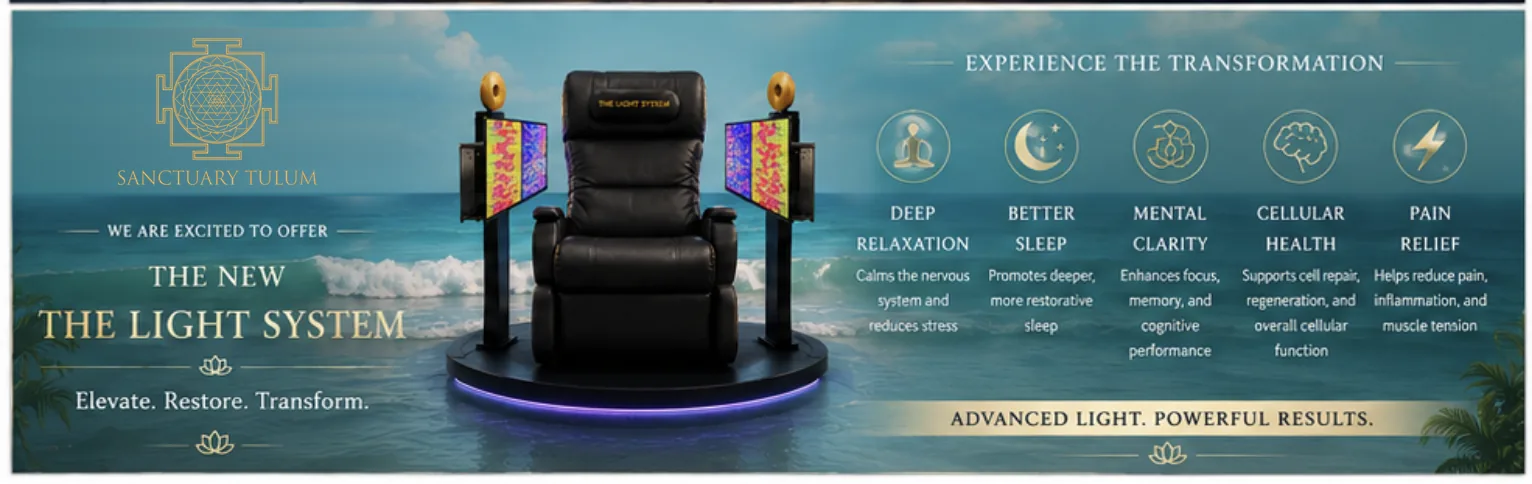
The Light System™, usually shortened to TLS, is a proprietary light-based wellness technology. It is not a conventional red light panel with a published wavelength and irradiance specification. It is built around engineered light environments and proprietary programming, delivered through devices the company calls the TLS Chair, the TLS Cube and a Supercharged Medallion. Its research orientation is unusual: instead of asking participants to rate symptoms, it attempts to measure physical changes in bioelectrical activity and cellular conductivity.
That distinction matters more than any single claim. Conventional red light therapy is studied scientifically as photobiomodulation (PBM), which is defined entirely by parameters — wavelength, irradiance, fluence, session duration, treatment frequency. TLS incorporates concepts that go beyond those parameters. Published PBM evidence therefore provides context for TLS. It does not validate it.
The Benefits People Actually Explore
Within a wellness framework — not a medical one — five categories come up repeatedly, and each deserves a different level of confidence.
Relaxation and stress management. This is the most defensible use, because it depends least on contested mechanisms. A dedicated light environment is a controlled sensory setting: low stimulation, a defined duration, nothing to do but be still. TLS's own materials include a 2025 Bio-Well/GDV report describing changes in stress and energy-related readings after a three-hour session. Those are preliminary observational measurements, not randomized comparisons against a validated clinical endpoint.
Sleep support. Early signals exist in the wider literature. A systematic review and meta-analysis of photobiomodulation and sleep quality pooled five randomized controlled trials with 240 participants and reported improved Pittsburgh Sleep Quality Index scores versus sham, while explicitly flagging limited precision from a small evidence base.

Physical recovery. This is where PBM research is strongest. A 2025 umbrella review of 15 meta-analyses, 204 randomized controlled trials and more than 9,000 participants found significant effects for 12 of 35 outcomes, including pain-related and disability measures — with certainty of evidence ranging from very low to moderate and no outcome reaching high certainty.
Mental clarity and cognitive wellness. A 2025 systematic review and meta-analysis of photobiomodulation and cognitive function reported potential benefits on specific cognitive measures while stressing protocol heterogeneity. The reasonable objective is focus, mental recovery and reduced subjective fatigue — not treatment of a neurological condition.
Cellular wellness. This is TLS's own territory, and the honest framing is the most cautious one: the company reports measurable bioelectrical changes whose health significance is still under investigation.
The Numbers, and What They Don't Mean
TLS's research page reports figures including up to 80% increased cellular conductivity following TLS Chair exposure and a 283% increase in bioelectrical activity after extended TLS Cube exposure. Attempting objective measurement is genuinely to the technology's credit. But a change in conductivity does not by itself demonstrate improved health, repaired DNA, strengthened immunity or reversed disease. Those are separate questions requiring separate human trials with control conditions and pre-declared endpoints.
How to Evaluate Any Light Claim
Five questions settle most arguments. Which wavelength? What dose, in joules per square centimetre? Delivered how, and to which tissue? Compared against what control? And measured with what endpoint — a laboratory reading, or a validated clinical outcome? A claim that cannot answer those is marketing, however large the percentage attached to it.
Where This Fits With Safety and Mechanism
Benefit claims cannot be evaluated in isolation from safety and mechanism, so it is worth reading this alongside our review of light therapy safety and contraindications and the broader science of photobiomodulation. Together the three pieces give a fuller picture than any single claim: what is measured, how confident the measurement is, and who should check with a physician before trying it.
What Independent Verification Would Look Like
The gap between a manufacturer's internal measurements and an independently verified clinical benefit is closed by a specific sequence of steps, not by repetition of the original figure. First, a pre-registered protocol that states the primary outcome before data collection begins. Second, a sham or placebo-controlled arm, because light exposure is difficult to blind and expectation effects are real. Third, blinded outcome assessment. Fourth, a sample size large enough to detect a clinically meaningful difference, not just a statistically significant one. Fifth, replication by investigators without a financial stake in the result. Bioelectrical and conductivity readings can be a legitimate first step in that sequence — they are not a substitute for the steps that follow.
Setting Realistic Expectations
A reasonable way to approach any light-based wellness technology, proprietary or conventional, is to treat it as one input in a broader plan rather than a stand-alone solution. That framing is consistent with what the published photobiomodulation literature actually supports: modest, condition-specific effects, mostly rated low to moderate certainty, useful as an adjunct alongside — never instead of — medical evaluation and treatment for anything persistent or severe.
For the full picture — mechanisms, safety consensus, sleep and pain evidence, and the complete reference list — read our Light System™ and photobiomodulation research guide, or compare it with photobiomodulation versus TLS.
How to Evaluate a Benefit Claim
Every claim in this space belongs to one of three tiers, and almost all confusion comes from mixing them. A laboratory measurement shows that something changed in a controlled setup. A mechanistic explanation gives a reason to expect change. A clinical outcome shows that a person felt or functioned differently. Only the third tier answers the question buyers are actually asking, and it is the tier with the least data behind proprietary light systems.
The practical test is short. Was there a sham or control group, given how obvious light exposure is to a participant? Were the assessors blinded? Was the reported result the outcome the study set out to measure, or one selected afterwards from many? Was the effect large enough to matter to a person rather than merely large enough to reach statistical significance in a small sample? A claim that clears all four deserves serious attention.
Applying that filter to the wider photobiomodulation literature produces a modest but genuine picture: real effects in specific conditions, mostly rated low to moderate certainty, generally as an adjunct rather than a standalone treatment. Applying it to system-specific conductivity and bioelectrical figures produces something different — interesting measurements awaiting independent, protocol-transparent clinical trials. Both statements can be true at once, and holding both is what an honest assessment looks like.
Educational information only. Not medical advice, not a diagnosis, and not an offer of The Light System™ as a service at Sanctuary Tulum.