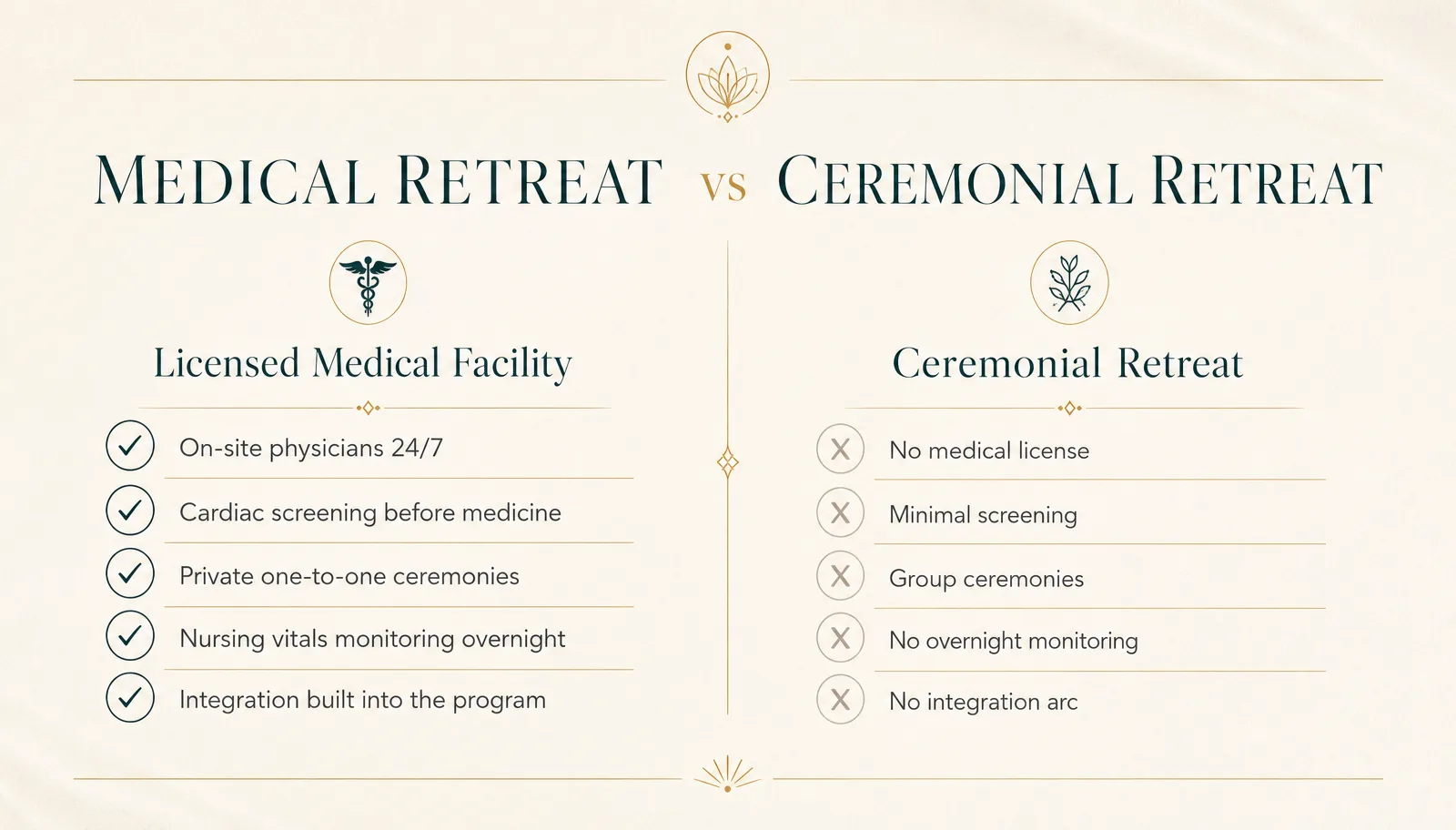
The short answer: real psychedelic therapy preparation starts with medical and psychiatric screening, includes a careful review of your current medications by a physician, and addresses your mindset and the physical setting well before any session takes place. This article is educational and is not medical advice; whether any specific medicine or program is right for you is a decision to make with a qualified physician.
1–2: Screening Comes Before Everything Else
1. Preparation begins with medical and psychiatric screening, not scheduling. Ask what a program's intake actually covers — personal and family psychiatric history, cardiac considerations, and current medications should all be part of it before a date is ever set.
Ask, too, how long the screening process typically takes from start to finish, and whether a program has ever declined an applicant. A program unable to name any instance of turning someone away has likely not been screening as carefully as it claims.
2. Screening should be specific to the medicine involved. Different medicines carry different physiological profiles and risks, so a program should be able to explain how screening differs depending on what you are preparing for, whether that is a plant medicine retreat or another modality.
A useful way to test whether screening is being taken seriously is to ask how long the process itself takes, from your first application to a final decision. Programs that decide within minutes of a short form are generally not doing the kind of layered review that catches psychiatric or cardiac concerns. A more thorough process usually involves a written intake, a follow-up conversation with someone clinically qualified, and, where relevant, a request for records or a note from your own physician. Ask directly who has the authority to say no, and what has actually led them to decline someone in the past — a program that cannot describe any past exclusions has likely not been screening carefully enough to find one.
3–4: Medication Review Belongs to Your Physician
3. A full medication review by a physician is not optional. Serotonergic medications and several other classes can interact with certain medicines, and a program should ask about your complete list, not just the obvious ones.
4. Never stop or adjust a prescribed medication without medical supervision. If a change is genuinely necessary, it should be planned and supervised by the physician who prescribed the medication, on a timeline that physician sets — never abruptly and never on a retreat team's instruction alone.
In practice, a thorough medication review means going through your full list line by line, including anything you take occasionally, any supplements, and anything prescribed by a different doctor than the one managing your primary condition. Ask specifically how the program's clinical staff communicate with your prescribing physician when a question comes up — do they request a written note, hold a call, or simply take your word for it? A program that treats this step as a formality, rather than an active conversation with the people who actually manage your care, is skipping one of the more consequential parts of preparation. If you take a medication with any known interaction profile, ask the program to explain, specifically, what that interaction means for you rather than offering a general disclaimer.

5–6: Mindset and Intention
5. Your mental state going in genuinely matters. Preparation conversations about intentions, expectations, and current stress levels are not a formality — they shape how an experience is likely to unfold and how well you can process it afterward.
6. Realistic expectations matter more than a fixed idea of what should happen. Accounts of psychedelic experiences vary considerably between individuals, so preparation should include an honest conversation about that variability rather than a promise of a particular outcome.
A good preparation conversation asks open questions rather than leading ones — what are you hoping to understand or work through, what has already been difficult about the period of life you are in, and what worries you about the experience itself. A vague conversation skips straight to logistics without ever asking what you actually want from the process. It also helps to talk plainly about difficult moments during a session, which are a normal and sometimes meaningful part of the experience rather than something to be avoided entirely. A program that only describes pleasant possibilities is not preparing you for the full range of what people report, and that gap between expectation and reality can itself be destabilizing if it is not addressed beforehand.

7–8: The Setting Itself
7. The physical environment should be deliberately designed, not incidental. Ask about the setting where a session will take place, who is present, and how the space accounts for the specific physiological effects of the medicine being used.
8. Trained monitoring should continue through the session and into integration. Preparation does not end when a session begins. Ask what support looks like immediately afterward and in the days that follow, since that is often where the value of preparation becomes clear.
Ask what a typical day looks like around the session itself — what time you are asked to stop eating, how the space is arranged, what music or lack of it is used, and whether you have any say in those choices. Ask, too, how staff are trained to respond if a participant becomes physically unwell or emotionally overwhelmed, and what the escalation plan is if something requires more than the staff present can manage on-site. On integration, get specific: how many follow-up conversations are included, over what period, and with whom? A single email a week later is not the same as a structured integration process with a named point of contact, and the difference matters more once the session itself is behind you.
What Preparation Looks Like Week by Week
It can help to picture preparation as a sequence rather than a single meeting. In the earliest stage, a program should collect your medical and psychiatric history in writing, along with a full medication list, and use that to decide whether you are an appropriate candidate at all. In the weeks that follow, a good program schedules at least one substantive conversation focused on your mindset, intentions, and any concerns, rather than folding this into a logistics call about arrival times. Closer to the session, expect practical guidance on diet, sleep, and anything else the program asks you to adjust in the days beforehand, along with a clear description of what the day of the session itself will involve from start to finish.
It is reasonable to ask for this timeline in writing before you commit. A program that can lay out what happens at each stage, and who you will speak with at each one, has clearly thought through preparation as a process rather than a single checkbox. If a program cannot describe this sequence with any specificity — if every question is answered with "we'll cover that when you arrive" — that is worth treating as a signal, not a minor gap. Preparation done well takes real time, and a program unwilling to invest that time before you arrive is unlikely to invest it once you are on-site either.
A Short Checklist Before You Begin
- Screening tailored to the specific medicine, completed well in advance
- A complete medication review conducted by a physician
- No instruction to stop or change medication without your prescriber's involvement
- A genuine conversation about mindset and expectations
- A deliberately designed physical setting with trained staff present
- A stated plan for support immediately after and in the days following
If you are weighing which medicine or program fits your situation, our guide to preparing for ayahuasca and our explanation of how ibogaine treatment works are useful starting points, or reach our team through the contact page.
Educational content only. This article does not diagnose, treat, or replace care from a licensed physician, and nothing here is a promise of any particular outcome. Never start, stop, or change a prescribed medication without medical supervision.
To see how this fits into a complete program, explore our luxury psychedelic retreats.