Ozone therapy has been used safely in European medicine for over fifty years, but not all ozone protocols are created equal. The most common form — Major Autohemotherapy (MAH) — treats roughly 200 ml of blood at a time. EBOO therapy treats your entire blood volume, continuously, for nearly an hour.
Side-by-Side Comparison
Volume Treated
Traditional MAH: ~200 ml. EBOO: 1,500–2,000 ml — your full circulating blood, processed multiple times.
Therapeutic Exposure
EBOO delivers 50–100× the ozone-blood interaction of a standard MAH session.
Filtration
EBOO uses a medical-grade membrane that mechanically removes lipid peroxides and biofilm fragments. MAH does not filter.
Clinical Result
Guests commonly describe MAH as mildly energizing and EBOO as more noticeable. Neither is FDA-approved or clinically proven for chronic illness, mold exposure, or methylation support — these are investigational, adjunctive therapies, and outcomes are not guaranteed.
When MAH Is Still Useful

Traditional ozone IV is excellent for maintenance, mild fatigue, and immune tune-ups. At Sanctuary Tulum, we frequently use MAH between EBOO sessions to keep the antioxidant cascade activated.
For clients dealing with depression, PTSD, sluggish methylation, or post-viral fatigue, EBOO is the gold standard.
EBOO is one component of the broader detox and residential care at Sanctuary Tulum. Learn more about our medically supervised luxury detox and full luxury residential rehab.
Clinical Screening Before Any Session
Every prospective guest at Sanctuary Tulum completes a confidential clinical intake and full medical screening before any EBOO vs traditional ozone session is scheduled. The intake reviews cardiovascular status, kidney and liver function, current medications, coagulation history, and any recent infections. Guests currently prescribed anticoagulants, immunosuppressants, or SSRIs are reviewed on a case-by-case basis with their treating physician before a session is planned.1 The team never advises anyone to discontinue prescribed medication on their own.
Who Is Screened Out
Both protocols are declined for guests with active bleeding disorders, uncontrolled anticoagulation, or unstable platelet counts. G6PD deficiency is screened for specifically before either EBOO or MAH, since ozone exposure can trigger hemolysis in G6PD-deficient red blood cells. Pregnancy, active systemic infection, and decompensated cardiac or pulmonary disease rule out both protocols. These exclusions are set from labs and history submitted before travel, not decided in the treatment room.
On-Site Medical Oversight
A physician is on site during every session, supported by registered nurses and IV therapy specialists. Vital signs — blood pressure, oxygen saturation, and cardiac rhythm where clinically indicated — are monitored continuously across the session, with emergency medications and airway equipment on hand.2 Credentialing detail lives on the Medical Review Board page, and a broader description of the safety approach is available on the safest psychedelic facility page. Guests are encouraged to review both before deciding whether the program fits them.
How This Fits the Wider Program
EBOO extracorporeal ozone sits inside a broader biological and neurological protocol at Sanctuary Tulum rather than being offered as a standalone service. That means medical stabilization first, then a physician-scheduled combination of NAD+ IV therapy, HBOT, targeted nutrition, and — where clinically appropriate — medically supervised medically supervised ibogaine treatment, private ayahuasca ceremonies, or psilocybin therapy. The full framework is described in the proprietary Pouyan Method™. The exact sequence is individual and set by the medical team after intake — one guest's plan rarely looks identical to another's.
Honest Limits of the Evidence
Published research on EBOO vs traditional ozone for the indications discussed here is still evolving. Therapeutic apheresis is well established for specific autoimmune and neurologic conditions in mainstream medicine,3 and ozone therapies have a longer clinical history in parts of Europe than in the United States. For broader wellness applications the evidence base is smaller and largely observational. Sanctuary Tulum does not present these protocols as cures or guaranteed treatments, and no diagnostic or prognostic claim is made outside a clinical evaluation.
Choosing Between Protocols: A Practical Framework
Guests frequently ask which protocol they should request before ever setting foot in the clinic. The honest answer is that this decision belongs to the medical team after reviewing labs and history, not to a marketing page — but there are useful heuristics. Someone coming in for a single-day reset, jet-lag recovery, or a light immune tune-up rarely needs the full EBOO circuit; a course of MAH sessions paired with IV nutrients is usually sufficient and considerably gentler on the schedule. Someone arriving with a documented history of mold exposure, Long COVID, sluggish methylation, or a plan to undergo plant-medicine work later in the stay is a more typical candidate for EBOO, precisely because the larger treated blood volume and closed filtration loop are designed to address a heavier circulating toxic and inflammatory load.
Cost and time are real variables too. A single EBOO session generally runs longer than a single MAH session and requires more specialized single-use tubing, which is part of why it carries a higher line-item cost. But because EBOO delivers dramatically more ozone-blood contact per session, guests often need fewer total sessions to reach a given clinical goal than they would with repeated MAH visits — so the total course of care is not simply "EBOO costs more." The medical team walks through this math individually rather than defaulting everyone to the more intensive protocol.
What a Typical EBOO Session Involves
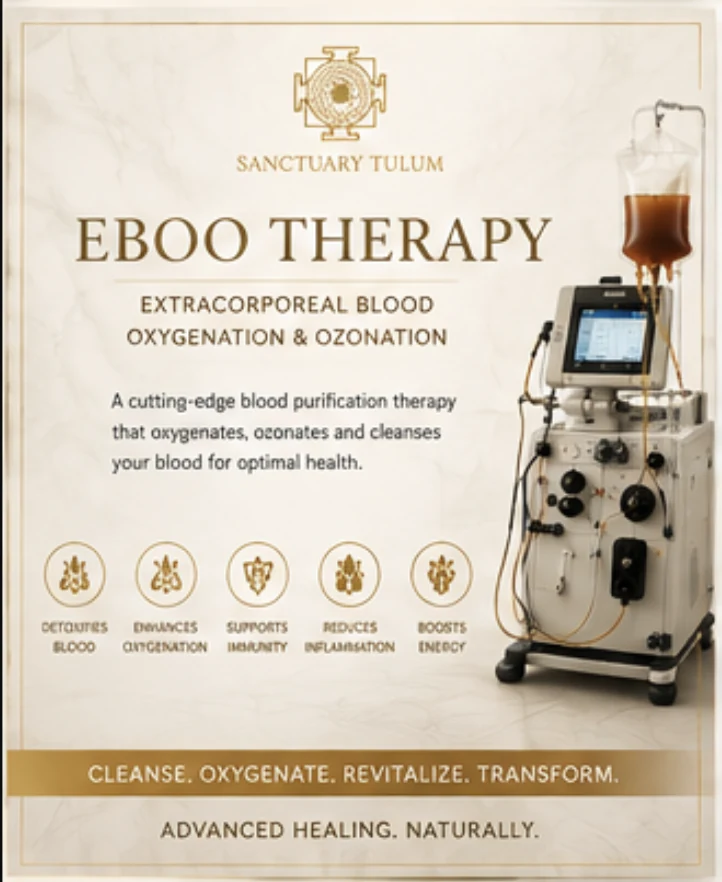
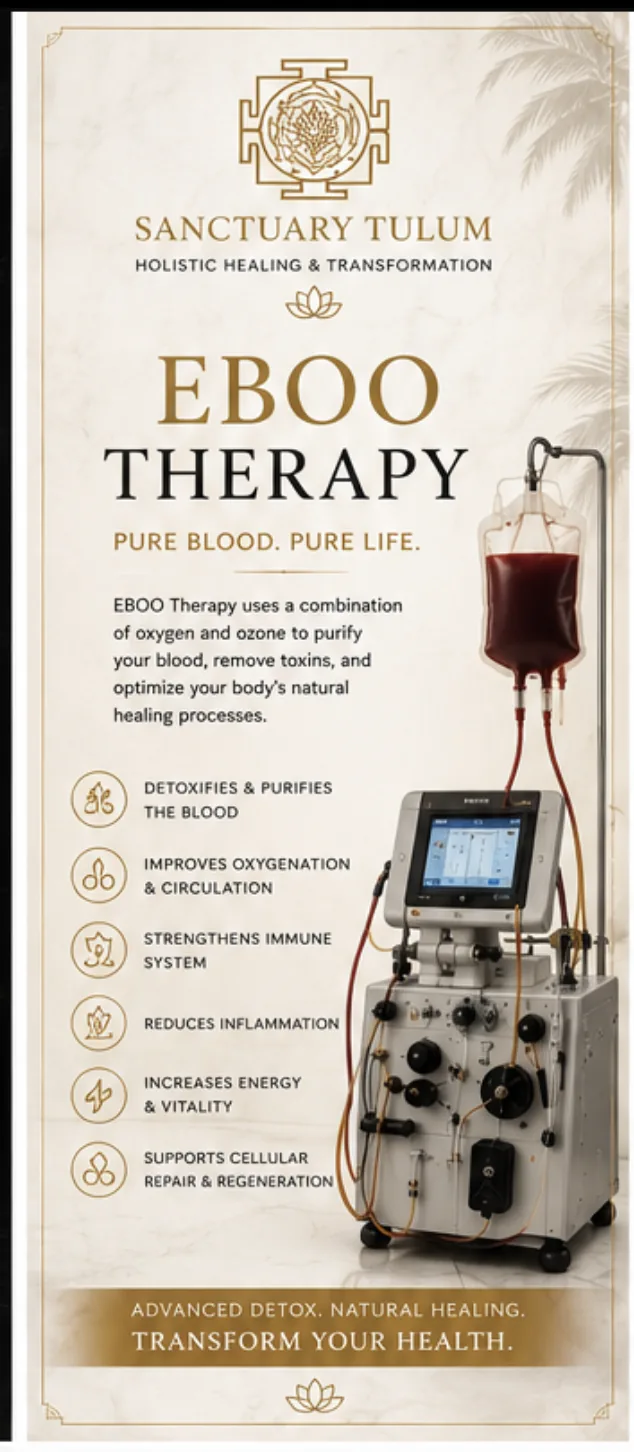
A standard EBOO session begins with two IV access points — one draws blood, the other returns it — connected through a sterile, single-use extracorporeal circuit. Blood passes through a specialized dialysis-style filter where it is exposed to a precisely calibrated ozone-oxygen mixture, then filtered to remove lipid peroxides and cellular debris before being returned to circulation. The full session typically runs 45 to 90 minutes, during which vital signs are monitored continuously. Most guests describe the sensation as unremarkable — mild warmth or lightheadedness at most — with the more noticeable effects, increased mental clarity and energy, emerging in the hours and days afterward rather than during the session itself.
A traditional MAH session is considerably shorter, often 20 to 30 minutes, using a single IV line to draw a smaller blood volume, mix it with ozone in a sealed bag, and reinfuse it. Because the treated volume is a fraction of total circulating blood, the systemic effect per session is smaller, which is why MAH is typically used more frequently as a maintenance therapy rather than a primary intervention for significant toxic burden.
Why This Comparison Matters for Pre-Ceremony Preparation
Guests preparing for ibogaine, ayahuasca, or psilocybin work often ask whether ozone therapy should precede plant medicine. The rationale offered by the medical team is that a lower systemic inflammatory and toxic load may make the body's response to subsequent modalities more predictable, and that a cleaner cardiovascular and hepatic baseline supports safer dosing decisions. This is discussed as a supportive consideration within an individualized plan, not a guaranteed prerequisite or a claim that ozone therapy changes the psychological content of a ceremony.
Integration and Aftercare
A stay is only useful if it holds. Every program ends with a written integration and aftercare plan — continued check-ins with the integration team, referral to trauma-informed practitioners at home when appropriate, and lifestyle protocols covering nutrition, sleep, movement, and nervous-system regulation. Guests are encouraged to maintain their existing relationship with a treating physician and to return for booster sessions when a specific life transition benefits from it.
References
- Elvis AM, Ekta JS. "Ozone therapy: A clinical review." J Nat Sci Biol Med. 2011;2(1):66-70.
- COFEPRIS — Mexico's federal health regulator.
- Bin-Alamer O, et al. "Hyperbaric oxygen therapy as a neuromodulatory technique: a review of the recent evidence." Front Neurol. 2024;15:1450134.
- National Institute on Drug Abuse. Treatment approaches for drug addiction.
- National Institute on Alcohol Abuse and Alcoholism. Understanding alcohol use disorder.
Neither EBOO nor MAH is FDA-approved. Both are offered as investigational, adjunctive therapies, not proven treatments for any diagnosis.