Hyperbaric oxygen therapy (HBOT) has become a common addition to serious addiction recovery protocols, and the question guests most often ask is direct: does it actually help with post-acute withdrawal, or is it borrowed credibility from a different field? The honest answer is adjunctive and specific — HBOT's strongest clinical evidence comes from traumatic brain injury and fibromyalgia populations, not from withdrawal-specific trials, and it should be understood and offered on that basis rather than oversold as a dedicated withdrawal treatment.
What Post-Acute Withdrawal Syndrome Actually Is
Post-acute withdrawal syndrome (PAWS) describes the weeks-to-months period of cognitive fog, mood dysregulation, sleep disruption, and anhedonia that can follow the resolution of acute physical withdrawal. It reflects the slow biological readjustment of a nervous system that has been chronically adapted to a substance or medication. A systematic review of PAWS following antidepressant discontinuation found that this post-acute pattern is real, clinically distinct from relapse of the original condition, and can persist well beyond the acute discontinuation period in a meaningful subset of patients (Rennwald et al., 2025). Opioid, alcohol, and benzodiazepine withdrawal each carry their own distinct receptor and circuit-level pictures, which is why PAWS should be understood as a family of related syndromes rather than one uniform condition.
Why HBOT Is Discussed in This Context
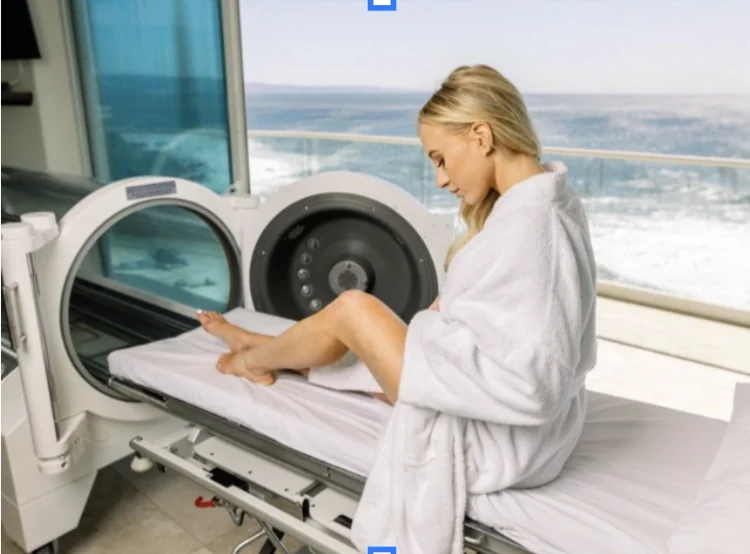
Hyperbaric oxygen therapy delivers 100% oxygen at increased atmospheric pressure inside a sealed chamber, which raises dissolved oxygen in plasma well above what erythrocyte-bound oxygen alone can deliver. A broader review of HBOT as a neuromodulatory technique summarizes proposed downstream mechanisms — including effects on neuroinflammation, angiogenesis, and markers associated with neuroplasticity — that are mechanistically plausible for other conditions involving altered brain function (Bin-Alamer et al., 2024). This mechanistic plausibility is the basis for its use as an adjunct in recovery settings; it is not the same as a completed trial in withdrawal populations.
What the Evidence Actually Shows — and Where the Limits Are
The clearest randomized evidence for HBOT comes from two specific populations. A randomized, prospective trial found that HBOT improved post-concussion syndrome symptoms years after mild traumatic brain injury (Boussi-Gross et al., 2013). A later randomized trial compared HBOT against pharmacological intervention in adults with fibromyalgia related to childhood sexual abuse and reported favorable outcomes for the HBOT arm (Boussi-Gross et al., 2024). Both are legitimate, peer-reviewed trials — and neither was conducted in patients undergoing withdrawal from opioids, alcohol, or benzodiazepines.
The overlap that makes HBOT relevant to PAWS is mechanistic rather than direct: mild TBI and fibromyalgia both involve altered cerebral function and central sensitization, which share some biological territory with the cognitive and mood symptoms of post-acute withdrawal. That overlap is a reasonable basis for offering HBOT as an adjunct. It is not the same as evidence that HBOT resolves withdrawal symptoms specifically, and guests should understand that distinction before treatment decisions are made.
How HBOT Fits Into the Sanctuary Tulum Protocol
Guests in acute and post-acute phases at Sanctuary Tulum who are appropriate candidates typically receive HBOT sessions as one part of a broader program that may also include NAD+ IV therapy, Brain Repair IV drips, stem cell therapy, and red light therapy. HBOT is positioned deliberately as adjunctive within this stack — supporting the broader clinical and psychological work of recovery rather than functioning as a stand-alone intervention or a replacement for medically supervised detox and, where indicated, medication-assisted treatment.
Who HBOT Is — and Is Not — Appropriate For
HBOT screening excludes guests with an untreated pneumothorax, certain forms of significant lung disease, and uncontrolled seizure disorders, among other contraindications identified during medical intake. It is generally well tolerated in guests who clear this screening, but tolerability is not the same as proof of benefit for a specific condition — which is why it is offered as one component of care rather than marketed as a dedicated withdrawal cure.
Guests whose primary need is acute medical stabilization from withdrawal require that stabilization first; HBOT is scheduled once a guest is medically stable enough to tolerate chamber sessions, not as a substitute for the initial medical management of withdrawal itself. Explore our full HBOT therapy program and opioid recovery pathway for how these pieces are sequenced.
Sequencing Care: Preparation, Stabilization, and Follow-Through
Guests typically begin with medical intake and cardiac/pulmonary screening before any chamber session is scheduled, since hyperbaric contraindications must be ruled out first. Acute withdrawal is managed medically on its own timeline; HBOT sessions are introduced once a guest is stable enough to sit through a session safely, then continued daily or near-daily across the residential stay. On discharge, guests who want to continue HBOT are guided toward reputable outpatient chambers near home, with clear documentation of what was done in Tulum and why, so continuity of care does not depend on memory alone.
Communicating honestly about the evidence gap matters here: guests are told directly that the strongest trial support for HBOT comes from mild TBI and fibromyalgia research, not from studies of people in withdrawal, so expectations are calibrated before treatment begins rather than adjusted afterward.
Practical Expectations
Sessions typically run 60-90 minutes in a monitored chamber, and most guests tolerate them without difficulty beyond mild ear pressure managed with standard equalization technique. Guests should expect HBOT to be discussed with them as one part of a longer conversation about their overall recovery plan — including an honest account of what the underlying trial evidence does and does not cover — rather than as a headline cure presented in isolation.
Why We Frame This Adjunctively, Not as a Cure
It would be easy to market HBOT as a dedicated withdrawal solution given how compelling the mechanistic story sounds — increased dissolved oxygen, reduced neuroinflammation, support for the brain's own repair processes. But the honest clinical position is narrower: the randomized trials behind those mechanisms were run in mild traumatic brain injury and fibromyalgia patients, and extrapolating directly to withdrawal populations without dedicated trials would overstate what is actually known. Sanctuary Tulum offers HBOT because the mechanistic rationale is reasonable and the safety profile in screened patients is well established, not because it has been proven in a withdrawal-specific randomized trial. Guests deserve that distinction stated plainly rather than blurred into a single confident claim.
References
- Boussi-Gross R, et al. Hyperbaric oxygen therapy can improve post concussion syndrome years after mild traumatic brain injury — randomized prospective trial. PLoS One. 2013;8(11):e79995.
- Boussi-Gross R, et al. Hyperbaric oxygen therapy vs. pharmacological intervention in adults with fibromyalgia related to childhood sexual abuse. Sci Rep. 2024;14(1):11599.
- Bin-Alamer O, et al. Hyperbaric oxygen therapy as a neuromodulatory technique: a review of the recent evidence. Front Neurol. 2024;15:1450134.
- Rennwald A, et al. Post-acute withdrawal syndrome (PAWS) after stopping antidepressants: a systematic review. Epidemiol Psychiatr Sci. 2025;34:e29.
- Moncrieff J, et al. Evidence on antidepressant withdrawal: an appraisal and reanalysis of a recent systematic review. Psychol Med. 2025;55:e191.
- StatPearls. Benzodiazepine withdrawal management. NCBI Bookshelf.
HBOT is most useful when it isn't a stand-alone service. Our guests receive it as part of a broader luxury wellness center program that layers oxygen therapy with IV nutrition, stem cells, and neuro-rehabilitation.
For the full program overview, read about our benzo withdrawal treatment.