When someone searches for the best ayahuasca retreat in Mexico, they usually get an answer that reads like a listicle — the same evaluation criteria that would apply to any retreat anywhere. That is not the interesting question. The interesting question is why Mexico specifically, and how the country's regulatory position, regional differences, and travel logistics change what "best" actually means. This guide focuses on the Mexico-specific factors that a general "how to pick a retreat" article does not cover. For the broader quality checklist, see our companion piece on the top 10 ayahuasca retreat factors.
Why Mexico Is the Leading Destination
Three factors have made Mexico the primary international destination for ayahuasca among North American travelers: legal position, medical infrastructure, and travel logistics. Peru and Costa Rica have longer traditions with the medicine, but Mexico combines a workable regulatory posture with proximity to the United States and a large concentration of licensed medical facilities catering to international patients. That combination does not exist in the same configuration anywhere else in the region.
The Legal Position (What Mexico's Regulation Actually Is)
Mexico does not schedule ayahuasca the way the United States schedules DMT. Ceremonial and therapeutic use exists in a tolerated, non-prohibited category. That distinction is important: it does not mean ayahuasca is "legal" the way alcohol is legal — it means that licensed facilities can administer it within a formal health-authority framework rather than being pushed into underground settings. This is why the medically supervised retreat model is possible in Mexico and largely is not possible domestically in the US. Our USA legal landscape article covers the American side of that comparison in detail.
federal health licensing: The Key Signal
Mexico's federal health authority is the country's national health regulator. It licenses hospitals, clinics, medical devices, and pharmaceuticals, and its licenses are the primary way to distinguish a facility operating within Mexico's regulatory framework from one that is not. A hospital or clinic license number is verifiable and subjects the facility to inspection, medical staffing requirements, and record-keeping standards. When evaluating a Mexican retreat, the single most efficient signal is: does the facility operate under a specific, verifiable federal health license, and what class of license is it? Sanctuary Tulum's license is issued in the hospital and clinic class — that is the standard to compare against.
Regional Differences Within Mexico
Mexico is a large country and the retreat market is not uniform across it. Three regions dominate:
Riviera Maya (Tulum, Playa del Carmen)
This is the largest and most established region for international wellness and medical travel. Direct flight access from most US hubs into Cancún, high concentration of licensed medical facilities catering to international patients, and infrastructure geared toward English-speaking travelers. Highest cost of living and correspondingly higher retreat pricing, but also the deepest medical bench.
Baja California (Rosarito, Ensenada)
Second-largest cluster, driven by proximity to Southern California and San Diego. Shorter travel time for West Coast travelers, established medical-tourism infrastructure, but a smaller pool of licensed ayahuasca-specific facilities than the Riviera Maya. Historically stronger for ibogaine than ayahuasca.
Oaxaca and Interior Mexico
Deeper indigenous plant-medicine traditions and lower cost, but meaningfully thinner medical infrastructure and more travel friction from major US hubs. A different type of experience — more traditional, less medically integrated. Appropriate for some seekers and not for others; evaluate carefully rather than by aesthetic.
Travel Logistics That Matter
Cancún International Airport (CUN) is one of the busiest airports in Latin America and offers direct daily service from a large set of US cities. Total door-to-door travel time from the East Coast is often shorter than a domestic flight to California. This is a real advantage relative to Peru (Iquitos requires a connection through Lima and adds a full travel day) or Costa Rica (fewer direct flights from smaller US markets). For someone traveling under emotional or physical strain, minimizing travel friction is not trivial.
Where Mexico-Specific Risk Lives
The fact that Mexico's regulatory posture allows ayahuasca ceremony to happen openly is a feature, but it also means the market includes facilities that market as "clinics" without actually operating under a federal medical license. The specific Mexico risk is not underground raids the way it would be domestically — it is unlicensed facilities in beach towns with legitimate-looking websites, no verifiable license, no on-site physician, and no formal medical oversight. The federal health license number is the fastest way to sort licensed operators from those trading on the aesthetic of one.
How Sanctuary Tulum Sits in This Landscape
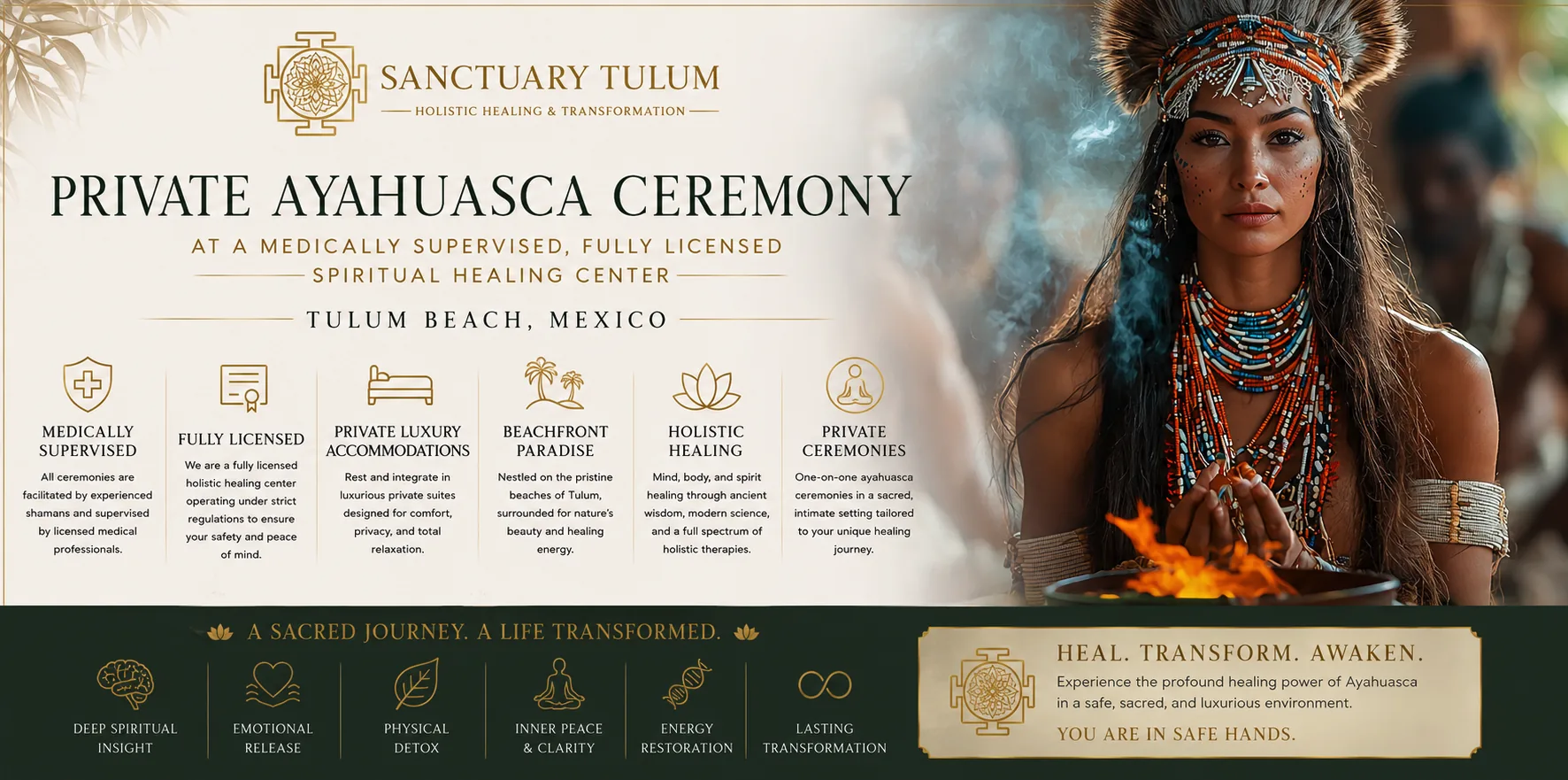
Sanctuary Tulum is one of a small number of Mexican facilities operating under a federal hospital and clinic license, located in Tulum on the Riviera Maya. Programs include pre-arrival medical clearance, on-site physician supervision during ceremony, one-on-one ceremony format, and structured integration. Whether it is the right fit depends on your specific medical profile, budget, and program length needs — see the full ayahuasca retreat program and our broader medical-infrastructure checklist for a safe psychedelic facility before shortlisting.
How to Verify a Mexican Health-Authority License Number
A license number by itself is a marketing claim; the verification is the substance. Mexican health-authority license numbers follow a structured format — a two-digit state code, a facility-class code, and a serialized identifier (Sanctuary Tulum's is an example). Ask the facility for the license number in writing, the class of license (hospital and clinic is the strongest tier for medical administration), and the name of the licensed responsible physician (médico responsable) attached to it. A legitimate clinic will provide all three without hesitation and will typically be willing to send a scan of the physical license posted on-site. If verification requires you to travel to the facility to "see it in person" before booking, or if the number does not match the facility name on regulator records, treat that as a disqualifying answer rather than a paperwork issue.
Typical Program Lengths in Mexico
Ayahuasca programs in Mexico generally cluster into three durations, and the right length is a function of the case rather than the calendar. Short-format programs run three to seven days and typically include one or two ceremonies with light preparation and integration; these are appropriate for experienced participants working on a defined issue with existing therapeutic support at home. Standard-format programs run two to four weeks, include multiple ceremonies spaced for medical safety, and add structured integration, medical monitoring, and complementary therapies — this is the most common bracket for people addressing trauma, depression, or long-standing patterns. Extended-format programs run four to twelve weeks and are built for complex cases involving addiction, benzodiazepine tapers, or multiple diagnoses that require a longer clinical arc. Short programs advertised as sufficient for severe cases, and extended programs sold to people whose situation does not warrant them, are both signs a facility is optimizing for revenue rather than clinical fit. A legitimate intake conversation ends with a program length that matches the case, not the other way around.
Bottom Line
The "best ayahuasca retreat in Mexico" is not a single answer — it is a filter. Start with federal health licensing, layer in region-specific travel logistics, and then apply the general quality checklist. That sequence gets you to a shortlist of legitimate options rather than to a marketing page.
Bottom Line
The "best ayahuasca retreat in Mexico" is not a single answer — it is a filter. Start with federal health licensing, layer in region-specific travel logistics, and then apply the general quality checklist. That sequence gets you to a shortlist of legitimate options rather than to a marketing page.
US-based readers evaluating travel logistics can also review our detailed guide on Ayahuasca Retreats in NYC for a NYC-focused breakdown of the legal landscape and licensed Mexico alternative.