Searches for "ayahuasca retreats USA," "is ayahuasca legal," and "plant medicine retreat USA" have grown quickly. Most of the top-ranking answers are vague, contradictory, or written to sell you something. This guide lays out the actual national legal picture — sourced, current, and without spin.
Federal Scheduling: The Starting Point
Ayahuasca's psychoactive compound is DMT (N,N-dimethyltryptamine). Under the federal Controlled Substances Act (21 U.S.C. § 812), DMT is classified as Schedule I — the most restrictive category, defined as having no accepted medical use and a high potential for abuse. That scheduling applies uniformly across all 50 states and US territories.
The Religious Exemption (What It Actually Covers)
In 2006 the Supreme Court decided Gonzales v. O Centro Espírita Beneficente União do Vegetal, 546 U.S. 418, unanimously holding that the federal government could not block the UDV church from sacramental ayahuasca use under the Religious Freedom Restoration Act. A subsequent line of cases and DEA correspondence extended similar treatment to specific Santo Daime congregations.
The exemption is narrow. It applies to identified religious organizations with documented sincere religious practice, DEA registration and reporting, and a controlled chain of custody for the sacrament. It does not authorize secular retreats, wellness businesses, integration circles, or "ceremonial" gatherings marketed to the general public.
Recent RFRA Cases (What Actually Extends the Exemption — and What Doesn't)
Two more recent developments are frequently misread. In 2022, the Church of the Eagle and the Condor reached a settlement with the DEA permitting sacramental ayahuasca use for its members — a federal administrative outcome, not a state-level or public authorization. In contrast, in Iowaska Church of Healing v. Werfel, 105 F.4th 402 (D.C. Cir. 2024), the D.C. Circuit affirmed the IRS's denial of Section 501(c)(3) tax-exempt status to an ayahuasca church, reasoning that the church's use of a Schedule I substance without a DEA exemption meant its activities were not exclusively for exempt purposes under the tax code. The ruling did not decide the underlying RFRA question on the merits, but it illustrates how narrowly religious-use claims are treated when the sacrament remains federally controlled and the group has not secured its own DEA exemption.
The federal Right to Try Act (2018) is also sometimes cited, but it does not apply. Right to Try covers investigational drugs that have already cleared FDA Phase 1 trials for a specific indication. Ayahuasca has no such FDA pipeline; it remains a Schedule I substance with no accepted medical use under federal law, which puts it entirely outside the Right to Try framework.
State-Level Psilocybin Reform Does Not Include Ayahuasca
Two state-level reforms are frequently misread as broader psychedelic legalization: Oregon Measure 109 (2020) and Colorado Proposition 122 (2022). Both are limited to psilocybin. Oregon's program regulates the supervised administration of psilocybin at licensed service centers. Colorado's law creates a regulated framework for psilocybin and, later, other listed natural medicines — but ayahuasca and DMT are not included.
Additionally, several cities (Denver, Oakland, Santa Cruz, Seattle, and others) have passed deprioritization measures. Deprioritization instructs local police to make natural entheogens their lowest enforcement priority. It does not legalize possession, distribution, or the operation of a licensed retreat, and it does not affect federal law.
What This Means for Retreat Options
Because federal scheduling controls, there is no legally operating public ayahuasca retreat inside the United States outside of the specific religious exemption. Listings that appear under "ayahuasca retreats in the united states" or "ayahuasca retreat united states" are, with few exceptions, informal underground ceremonies. They are typically unlicensed, medically unsupervised, and legally exposed for both facilitators and participants.
The Practical Path for Americans
The most common legal path for US residents is to travel to a country where ayahuasca is administered in a regulated therapeutic setting. Mexico, Peru, and Costa Rica each have different regulatory structures. In Mexico, ayahuasca falls into a tolerated, non-prohibited category when administered in ceremonial or therapeutic contexts by licensed facilities.
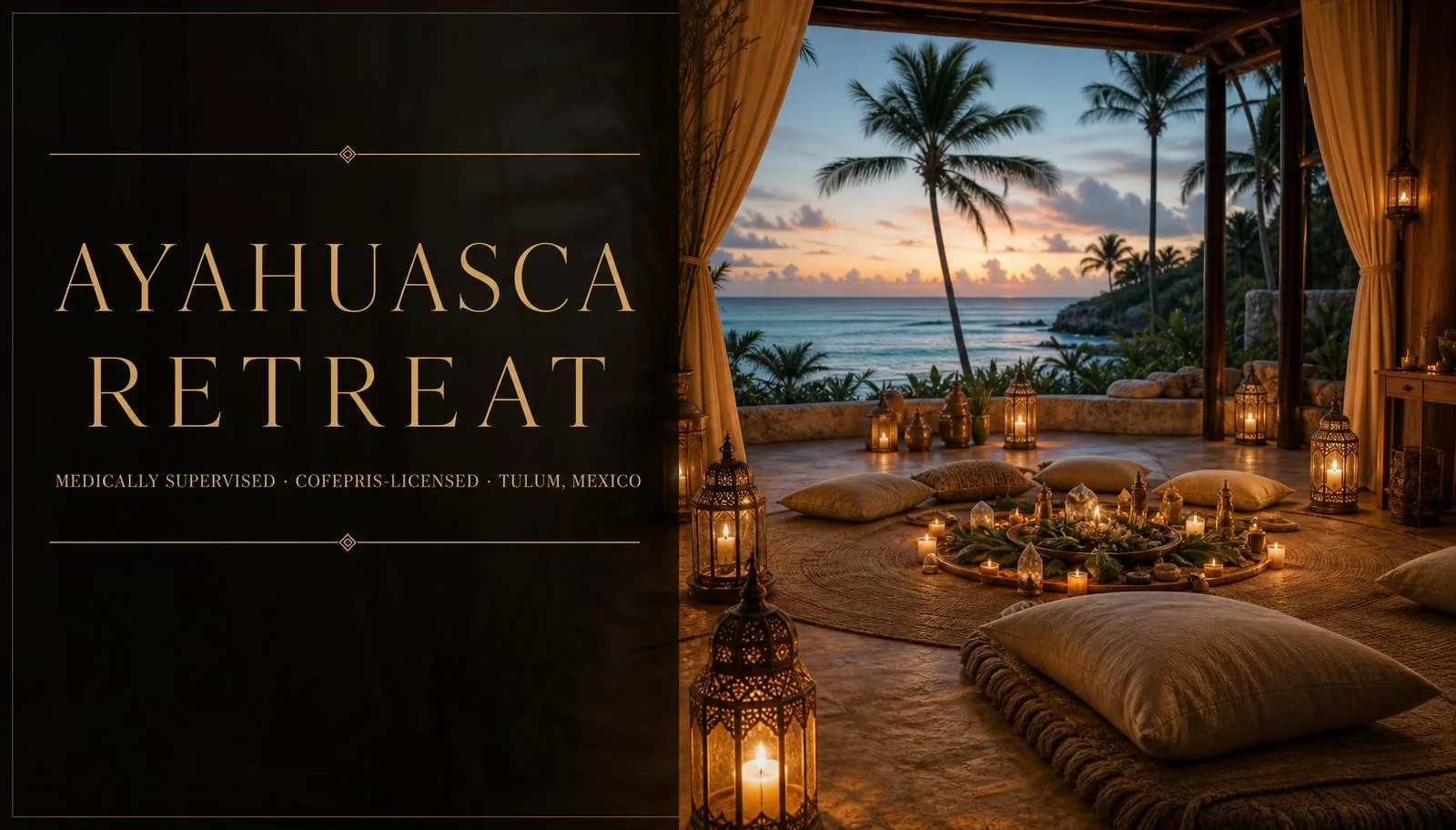
Sanctuary Tulum operates in Tulum, Mexico under a federal health license as a hospital and clinic. Every ayahuasca retreat program includes pre-arrival medical screening, on-site physician supervision, and documented emergency protocols — the operational baseline a licensed facility should meet. See our overview of what a safe psychedelic facility looks like for the specific questions to ask.
Travel logistics are straightforward: direct flights to Cancún International Airport (CUN) from most major US hubs, followed by a ground transfer to Tulum. For anyone on the East Coast, the total travel time is often shorter than a domestic cross-country flight. See our companion article on ayahuasca retreats near me for regional detail.
Bottom Line
Ayahuasca is not legal for public retreats in the United States, and state psychedelic reforms do not change that. The realistic path for Americans is a licensed international facility with verifiable medical infrastructure. Anything else — regardless of how the marketing is dressed up — is an underground ceremony with all the risks that come with it.
References
- Controlled Substances Act, 21 U.S.C. § 812, Schedule I(c) (DMT).
- Gonzales v. O Centro Espírita Beneficente União do Vegetal, 546 U.S. 418 (2006).
- Religious Freedom Restoration Act, 42 U.S.C. § 2000bb et seq.
- Oregon Psilocybin Services Act, ORS Chapter 475A (implementing Measure 109, 2020).
- Colorado Proposition 122 / Natural Medicine Health Act (2022).
- Callaway JC, et al. Pharmacokinetics of Hoasca alkaloids in healthy humans. J Ethnopharmacol. 1999;65(3):243-256.
- dos Santos RG, Bouso JC, Hallak JEC. Ayahuasca, dimethyltryptamine, and psychosis: a systematic review of human studies. Ther Adv Psychopharmacol. 2017;7(4):141-157.
US-based readers evaluating travel logistics can also review our detailed guide on ayahuasca retreats near me for a NYC-focused breakdown of the legal landscape and licensed Mexico alternative.