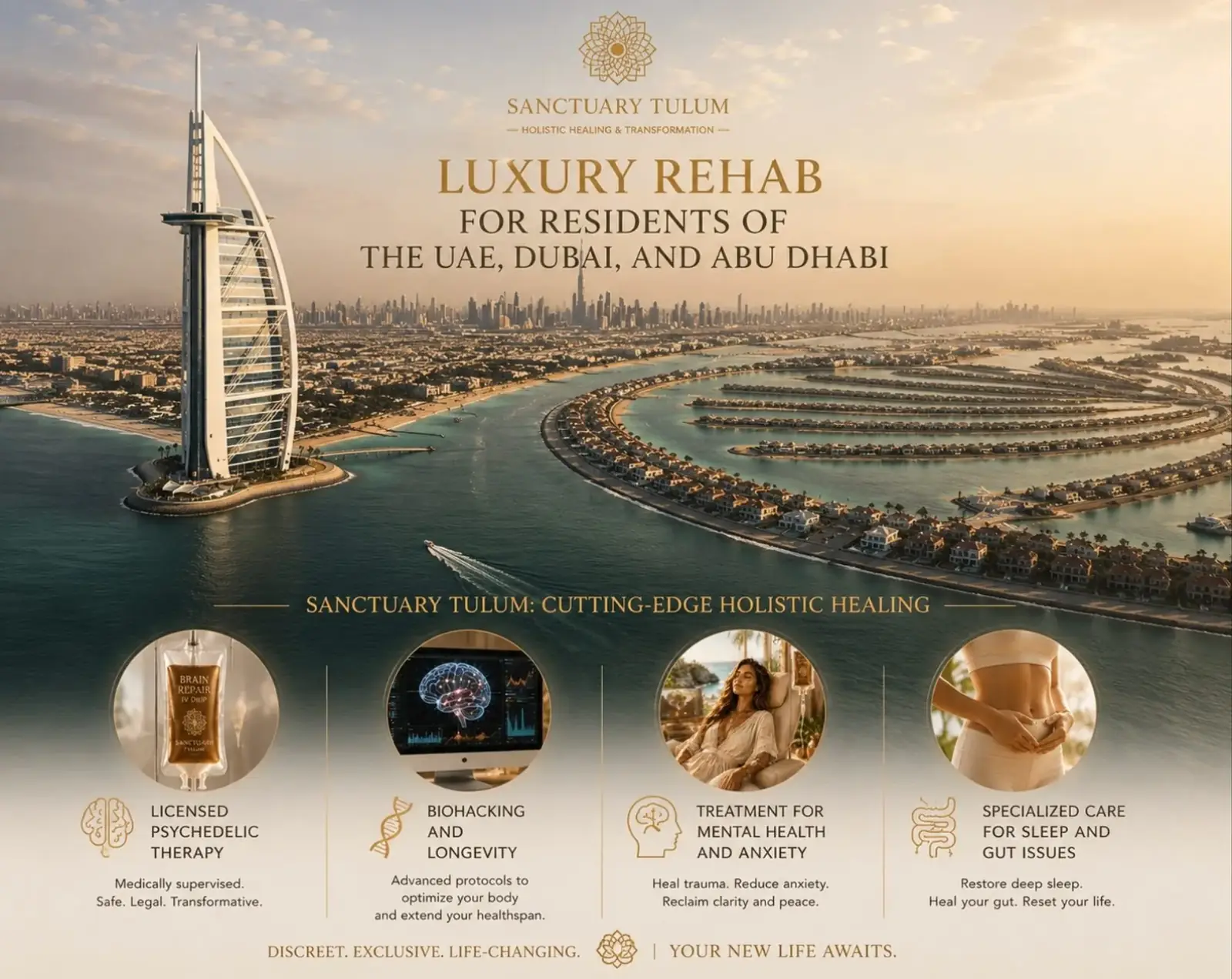
For residents of Dubai, Abu Dhabi, and the wider UAE, choosing where to enter a luxury healing program is rarely just a clinical decision — it is also a decision about privacy, environment, and how completely the setting allows you to step out of daily life. This piece walks through why a growing number of UAE residents are traveling to Tulum, Mexico rather than choosing a regional facility.
Why Tulum, Specifically
Tulum sits on the Riviera Maya, a stretch of Mexico's Caribbean coast known for turquoise water, white-sand beaches, and a warm, stable climate year-round. The town has become a discreet destination for high-profile visitors precisely because it manages to be internationally recognized as a luxury getaway while remaining low-density and visually low-key — no high-rise skyline, strict coastal building limits, and long stretches of undeveloped jungle behind the beach road.
The Yucatán Peninsula is also home to the a large network of underground rivers and cenotes — freshwater sinkholes carved through the limestone bedrock. They are geologically unique to this region and are woven into the daily rhythm of a stay here. That environment is not a decorative backdrop; it is a substantive part of what makes an oceanfront healing program different from a clinical setting in a major city.
Discretion for a Tight-Knit Region
The UAE's high-net-worth community is small and interconnected. Business, family, and social circles overlap in ways that make true anonymity within the region genuinely difficult, even at the most private facilities. Traveling to Tulum provides something a regional option cannot structurally provide: physical distance from the networks you're separating from.
Tulum's reputation as a getaway destination for celebrities, executives, and public figures also works in a UAE client's favor — a stay there does not carry the specific signal that a stay at a well-known regional clinic might.

The Practical Travel Picture
There are currently no non-stop commercial flights from Dubai (DXB) to Cancún (CUN). Most travelers route once through Europe (London, Paris, Frankfurt, Amsterdam, or Madrid are common) or once through a US gateway. Door-to-door travel time typically lands at 18–20 hours. From Cancún International, Sanctuary Tulum arranges a private transfer of roughly 90 minutes south along the coast. For clients traveling privately, several Riviera Maya airports can accommodate direct arrivals with the appropriate handling.
Medical Credibility Behind the Destination
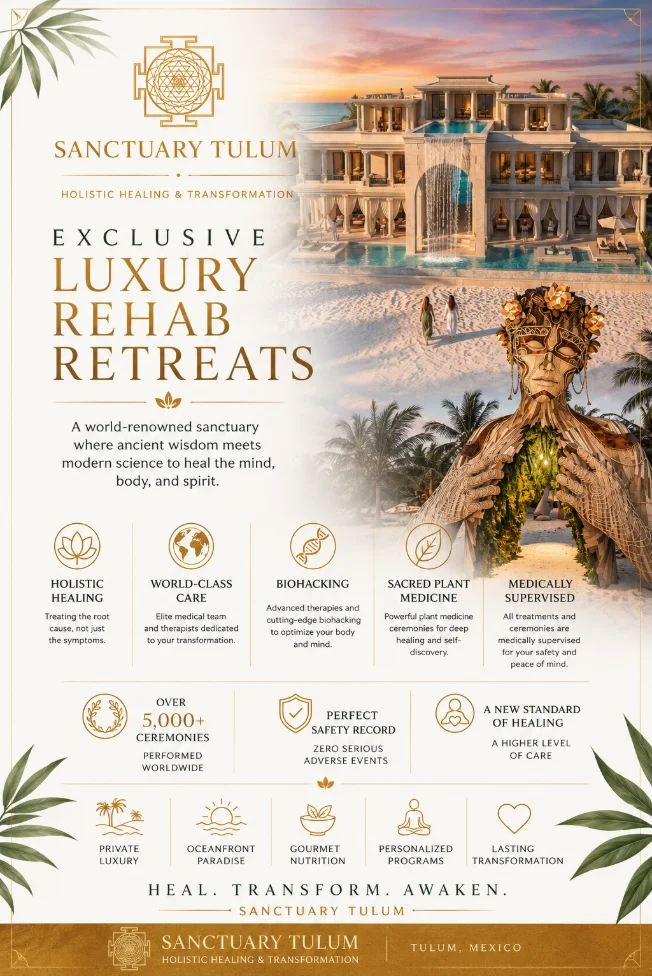
The destination is the lead — but the medical infrastructure is what makes it a viable choice rather than a wellness holiday. Sanctuary Tulum operates under a federal health license as a hospital and clinic, with a physician on site and medical supervision throughout every program. If you want to go deeper on the residential program itself, our luxury rehab center and holistic alcohol rehab pages describe the clinical structure in detail.
Related Dubai & UAE Resources
Guests whose picture is more specific may want to review our companion Dubai & UAE guides: luxury alcohol rehab, luxury benzo detox, luxury detox center, and ibogaine treatment.
A Short Note on Frame
This is not a comparison against Dubai's clinics or a claim that any regional facility is inadequate. It is a description of what Tulum genuinely offers as a destination — climate, coastline, cenotes, distance, and discretion — for people who want a healing environment that is structurally separated from their daily life.
UAE Narcotics Law and Why Plant Medicine Is Not Offered Locally
The UAE maintains some of the strictest narcotics laws in the world, with zero-tolerance enforcement that applies to possession, use, and traces of controlled substances regardless of where they were consumed. Ibogaine, ayahuasca, psilocybin, and 5-MeO-DMT are not legally available for treatment anywhere in the UAE, and no facility in Dubai or Abu Dhabi can lawfully offer plant-medicine ceremonies. This is precisely why clients seeking those specific protocols travel to a jurisdiction like Mexico, where Sanctuary Tulum operates them under a COFEPRIS medical license — the legal picture, not just privacy, is a genuine reason UAE residents look abroad for this category of care.
How Addiction Treatment Is Structured in the UAE
Healthcare in the UAE runs through a regulated private-hospital system overseen by the Dubai Health Authority and the Department of Health in Abu Dhabi, alongside public facilities for citizens. Private psychiatric and addiction care is available and professionally run, but it is delivered within a legal framework that treats substance use as a criminal matter as much as a medical one — a structural difference from jurisdictions where addiction is approached purely as a health condition. That framework, combined with the region's tight-knit business and family circles, is what pushes many UAE residents toward a fully private program abroad rather than a local one, regardless of how discreet the local option claims to be.
Questions to Ask Any Facility Before You Book
UAE families evaluating an international program should ask directly: who is the supervising physician and what is their license status; is treatment one-to-one or group-based; how are current psychiatric medications reviewed and tapered during intake; what is the facility's documented emergency protocol and distance to the nearest hospital; and — specific to UAE clients — how the facility structures confidentiality around travel bookings and correspondence so that a trip does not surface within a small regional network. A program unable to answer plainly has not earned the trust it is asking for.
Related Luxury Rehab Locations (International)
Clinical Standards Behind International Care
Independent guidance from bodies such as the National Institute on Drug Abuse emphasizes individualized, medically supervised care as a core marker of quality treatment, regardless of geography. For UAE residents comparing a regional clinic against an international option, the useful comparison is not "local versus abroad" in the abstract, but which specific facility can demonstrate physician-led, individualized care with verifiable licensing.
Cultural and Language Considerations
Sanctuary Tulum regularly works with guests from the Gulf region and can arrange Arabic-speaking support where needed, alongside dietary accommodation and privacy protocols appropriate to a guest's background. These logistics are handled individually during pre-arrival planning rather than through a fixed, one-size package, since the practical needs of a Dubai-based executive differ meaningfully from those of a younger family member traveling for the first time.
Visa, Documentation, and Arrival Logistics
UAE passport holders can typically enter Mexico visa-free for tourism purposes for stays under 180 days, though requirements can change and should always be confirmed directly with Mexican consular authorities before booking travel. Sanctuary Tulum's admissions team coordinates airport transfer, accommodation logistics, and any documentation questions as part of intake, so that the travel component of treatment is handled well before the guest arrives.
What the First Week Typically Involves
Arrival is followed by a full medical and psychiatric intake, a physician-led review of any current medications, and the start of an individualized treatment plan built around one-to-one clinical hours rather than a group cohort schedule. Because every therapeutic hour is delivered one-to-one, the plan can be adjusted in real time as the treating physician and guest learn more about what the work actually requires — a structural difference from fixed-length group tracks common at many regional facilities.
References
- National Institute on Drug Abuse. Treatment approaches for drug addiction.
- National Institute on Alcohol Abuse and Alcoholism. Understanding alcohol use disorder.
- World Health Organization. Alcohol fact sheet.
- Park K, et al. Effectiveness of psychosocial interventions for drug use disorders in inpatient settings: a systematic review. Subst Use Misuse. 2026.
- Shanafelt TD, Noseworthy JH. Executive leadership and physician well-being: nine organizational strategies to promote engagement and reduce burnout. Mayo Clin Proc. 2017;92(1):129-146.
- COFEPRIS — Mexico's federal health regulator.