People searching "ayahuasca london" are usually asking two questions at once: is this available here, and can it be done safely? This guide answers both plainly for London, then explains the medically supervised alternative many seekers choose instead.
The Legal Picture in London
DMT is a Class A drug under the UK Misuse of Drugs Act 1971, and ayahuasca brew has been prosecuted as such. There is no lawful public ceremony in London, and possession alone carries serious penalties. Ayahuasca's principal active compound is DMT, listed at the highest control level in the United States under 21 U.S.C. § 812 and restricted under comparable statutes internationally. The narrow religious exemption recognised in Gonzales v. O Centro Espírita Beneficente União do Vegetal (2006) applies only to specific registered religious bodies — not to secular wellness ceremonies marketed to the public.
What the Local Scene Looks Like
London's circles are private, word-of-mouth, and often held in flats or rented country houses. No screening, no clinician, no plan if a participant with an undisclosed cardiac history reacts badly.
- No pre-arrival medical screening for cardiac, seizure or psychiatric risk
- No physician on site and no written emergency protocol
- No MAOI interaction review against SSRIs, SNRIs or stimulants
- No verified alkaloid potency or chain of custody for the brew
- No structured integration once the ceremony ends
The Supervised Alternative
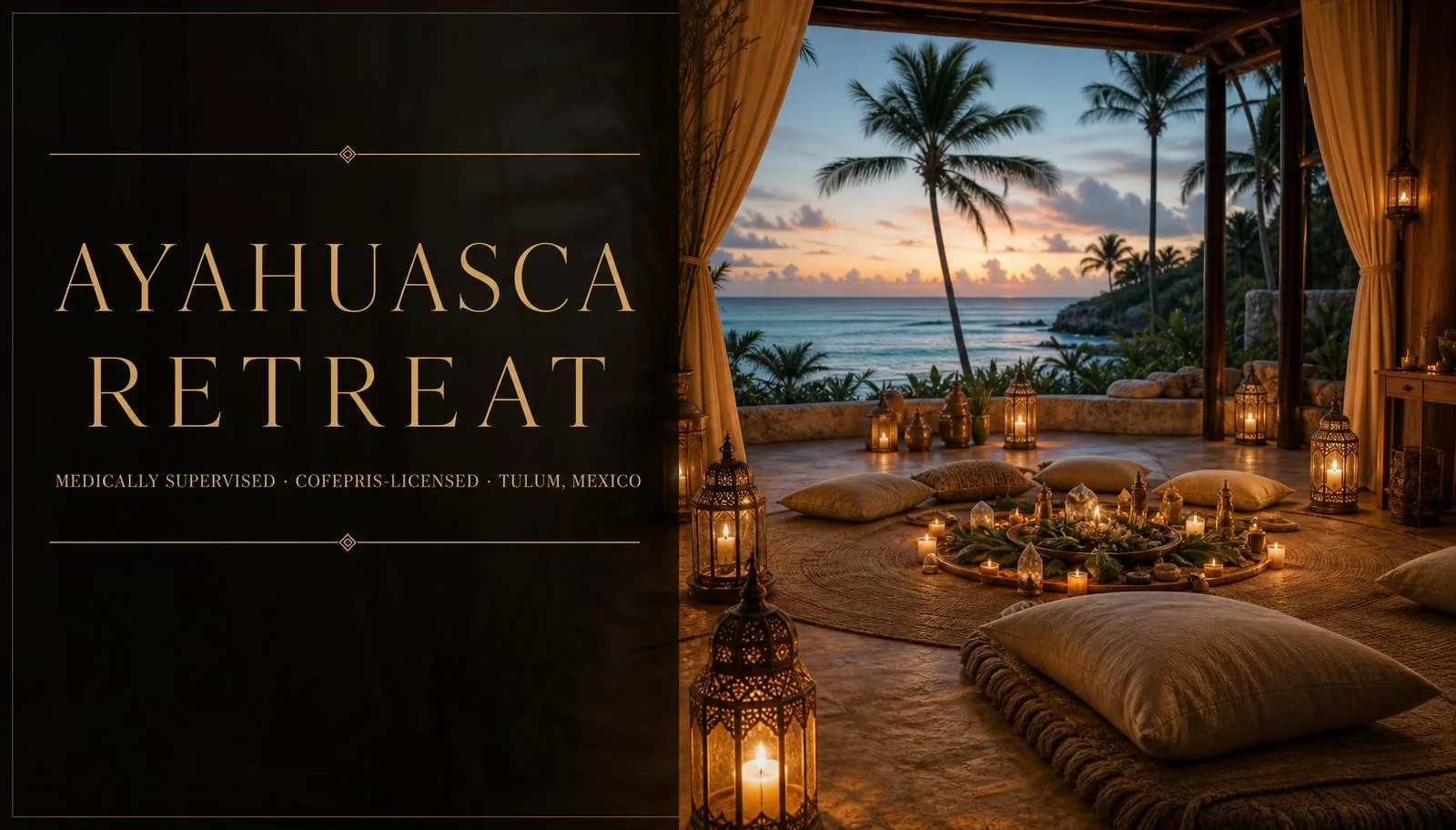
Sanctuary Tulum operates in Tulum, Mexico as a facility licensed by COFEPRIS, Mexico's federal health regulator. Every ayahuasca ceremony is one-on-one and physician-supervised, preceded by medical screening and a full medication review. Where an unregulated circle offers atmosphere, a licensed facility offers accountability: named clinicians, documented protocols, and a plan for the night that does not go as expected.
London Heathrow (LHR) to Cancún is a single direct flight of roughly 10 to 11 hours, which is why UK seekers frequently choose a licensed Mexican facility over a domestic underground circle. For most London seekers, the deciding factor is not travel time — it is whether anyone present is qualified to intervene. Read how the ayahuasca retreat program is structured, or start with the Sanctuary Tulum homepage.
What UK Sentencing Guidance Means in Practice
DMT's Class A status under the Misuse of Drugs Act 1971 carries penalties up to seven years for possession and up to life imprisonment for supply. UK courts have treated ayahuasca brew itself as a controlled preparation, not a herbal grey area, in prior prosecutions. That legal exposure sits alongside the clinical risk: a London facilitator operating outside any licensing framework has no accountability if a participant's undisclosed SSRI prescription interacts badly with the brew's MAOI content.
Who a Supervised Ceremony Is — and Is Not — For
A licensed intake process exists to identify who should not proceed. Uncontrolled hypertension, certain arrhythmias, a personal or family history of psychosis, and medications that cannot be safely tapered are common reasons a physician may recommend against ceremony, or suggest an alternative such as psilocybin therapy. That judgment call requires a clinician reviewing your history in advance — not a form filled out on arrival at a rented country house.
Preparation Matters as Much as the Ceremony
Outcomes track preparation. A supervised program reviews your medications weeks ahead, tapers where clinically appropriate under physician guidance, supports the nervous system before the first ceremony, and builds structured integration into the days that follow. That sequence is what a weekend circle cannot reproduce, however sincere the intention behind it.
Continue through this regional series with Ayahuasca Toronto, or read the preceding guide on Ayahuasca Peru. For a wider view, see ayahuasca retreats near me.
Pre-Arrival Medical and MAOI Screening
Ayahuasca's harmala alkaloids act as monoamine oxidase inhibitors, which is precisely what allows orally ingested DMT to become active. That same mechanism is what makes the brew dangerous to combine with SSRIs, SNRIs, stimulants or certain other prescription medications, up to and including serotonin syndrome. A pharmacokinetic study of hoasca alkaloids in healthy volunteers documented how these compounds are absorbed and metabolized, underscoring why medication review is a safety requirement rather than paperwork. At a licensed facility, screening begins weeks before travel: a written health history, a full medication list reviewed by a physician, cardiac and psychiatric risk assessment, and — where clinically appropriate — a supervised taper off any drug that would interact with the brew. A private London circle typically asks none of these questions before the ceremony begins.
What the First 72 Hours Involve
In a supervised program, the first 72 hours are structured, not improvised. Arrival day is spent on intake: verifying the medical history submitted before travel, a physician consultation, and orientation to the space and the team who will be present. The ceremony itself follows a dietary and rest protocol in the days beforehand, with a physician and support staff present throughout and continuous monitoring of vital signs. The day after ceremony is deliberately unstructured — rest, hydration, and a first integration conversation with a facilitator, not a flight home. That sequencing exists because the physiological and psychological effects of ayahuasca extend well past the night of the ceremony itself, and a rushed exit undermines both safety and outcome.
Integration and Aftercare
A single ceremony without structured integration is a missed opportunity at best and, for some guests, a source of prolonged disorientation. Research on ayahuasca's sub-acute and longer-term effects on affect and cognitive style points to a window of days to weeks in which new patterns are more available to be reinforced or lost. Sanctuary Tulum builds integration sessions into the days following ceremony and provides a plan for continued support once a guest returns home, rather than treating the ceremony as a stand-alone event. Where a guest is also managing depression or a prior antidepressant prescription, a scoping review of concomitant antidepressant and classic psychedelic use is one reason medication planning continues past the ceremony date, not just before it.
Travel and Privacy From London
UK travelers weighing a licensed alternative typically fly Heathrow direct to Cancún, arriving to a private, discreet setting rather than a rented country house shared with strangers. Privacy matters as much as clinical infrastructure for many guests: a one-on-one ceremony model means no group disclosure of medical history, no shared accommodations, and no risk of being photographed or recorded by other participants — an exposure that concerns UK professionals in particular given the criminal exposure discussed above.
How to Vet a Facility
Whether evaluating a private London circle or a licensed clinic abroad, the same questions apply: what is the facility's actual medical license, who administers screening and what is their training, is a physician physically present during the ceremony, what is the written emergency protocol, and what happens after the ceremony ends. A facility that cannot answer each of these with specifics — a license number, a named clinician, a documented plan — has not built the infrastructure a visitor needs, regardless of how the ceremony itself is marketed.
Medical & Educational Disclaimer
This page is educational and does not diagnose, treat or replace care from a licensed physician. Ayahuasca carries cardiovascular, psychiatric and drug-interaction risks and should only be considered within a medically supervised setting after a clinical evaluation.
References
- Controlled Substances Act, 21 U.S.C. § 812, Schedule I(c) (DMT).
- Gonzales v. O Centro Espírita Beneficente União do Vegetal, 546 U.S. 418 (2006).
- Callaway JC, et al. Pharmacokinetics of Hoasca alkaloids in healthy humans. J Ethnopharmacol. 1999;65(3):243-256.
- Misuse of Drugs Act 1971 (UK).
- Hamill J, et al. Ayahuasca: psychological and physiologic effects, pharmacology and potential uses in addiction and mental illness. Curr Neuropharmacol. 2019;17(2):108-128.
- Uthaug MV, et al. Sub-acute and long-term effects of ayahuasca on affect and cognitive thinking style. Psychopharmacology (Berl). 2018;235(10):2979-2989.
- Tap SC. Concomitant use of antidepressants and classic psychedelics: a scoping review. J Psychopharmacol. 2025;39(10):1072-1088.
- COFEPRIS — Mexico's federal health regulator.