People searching "ayahuasca los angeles" are usually asking two things at once: can I do this here, and can I do it safely? This guide answers both plainly, then explains the supervised alternative most Los Angeles seekers end up choosing.
The Legal Picture in Los Angeles
Ayahuasca's active compound is DMT, controlled at the highest level in the United States under 21 U.S.C. § 812 and restricted under comparable statutes internationally. Los Angeles City Council has discussed entheogen resolutions, and California legislative attempts at decriminalization have repeatedly stalled or been vetoed. DMT remains Schedule I in California. The narrow religious exemption recognized in Gonzales v. O Centro Espírita Beneficente União do Vegetal (2006) applies only to specific registered religious bodies — not to secular wellness ceremonies marketed to the public.
What the Local Scene Looks Like
From Silver Lake to Topanga Canyon, Los Angeles has the largest underground ceremony network in the country — and the widest variation in facilitator competence. These gatherings vary enormously. Some facilitators are careful and experienced; others cannot tell you the alkaloid content of the brew they are pouring. Nobody in the room is licensed to manage a hypertensive episode, a seizure, or an acute psychiatric reaction.
- No pre-arrival medical screening for cardiac, seizure or psychiatric risk
- No physician on site and no written emergency protocol
- No MAOI interaction review against SSRIs, SNRIs or stimulants
- No verified potency or chain of custody for the brew
- Real legal exposure for participants and facilitators alike
The Supervised Alternative
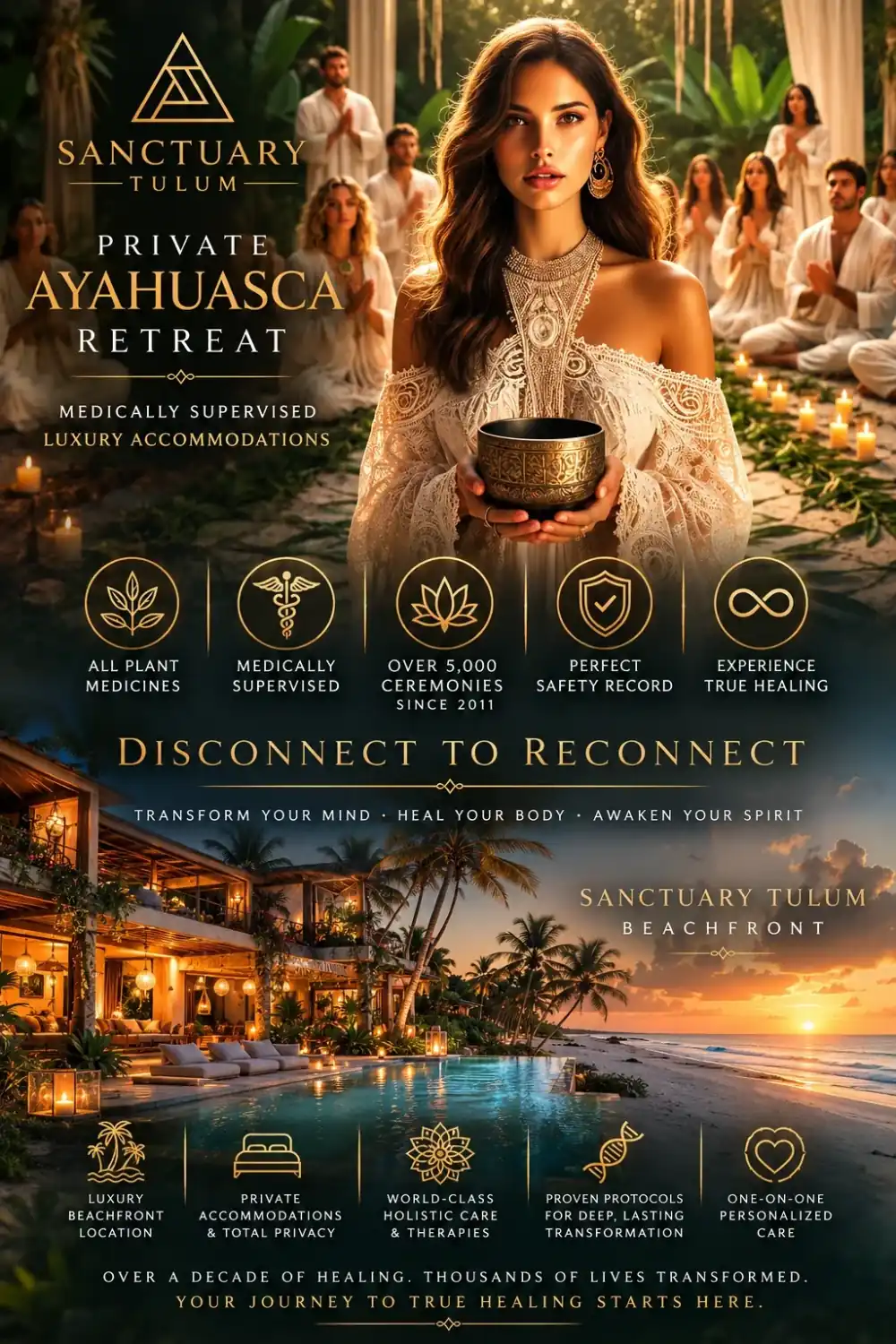
Sanctuary Tulum operates in Tulum, Mexico as a facility licensed by COFEPRIS, Mexico's federal health regulator. Every ayahuasca retreat is one-on-one, physician-supervised, and preceded by medical screening and medication review. Where an underground circle offers atmosphere, a licensed facility offers accountability: named clinicians, documented protocols, and a plan for the night that does not go as expected.
LAX, Burbank and Long Beach all connect to Cancún, with LAX nonstops around 4.5 hours. For most Los Angeles seekers, the deciding factor is not distance — it is whether anyone in the room is qualified to intervene. Read more about the ayahuasca ceremony structure, or start with our Sanctuary Tulum homepage.
How the Brew and the Body Actually Interact
Ayahuasca is a decoction of a beta-carboline-containing vine (typically Banisteriopsis caapi) and a DMT-containing leaf (typically Psychotria viridis). The beta-carbolines act as monoamine oxidase inhibitors, which is the only reason orally ingested DMT becomes active at all — without that inhibition, gut enzymes break DMT down before it reaches the bloodstream. Pharmacokinetic work on Hoasca alkaloids has documented how these compounds are absorbed and cleared, and that same MAOI mechanism is precisely what makes combining ayahuasca with SSRIs, SNRIs, stimulants, or certain migraine and cold medications potentially dangerous — a risk that is identical whether the ceremony happens in a licensed clinic or a private home in Los Angeles.
Preparation Matters as Much as the Ceremony
Outcomes track preparation. A supervised program screens your medications weeks ahead, tapers where clinically appropriate under physician guidance, supports the nervous system before the first ceremony, and builds structured integration into the days after. That sequence is what a weekend circle in Los Angeles cannot reproduce, regardless of intention.
Continue through this regional series with Ayahuasca Hollywood, or read the preceding guide on Ayahuasca Beverly Hills. For a wider view, see ayahuasca retreats near me.
Medical & Educational Disclaimer
This page is educational and does not diagnose, treat or replace care from a licensed physician. Ayahuasca carries cardiovascular, psychiatric and drug-interaction risks and should only be considered within a medically supervised setting after a clinical evaluation.
What a Screening Call Actually Covers
Before any ceremony date is confirmed, a supervised program runs a structured medical and psychiatric intake rather than a brief questionnaire. Cardiac history is reviewed first, since certain heart conditions change the risk calculus for plant medicine work. Psychiatric history is reviewed next — a personal or family history of psychosis or unmanaged bipolar disorder can be grounds to decline or delay a ceremony. Current medications are checked for MAOI interactions, since SSRIs, SNRIs, certain migraine medications and some supplements can interact dangerously with the MAOIs present in the brew itself.
A responsible program is also transparent about the limits of the evidence. Ayahuasca research remains an evolving field, and no facility should promise that a ceremony will resolve a diagnosed condition on its own. What a licensed setting can offer is a documented screening process, a named physician present throughout, and a structured plan for the hours and days after the ceremony ends.
Who Is Not a Candidate
Ayahuasca is not appropriate for everyone, and a responsible program says so plainly rather than after arrival. Individuals with a personal or family history of psychosis or unmanaged bipolar disorder, uncontrolled hypertension, certain cardiac arrhythmias, or current use of MAOI-interacting medications are typically screened out or asked to complete a supervised medication taper first. Pregnancy and certain liver conditions are also standard exclusions. None of this is visible from a ceremony listing or a testimonial video, which is exactly why the intake call matters more than the setting.
Why the Setting Itself Matters
Los Angeles seekers researching this topic are often weighing convenience against the quality of care available, and that trade-off deserves full information. A private ceremony in Topanga or Silver Lake may feel lower-friction than a flight to Mexico, but proximity does not substitute for licensing, medical infrastructure or facilitator training. Sanctuary Tulum's oceanfront setting was chosen deliberately — daylight, ocean air and genuine distance from ordinary routine support the nervous-system regulation ceremony work depends on — and the surrounding residential program means the days before and after are also clinically supported.
Anyone comparing options should ask directly who the supervising physician is, what happens in a cardiac or psychiatric emergency, and what the written protocol actually says. Guests exploring the wider range of programs can review our treatment index and about us page.
References
- Controlled Substances Act, 21 U.S.C. § 812, Schedule I(c) (DMT).
- Gonzales v. O Centro Espírita Beneficente União do Vegetal, 546 U.S. 418 (2006).
- Callaway JC, et al. Pharmacokinetics of Hoasca alkaloids in healthy humans. J Ethnopharmacol. 1999;65(3):243-256.
- Hamill J, et al. Ayahuasca: psychological and physiologic effects, pharmacology and potential uses in addiction and mental illness. Curr Neuropharmacol. 2019;17(2):108-128.
- Palhano-Fontes F, et al. Ayahuasca for the treatment of depression. Curr Top Behav Neurosci. 2022;56:113-124.
- COFEPRIS — Mexico's federal health regulator.