
The short answer: a private treatment environment supports discretion mainly through structural choices — a small number of clients at a time, controlled physical access, confidentiality agreements with staff, and deliberate limits on how information about who is on site circulates. These are concrete, checkable features rather than a marketing claim, and a program serious about discretion should be able to describe each one specifically rather than in vague reassurances. This article is educational and general in nature, not medical or legal advice. Treat the points below as questions worth raising directly with any program you're evaluating, rather than assumptions to make on your own.

1–3: Structural Privacy
1. A limited number of clients on site at one time. A low census means fewer people who could recognize you, fewer shared common areas at once, and a program that can actually manage privacy rather than promise it. Ask directly how many clients are typically in residence during the period you'd be there, since census can vary by season.
2. Private accommodation rather than shared dormitory-style rooms. Individual or villa-style accommodation reduces the chance encounters that come with communal living and gives you control over your own space during the stay, which also tends to support a calmer, more focused daily rhythm.
It is also worth asking what happens between stays — whether the same accommodation is used by a series of different clients in quick succession, and if so, how much time and cleaning separates one guest from the next. This is a small operational detail, but it says something about how carefully a property manages the boundary between one client's visit and another's, which is part of the broader discretion picture even though it rarely comes up unless you ask directly.
A useful follow-up question is what "private" actually means at a given property. Some programs describe accommodation as private when it simply means a single bed in a shared suite with a common living area; others mean a fully separate villa with its own entrance, kitchenette, and outdoor space. Neither answer is automatically wrong, but they are very different experiences, and the difference matters more for someone concerned about discretion than for someone focused purely on comfort. Ask to see floor plans or photographs of the specific unit type you would be assigned, not a generic marketing image of the property, and ask whether the accommodation you are shown is guaranteed for your dates or merely representative of what is sometimes available.
3. Controlled physical access to the grounds. Gated or otherwise controlled entry, and a policy on visitors and deliveries, limits who can approach the property at all — a practical, physical form of privacy rather than a policy on paper. Ask specifically what happens if an unexpected visitor arrives at the gate.
4–5: Staff Practices and Information Handling
Structural privacy only holds up if the people working on the property understand and respect it day to day, which is why staff practices deserve as much scrutiny as the physical layout. A gated entrance means little if a driver mentions a client's name to a colleague outside the property, or if a housekeeper describes a memorable guest to a friend. Discretion is ultimately a habit built into how a team is trained, supervised, and held accountable, not a single policy printed in a handbook and then forgotten.
4. Staff confidentiality agreements, enforced in practice. Ask whether staff sign confidentiality agreements, how breaches are handled, and whether that extends to housekeeping, drivers, and kitchen staff — not only clinicians. A program that trains its full staff on confidentiality, rather than only clinical roles, is signaling that privacy is treated as a standard rather than an afterthought.
5. Careful handling of names on records and payments. Ask how your name appears on billing, correspondence, and internal records, and whether alternative arrangements exist for clients who need additional discretion around identifying details, such as how a stay is described on any documentation that might be requested for insurance or work purposes.
It is reasonable to ask a program for a sample of what a redacted invoice or confirmation letter looks like, and to ask who within the organization would have access to your full file versus a limited summary. A vague answer — "we're very discreet about that" — is worth pressing further; a specific answer describes exactly which fields appear on which document and who can see them. If you are traveling with an assistant or family member who will help coordinate logistics, it is also worth clarifying in advance what that person will and will not be told, so everyone's expectations line up before the stay begins rather than being sorted out awkwardly partway through.
6–7: A Response Plan and Limited Group Exposure
6. A defined response if outside enquiries arise. Ask how the program would handle a call from a journalist, an employer, or a curious acquaintance. A program that has thought this through in advance is more reliable than one improvising in the moment. Ask, too, how the program trains staff to handle unexpected questions from outside the facility.
7. A treatment structure that limits unnecessary group exposure. A program built around one-on-one clinical work naturally limits how much of your stay involves group settings, which is a privacy benefit as well as a clinical choice, since fewer shared sessions generally means fewer opportunities for your presence to be noticed by others.

8: Continuity Without Compromise
It is worth being clear-eyed about a real trade-off here: the most private, lowest-census environments are not automatically the best clinical fit for everyone, and the reverse is also true. Some people benefit from the structure and peer perspective that a slightly larger group setting can offer, even if it means a bit less physical isolation. The goal of asking these discretion questions is not to chase the smallest possible census as an end in itself, but to understand clearly what trade-offs a given program has made, so you can weigh privacy against other factors — clinical approach, length of stay, location — that matter just as much to your decision.
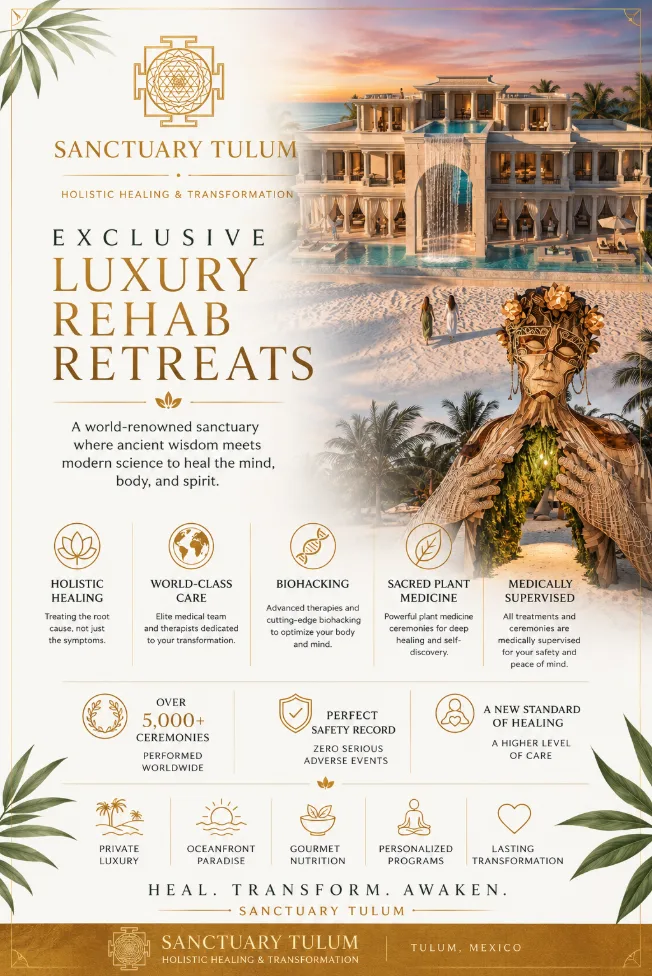
8. A model that protects privacy without sacrificing clinical continuity. Discretion should not come at the cost of proper medical oversight. A program like Sanctuary Tulum, licensed by COFEPRIS, Mexico's federal health regulator, should be able to describe both its privacy measures and its clinical structure specifically. Compare details across the programs and pricing pages of anywhere you're considering, and ask questions directly through the contact page. A program willing to walk through these details on a call, before you commit to anything, is usually a good early sign.
A Short Checklist for Assessing Discretion
- Number of clients typically on site at one time
- Private versus shared accommodation
- Physical access controls on the grounds
- Written staff confidentiality agreements
- How your name is handled on records and payments
- A defined plan for outside enquiries
- How much of the program is one-on-one versus group
Discretion is easiest to evaluate when it's described in specifics rather than adjectives. Ask for the specifics before you decide, and weigh the answers alongside the clinical model itself, since privacy without proper clinical oversight is not the goal.
It also helps to ask these questions of more than one program, so you have a basis for comparison rather than judging a single answer in isolation. A program that welcomes detailed questions about its privacy practices, and answers them specifically rather than defensively, is generally signaling that it has genuinely built discretion into its operations rather than treating the word as a selling point. Take the time to have this conversation before committing to dates or making a deposit, since it is far easier to ask now than to renegotiate expectations once you have already arrived.
Educational content only. This article does not diagnose, treat, or replace care from a licensed physician, and nothing here is a promise of any particular outcome. Never start, stop, or change a prescribed medication without medical supervision.
Ready to take the next step? Learn about our executive rehab at Sanctuary Tulum.