Ibogaine has strong clinical evidence for opioid dependence — but if you're searching "ibogaine New York," you're going to run into a legal wall inside the United States. This guide covers ibogaine's actual legal status in New York, the specific safety reasons the treatment requires proper medical infrastructure, and the licensed international alternative NYC residents typically use.

Ibogaine Is Federal Schedule I
Ibogaine, the primary alkaloid of the West African shrub Tabernanthe iboga, is a Schedule I controlled substance under the federal Controlled Substances Act (21 U.S.C. § 812). Schedule I is the most restrictive federal category and is defined as substances with no currently accepted medical use in the United States and a high potential for abuse. Ibogaine has not been approved by the FDA for any indication.
That classification applies uniformly across all 50 states, including New York. New York Public Health Law and the state's Controlled Substances Act mirror federal scheduling for ibogaine.
No State Has Legalized Ibogaine Treatment
Unlike psilocybin, where Oregon (Measure 109, 2020) built a functioning regulated program, no US state currently operates a licensed ibogaine treatment framework. Colorado's Proposition 122 (2022) added ibogaine to a list of natural medicines that the state may regulate in the future, but the regulatory framework for ibogaine has not been implemented and is not equivalent to a licensed treatment program. New York has passed no comparable legislation.

Why Ibogaine Requires Real Medical Infrastructure
This point matters more for ibogaine than for many other entheogens. Ibogaine has documented cardiac effects — most notably QT-interval prolongation — that require pre-treatment ECG screening, electrolyte correction, continuous cardiac monitoring during the active phase, and physician-led emergency capability. Fatalities associated with ibogaine in the literature have almost universally involved undiagnosed cardiac risk factors, drug interactions, or the absence of medical supervision.
That is why any ibogaine encounter that isn't operating in a fully equipped clinical setting — whether in New York or elsewhere — carries a different order of safety risk than a psilocybin or ayahuasca experience. Ibogaine is not a substance to attempt in an underground context.
Cardiac Safety: What Screening and Monitoring Actually Involve
Ibogaine's primary risk is cardiac, not psychiatric. Ibogaine and its metabolite noribogaine block the cardiac potassium channel responsible for repolarising the heart between beats, prolonging the QT interval; a sufficiently prolonged QT interval can trigger torsades de pointes, a potentially fatal arrhythmia. This is documented in case reports of ibogaine-induced cardiac arrest, which is why a medically supervised program treats cardiac clearance as the central safety question rather than a footnote.
Before dosing, a 12-lead ECG establishes baseline QTc, a comprehensive metabolic panel checks magnesium and potassium — both corrected to normal range before treatment, since low levels of either independently prolong the QT interval — and a liver panel screens for impaired clearance, since ibogaine is metabolised hepatically. A physician reviews all current medications for QT-prolonging interactions. During dosing, continuous cardiac telemetry lets the clinical team see rhythm changes in real time, a physician remains present rather than on call, and a documented emergency protocol with resuscitation equipment is ready before the first dose. This is the sequence that recent cardiac case literature identifies as absent in fatal and near-fatal cases reported outside supervised settings.
Who Ibogaine Treatment Is — and Isn't — Appropriate For
Ibogaine is generally considered for adults with opioid dependence or other treatment-resistant substance use who clear a full cardiac and psychiatric screening — normal QTc, corrected electrolytes, no unmanaged structural heart disease, and no medication that cannot be safely paused. It is not appropriate for patients with a QT interval that cannot be corrected, cardiac conduction abnormalities such as second- or third-degree heart block, significant unmanaged structural heart disease, active psychosis or an unstabilized psychiatric condition, pregnancy, severe hepatic impairment, current use of medications that cannot be safely paused (including certain antiarrhythmics, some antipsychotics, and other QT-prolonging drugs), or anyone unwilling to complete the full pre-treatment workup. A responsible program will decline to dose a patient who does not clear screening, even after travel from New York has already been arranged.
Pre-Arrival Screening: What Happens Before You Fly
Screening starts well before a New York patient boards a flight. Intake begins with a medical history review, current medication list, and a discussion of opioid or other substance use so the clinical team can plan an opioid transition safely rather than reactively. Patients on long-acting opioids such as methadone are typically transitioned to a short-acting agent in the days before dosing, since ibogaine's interaction with residual long-acting opioids raises the risk of complications during and after treatment. Baseline labs, when available from a patient's own physician, are reviewed early so any red flag — an abnormal QTc, a liver enzyme elevation — can be addressed before travel is booked, not discovered after arrival.
On arrival in Tulum, that groundwork is confirmed and completed: a 12-lead ECG, a comprehensive metabolic panel, and a liver panel. Electrolyte repletion — correcting magnesium and potassium to normal range — matters because both minerals independently affect the QT interval, and a patient who is even mildly depleted going into dosing carries avoidable cardiac risk. A liver panel matters because ibogaine is cleared hepatically; impaired clearance means the drug and its cardioactive metabolite noribogaine stay in circulation longer, extending the window during which arrhythmia risk is elevated.
The Dosing Window, Hour by Hour
The dosing day itself follows a structured timeline rather than a single administration. A test dose is typically given first, with continuous cardiac telemetry running throughout, so the clinical team can observe an individual patient's response to ibogaine before committing to a full dose. The main dose follows once the test dose is tolerated without concerning rhythm changes. Ibogaine's effects unfold over an extended period — patients are typically monitored for 24 hours or more, since the acute neurological and cardiac effects last considerably longer than most other substances used in a therapeutic context. A physician and monitoring staff remain present throughout, watching telemetry, checking vital signs at set intervals, and prepared to intervene immediately if the QT interval prolongs beyond a safe threshold.
The days immediately following the dosing session are a second high-risk window that unsupervised settings routinely ignore. Cardiac risk does not end when the acute session ends, and neither does the physical and psychological adjustment that follows. Sleep is often disrupted, appetite takes time to normalize, and the nervous system is recalibrating. This is why aftercare — nutrition support, continued monitoring, and structured integration — is treated as part of the treatment itself rather than an optional add-on: a patient discharged the same day, without observation through this window, is exactly the scenario documented in unsupervised-setting case reports.
Local Logistics and Privacy for New York Patients
New York residents, particularly those in high-visibility professions, often weigh privacy alongside safety when researching treatment abroad. A licensed facility in Tulum offers confidential intake and private accommodations independent of any NYC referral network. Total time away from New York — including screening, dosing and the initial recovery window — typically runs a minimum of one to two weeks, though this varies by individual case and is determined by the treating physician rather than a fixed itinerary.
When vetting any provider, ask direct questions: is the facility named and licensed by an identifiable health regulator; is a physician present throughout dosing rather than reachable by phone; are ECG, electrolyte and liver panels mandatory with no exceptions; and what is the documented plan for the days after dosing. A provider that cannot answer these plainly, in writing, is not one worth the risk.
The Licensed International Path from NYC
Ibogaine is legally administered in Mexico under Mexico's federal health authority medical oversight when delivered in licensed facilities. From New York City, direct flights to Cancún International Airport (CUN) from JFK and EWR run approximately 4 to 4.5 hours, followed by a ground transfer of roughly 90 minutes to Tulum.
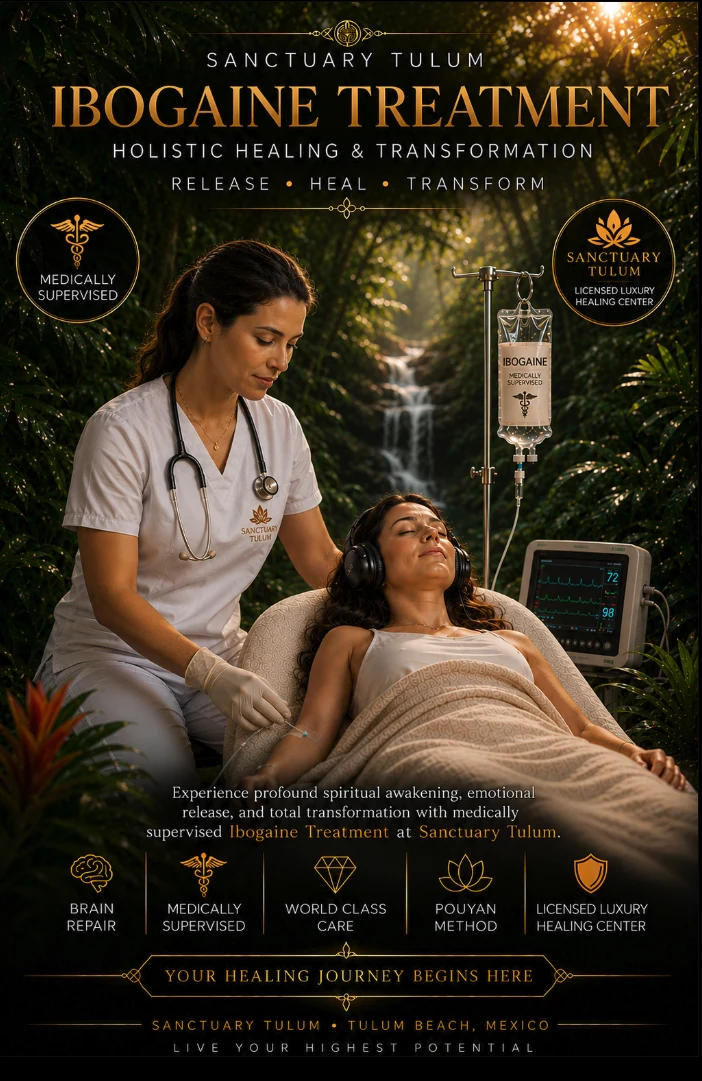
Sanctuary Tulum operates in Tulum, Mexico under a federal health license as a hospital and clinic. Every ibogaine treatment center program includes pre-arrival medical screening (including ECG and liver function review), on-site physician supervision, continuous cardiac monitoring, and documented emergency protocols. For the broader view of what a licensed facility should look like, see our guide to a safe psychedelic facility.
New York residents evaluating this alongside conventional treatment often also read luxury rehab for New York residents.
Bottom Line for New Yorkers
Ibogaine is federally Schedule I, is not FDA-approved, and has no licensed treatment framework in New York State. Given the specific cardiac safety profile, ibogaine especially should not be attempted outside a properly equipped medical setting. The realistic option for NYC residents is a licensed international facility.
References
- Controlled Substances Act, 21 U.S.C. § 812, Schedule I(c) (ibogaine).
- Colorado Proposition 122 (2022); Natural Medicine Health Act.
- Alper KR, et al. Fatalities temporally associated with the ingestion of ibogaine. J Forensic Sci. 2012;57(2):398-412.
- Koenig X, Hilber K. The anti-addiction drug ibogaine and the heart: a delicate relation. Molecules. 2015;20(2):2208-2228.
- Brunt TM, et al. Rare but relevant: ibogaine and cardiovascular complications — prolonged QT interval and ventricular arrhythmias. Addiction. 2026;121(6):1616-1621.
- Mestre D, et al. Multiple episodes of cardiac arrest induced by treatment with ibogaine: a case report. Cureus. 2024;16(6):e63487.
- Noller GE, et al. Ibogaine treatment outcomes for opioid dependence from a twelve-month follow-up observational study. Am J Drug Alcohol Abuse. 2018;44(1):37-46.
- COFEPRIS — Mexico's federal health regulator.
To see how this fits into a complete program, explore our medically supervised ibogaine treatment.