People searching "ibogaine malibu" are usually asking two things at once: can I get this here, and can it be done safely? This guide answers both plainly for Malibu, then explains the medically supervised alternative most patients choose.

The Legal Picture in Malibu
No. Malibu's licensed residential treatment centres operate under California and federal law, which prohibit administering ibogaine; federal Schedule I status leaves no room for a state workaround. Ibogaine is listed at the highest control level in the United States under 21 U.S.C. § 812, meaning no clinic anywhere in the country may lawfully administer it outside an authorised research protocol. That single fact explains why legitimate ibogaine care is delivered abroad, in jurisdictions where it can be provided inside a regulated medical facility.
What the Unregulated Market Looks Like
Malibu's luxury rehab corridor sometimes fields ibogaine requests and refers them offshore. The quality of that referral varies enormously, and a beachfront property abroad is not a proxy for COFEPRIS licensing or cardiac monitoring.
- No pre-treatment ECG or QT-interval assessment
- No magnesium and potassium correction before dosing
- No continuous cardiac telemetry and no physician on site
- No liver function panel or drug-interaction review
- No aftercare — the highest-risk window is the days that follow
The Supervised Alternative
Sanctuary Tulum operates in Tulum, Mexico as a facility licensed by COFEPRIS, Mexico's federal health regulator. Every course of ibogaine treatment begins with cardiac screening and bloodwork, proceeds under physician supervision with continuous monitoring, and continues into structured recovery support rather than ending at discharge. Over more than a decade of medically supervised administration, the facility has maintained a zero-fatality record — notable given documented deaths at unregulated clinics elsewhere.
LAX is roughly 45 minutes from Malibu, then 5 to 7 hours to Cancún with a connection. For most Malibu patients the deciding factor is not travel — it is whether a physician and a cardiac monitor are in the room. See how ibogaine for fentanyl detox is handled clinically, read the cardiac safety screening protocol, or start with the Sanctuary Tulum homepage.
Preparation Decides the Outcome
Ibogaine is not a one-day event. Screening happens weeks ahead; short-acting opioid transition, electrolyte repletion and nervous-system support come before dosing; and integration, nutrition and follow-up care come after. That full sequence — not the dose itself — is what separates a medical program from a hotel-room administration.
Continue through this regional series with Ibogaine Pacific Palisades, or read the preceding guide on Ibogaine Hollywood. For the full clinical picture see ibogaine treatment in Mexico.
Medical & Educational Disclaimer
This page is educational and does not diagnose, treat or replace care from a licensed physician. Ibogaine carries documented cardiac and drug-interaction risks and should only be considered within a medically supervised setting after a full clinical evaluation.
What a Cardiac Screening Actually Involves
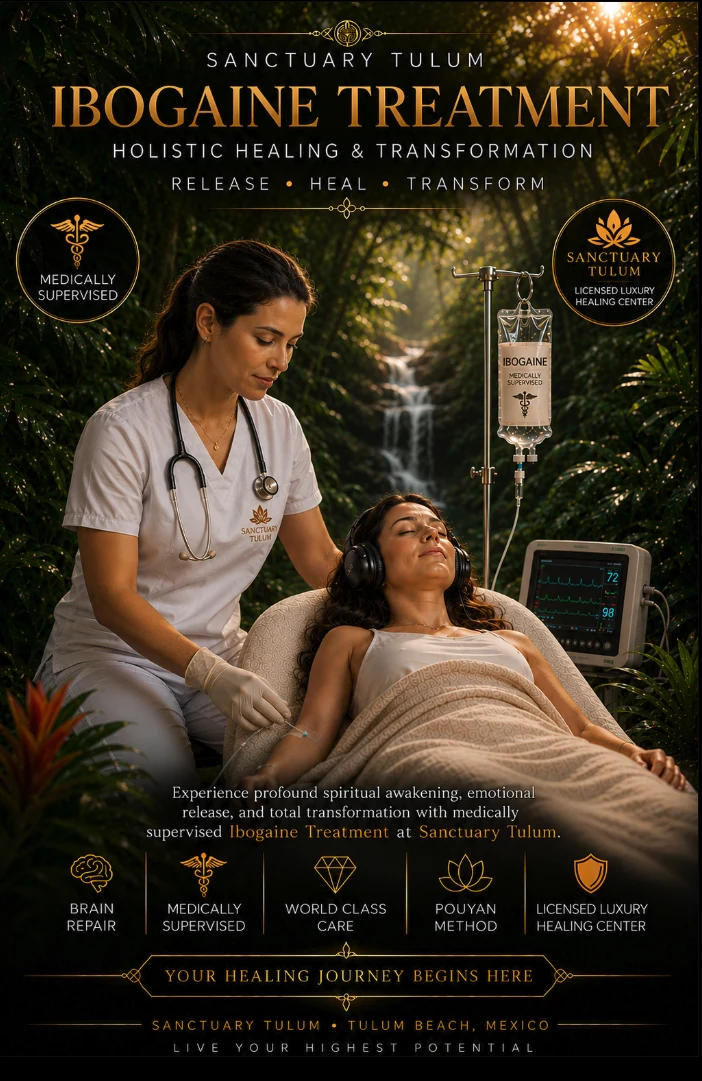
A pre-treatment cardiac workup for ibogaine is not a single test — it is a sequence. A resting 12-lead ECG establishes baseline QT interval and rules out pre-existing conduction abnormalities. Bloodwork checks electrolytes, particularly magnesium and potassium, since low levels of either raise the risk of the dangerous arrhythmias ibogaine is known to provoke. A liver panel screens for impaired metabolism that could prolong the drug's effects. A physician reviews current medications for interactions, since several common prescriptions — including some antidepressants and certain antibiotics — can independently prolong the QT interval and compound the risk. None of this can be meaningfully replicated in a private residence without hospital-grade monitoring equipment on hand.
Why Malibu Patients Specifically Ask About This
Malibu sits inside a dense concierge-medicine market where ketamine clinics, IV therapy lounges, and wellness practices are common and, for those modalities, often lawfully operated. That normalized landscape can make it easy to assume ibogaine occupies similar legal footing — it does not. The Schedule I classification under 21 U.S.C. § 812 applies uniformly across the United States regardless of a provider's other credentials, and no state licensing board can authorize an exception. Patients researching options from Malibu are generally better served treating the destination question and the safety question as two separate decisions, rather than assuming a well-reviewed local provider can simply extend into ibogaine care.
What to Ask Before Booking Any Ibogaine Program
- Is there a physician physically on site during dosing, not just on call?
- Is continuous cardiac telemetry used throughout the session, and for how long afterward?
- What specific regulator has licensed the facility, and can that be verified independently?
- What is the documented emergency protocol if a cardiac event occurs?
- What does structured integration and aftercare look like in the weeks following treatment?
A program confident in its safety record will answer each of these specifically and without hesitation. Vague reassurance in place of a direct answer is itself useful information when evaluating where to go for care.
The Broader Opioid Detox Picture
Ibogaine is most often sought by patients working through opioid dependence, where it is used to substantially reduce the acute physical symptoms of withdrawal during a single supervised session, followed by structured nervous-system support and integration. It is not positioned as a stand-alone cure, and durable outcomes depend heavily on the preparation and aftercare that surround the dosing session itself. Guests considering this route can review the fuller clinical picture on our ibogaine for fentanyl detox page and the ibogaine mechanism of action guide before making a decision.
References
- Controlled Substances Act, 21 U.S.C. § 812, Schedule I(c) (ibogaine).
- Alper KR, Stajić M, Gill JR. Fatalities temporally associated with the ingestion of ibogaine. J Forensic Sci. 2012;57(2):398-412.
- Koenig X, Hilber K. The anti-addiction drug ibogaine and the heart: a delicate relation. Molecules. 2015;20(2):2208-2228.
- COFEPRIS — Mexico's federal health regulator.
To see how this fits into a complete program, explore our medically supervised ibogaine treatment.