People searching "ibogaine hollywood" are usually asking two things at once: can I get this here, and can it be done safely? This guide answers both plainly for Hollywood, then explains the medically supervised alternative most patients choose.
The Legal Picture in Hollywood
No. There is no lawful ibogaine treatment in Hollywood or anywhere else in California; the substance is federally Schedule I with no state exemption. Ibogaine is listed at the highest control level in the United States under 21 U.S.C. § 812, meaning no clinic anywhere in the country may lawfully administer it outside an authorised research protocol. That single fact explains why legitimate ibogaine care is delivered abroad, in jurisdictions where it can be provided inside a regulated medical facility.
What the Unregulated Market Looks Like
Public interest in ibogaine has grown through podcasts and celebrity accounts, which has drawn informal providers into the Hollywood market. High-profile testimonials describe outcomes, not screening standards, and they are not evidence of safe administration.
- No pre-treatment ECG or QT-interval assessment
- No magnesium and potassium correction before dosing
- No continuous cardiac telemetry and no physician on site
- No liver function panel or drug-interaction review
- No aftercare — the highest-risk window is the days that follow

The Supervised Alternative
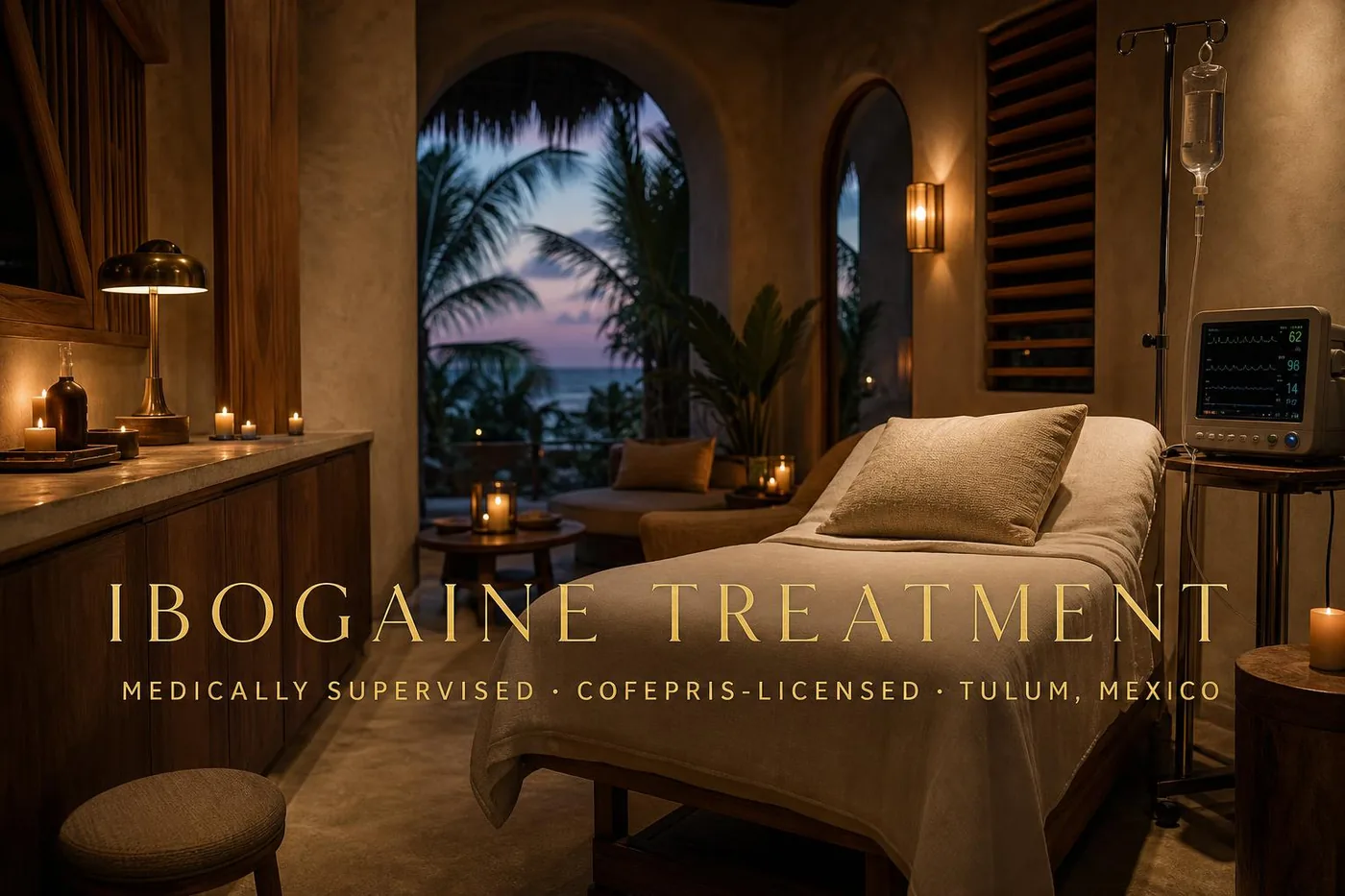
Sanctuary Tulum operates in Tulum, Mexico as a facility licensed by COFEPRIS, Mexico's federal health regulator. Every course of ibogaine treatment begins with cardiac screening and bloodwork, proceeds under physician supervision with continuous monitoring, and continues into structured recovery support rather than ending at discharge. Over more than a decade of medically supervised administration, the facility has maintained a zero-fatality record — notable given documented deaths at unregulated clinics elsewhere.
Burbank (BUR) and LAX both connect to Cancún, typically 5 to 8 hours with one stop. For most Hollywood patients the deciding factor is not travel — it is whether a physician and a cardiac monitor are in the room. See how ibogaine for fentanyl detox is handled clinically, read the cardiac safety screening protocol, or start with the Sanctuary Tulum homepage.
Preparation Decides the Outcome
Ibogaine is not a one-day event. Screening happens weeks ahead; short-acting opioid transition, electrolyte repletion and nervous-system support come before dosing; and integration, nutrition and follow-up care come after. That full sequence — not the dose itself — is what separates a medical program from a hotel-room administration.
Continue through this regional series with Ibogaine Malibu, or read the preceding guide on Ibogaine Los Angeles. For the full clinical picture see ibogaine treatment in Mexico.
Who Ibogaine Treatment Is — and Is Not — Appropriate For
Ibogaine is contraindicated for patients with QT-prolonging conditions, certain cardiac arrhythmias, significant liver impairment, or medications that prolong the QT interval and cannot be safely discontinued. A pre-treatment ECG, electrolyte panel and liver function test exist to identify these cases before dosing, not after. This is also why methadone maintenance requires a longer, physician-managed transition before ibogaine can be considered safely — a step an unsupervised provider in Hollywood has no clinical basis to manage.
ECG, QT Interval and Electrolyte Protocol
Ibogaine's principal risk is cardiac: it prolongs the QT interval and, in susceptible patients, can trigger torsades de pointes and other fatal arrhythmias. A safe protocol starts with a 12-lead ECG to establish baseline QTc, a full electrolyte panel — magnesium and potassium are corrected before dosing because low levels independently increase arrhythmia risk — and a liver function panel, since ibogaine is hepatically metabolized. During dosing, continuous cardiac telemetry lets a physician catch a lengthening QT interval in real time and intervene before it becomes clinically dangerous, rather than discovering a problem after the fact. Any medication that itself prolongs QT — certain antipsychotics, some antibiotics, methadone at higher doses — has to be reviewed and, where possible, adjusted well ahead of the treatment date.
The First 72 Hours
Arrival day is medical intake: ECG, bloodwork, a physician review of the pre-arrival screening, and time to settle before anything else happens. Dosing typically follows once labs and cardiac results confirm it is safe to proceed, under continuous telemetry with a physician present throughout the acute period, which can extend well beyond the dose itself given ibogaine's long half-life. The hours immediately after dosing are the highest-risk window for cardiac events, which is exactly why monitoring continues rather than ending when the visionary effects subside. By day three, most patients are stable, eating, and beginning the shift from acute monitoring into rest and early integration conversations — a pace that a hotel-room administration has no ability to replicate.
Integration and Aftercare Structure
Ibogaine treatment does not end at discharge. Structured aftercare includes nutritional support to rebuild after the physical demands of treatment, a private integration conversation to work through what surfaced, and a follow-up plan for the weeks after — particularly important for patients transitioning off opioids, where the physical dose is only one part of a longer recovery arc. An underground provider that sends a patient home the same day it wears off has, by definition, no aftercare structure at all.
How to Vet Any Facility Before You Travel
Before committing to any provider, ask for specifics: the supervising physician's name and credentials, whether a pre-treatment ECG and electrolyte panel are mandatory (not optional), what cardiac monitoring equipment is used during dosing, the facility's operating licence, and its documented emergency protocol including proximity to a hospital capable of managing a cardiac event. A legitimate program answers each of these in writing before booking. If a provider cannot produce a licence or describes monitoring vaguely, that is disqualifying.
Travel and Privacy Logistics from Hollywood
Burbank (BUR) and LAX both connect to Cancún, typically 5 to 8 hours with one stop. Most Hollywood patients value discretion: private transfer from Cancún avoids a shared shuttle, and a licensed facility should accommodate arrival scheduling without a public group intake process. Bring a current medication list and any recent bloodwork for the physician review, and expect a multi-day stay rather than a same-day procedure — ibogaine's extended half-life and monitoring requirements make a rushed schedule incompatible with safe administration.
Medical & Educational Disclaimer
This page is educational and does not diagnose, treat or replace care from a licensed physician. Ibogaine carries documented cardiac and drug-interaction risks and should only be considered within a medically supervised setting after a full clinical evaluation.

References
- Controlled Substances Act, 21 U.S.C. § 812, Schedule I(c) (ibogaine).
- Alper KR, et al. Fatalities temporally associated with the ingestion of ibogaine. J Forensic Sci. 2012;57(2):398-412.
- Koenig X, Hilber K. The anti-addiction drug ibogaine and the heart: a delicate relation. Molecules. 2015;20(2):2208-2228. \n
- Noller GE, et al. Ibogaine treatment outcomes for opioid dependence from a twelve-month follow-up observational study. Am J Drug Alcohol Abuse. 2018;44(1):37-46. \n
- Brunt TM, et al. Rare but relevant: ibogaine and cardiovascular complications — prolonged QT interval and ventricular arrhythmias. Addiction. 2026;121(6):1616-1621.
- COFEPRIS — Mexico's federal health regulator.
For the full program overview, read about our ibogaine treatment program.