People searching "ibogaine london" are usually asking two things at once: can I get this here, and can it be done safely? This guide answers both plainly for London, then explains the medically supervised alternative most patients choose.

The Legal Picture in London
Ibogaine is a controlled substance under the UK Misuse of Drugs Act 1971 and is not licensed as a medicine by the MHRA, so no London clinic can lawfully provide supervised treatment. In the United States, ibogaine is listed at the highest control level under 21 U.S.C. § 812, meaning no clinic anywhere in that country may lawfully administer it outside an authorised research protocol. Given the UK controlled-substance status and the US federal schedule, legitimate ibogaine care is delivered in jurisdictions such as Mexico, where it can be provided inside a regulated medical facility.
What the Unregulated Market Looks Like
UK patients often find ibogaine through informal networks or budget clinics in Europe and Africa, several of which have documented fatalities. Legal ambiguity in Britain has produced no clinical standard and no regulator to appeal to.
- No pre-treatment ECG or QT-interval assessment
- No magnesium and potassium correction before dosing
- No continuous cardiac telemetry and no physician on site
- No liver function panel or drug-interaction review
- No aftercare — the highest-risk window is the days that follow
The Supervised Alternative
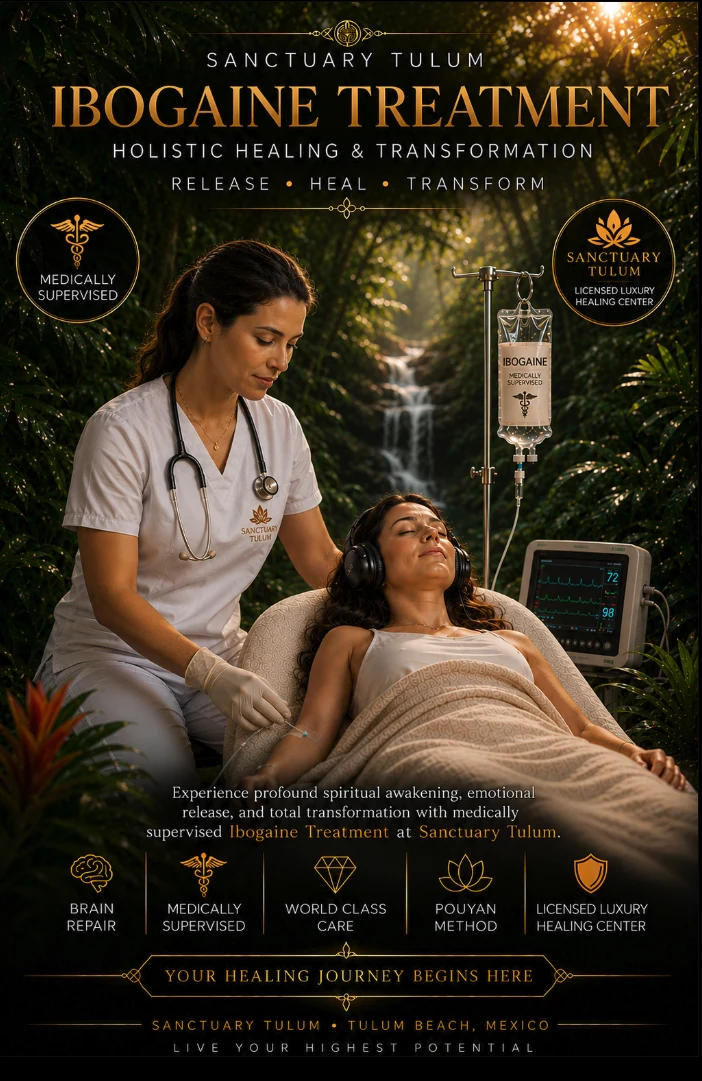
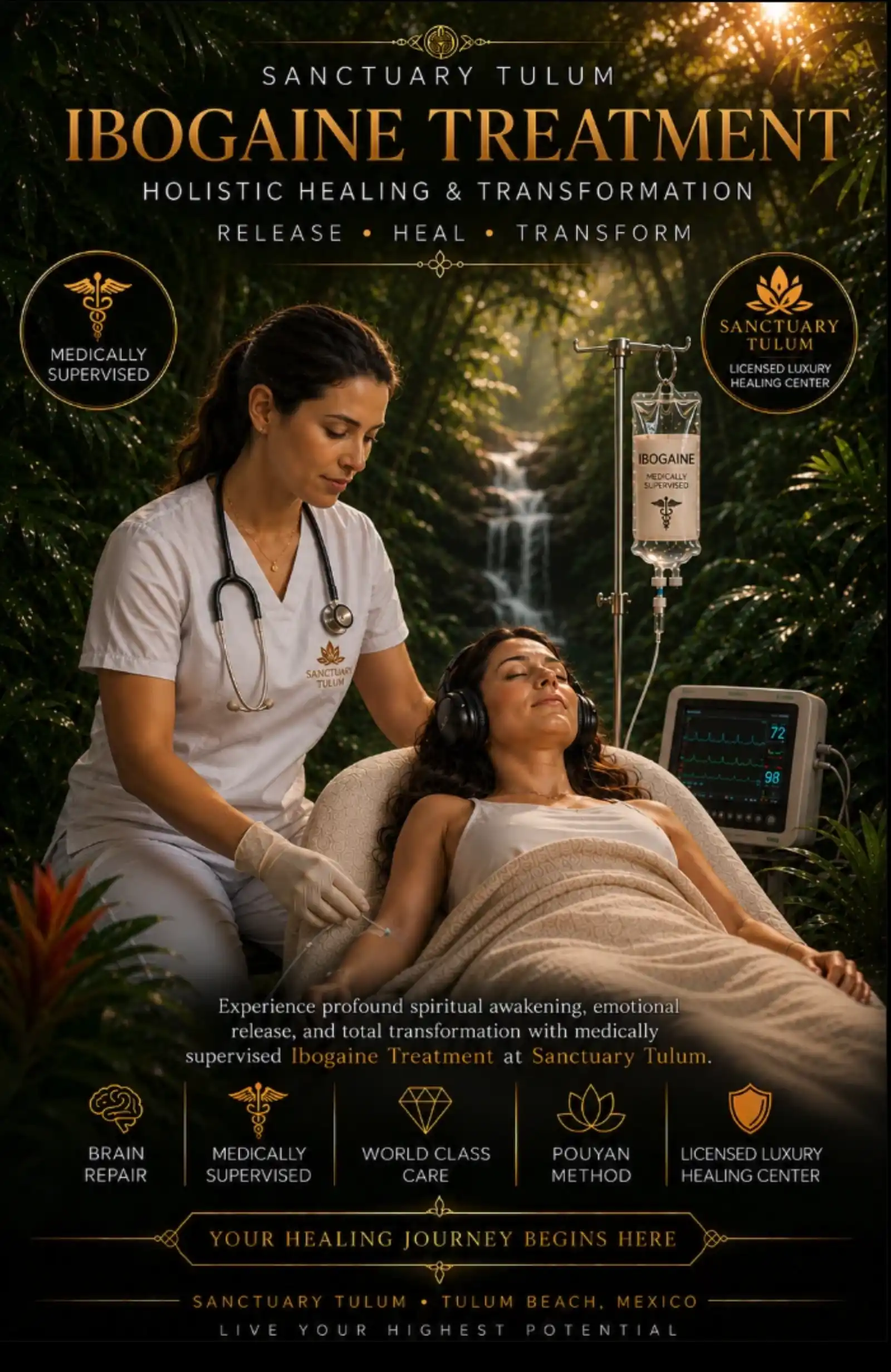
Sanctuary Tulum operates in Tulum, Mexico as a facility licensed by COFEPRIS, Mexico's federal health regulator. Every course of ibogaine treatment begins with cardiac screening and bloodwork, proceeds under physician supervision with continuous monitoring, and continues into structured recovery support rather than ending at discharge. Over more than a decade of medically supervised administration, the facility has maintained a zero-fatality record — notable given documented deaths at unregulated clinics elsewhere.
London Heathrow (LHR) to Cancún is a single direct flight of roughly 10 to 11 hours, followed by a short transfer to Tulum. For most London patients the deciding factor is not travel — it is whether a physician and a cardiac monitor are in the room. See how ibogaine for fentanyl detox is handled clinically, read the cardiac safety screening protocol, or start with the Sanctuary Tulum homepage.
Cardiac Safety: What Screening and Monitoring Actually Involve
Ibogaine's primary risk is cardiac, not psychiatric. Ibogaine and its metabolite noribogaine block the cardiac potassium channel responsible for repolarising the heart between beats, prolonging the QT interval; a sufficiently prolonged QT interval can trigger torsades de pointes, a potentially fatal arrhythmia. Recent case reports of ibogaine-induced cardiac arrest make the mechanism concrete rather than theoretical, which is why every stage of a medically supervised program is built around cardiac clearance rather than treated as a formality.
Before any dosing decision at a licensed facility, patients undergo a 12-lead ECG to establish baseline QTc, a comprehensive metabolic panel with specific attention to magnesium and potassium — both corrected to normal range before treatment, since low levels of either independently prolong the QT interval — and a liver panel, since ibogaine is metabolised hepatically and impaired clearance extends the risk window. A physician also reviews every current medication for QT-prolonging interactions. During the dosing window itself, continuous cardiac telemetry lets the clinical team see rhythm changes in real time, a physician remains present at bedside rather than on call, and a documented emergency protocol — including resuscitation equipment and ACLS-trained staff — is in place before the first dose is given. That sequence is exactly what recent cardiac case literature identifies as absent in the fatal and near-fatal cases reported outside supervised settings.
Who Ibogaine Treatment Is — and Isn't — Appropriate For
Ibogaine is generally considered for adults with opioid dependence or other treatment-resistant substance use who clear a full cardiac and psychiatric screening — normal QTc, corrected electrolytes, no unmanaged structural heart disease, and no medication that cannot be safely paused. It is not appropriate for patients with a QT interval that cannot be corrected, significant unmanaged cardiac disease, pregnancy, severe hepatic impairment, or anyone unwilling to complete the full pre-treatment workup. A responsible program will decline to dose a patient who does not clear screening, even after travel from London has already been arranged — that willingness to say no is itself a safety signal worth asking about directly.
Preparation Decides the Outcome
Ibogaine is not a one-day event. Screening happens weeks ahead; short-acting opioid transition, electrolyte repletion and nervous-system support come before dosing; and integration, nutrition and follow-up care come after. That full sequence — not the dose itself — is what separates a medical program from a hotel-room administration.
Continue through this regional series with Ibogaine Treatment Dubai UAE, or read the preceding guide on Ibogaine Toronto. For the full clinical picture see ibogaine treatment in Mexico.
Medical & Educational Disclaimer
This page is educational and does not diagnose, treat or replace care from a licensed physician. Ibogaine carries documented cardiac and drug-interaction risks and should only be considered within a medically supervised setting after a full clinical evaluation.
Why HB 3717 and UK Reform Discussions Do Not Change Today's Options
London patients sometimes point to renewed research funding elsewhere — including Texas's 2025 HB 3717, which directs state money toward ibogaine clinical trials for opioid use disorder — as a sign that ibogaine is becoming mainstream. It is a meaningful shift in tone, but a research appropriation is not a treatment authorisation. In the UK, ibogaine's controlled status under the Misuse of Drugs Act 1971 and the absence of MHRA licensing mean the practical picture for a London patient today is unchanged: no domestic clinic can lawfully administer ibogaine, whatever momentum exists in research circles abroad.
The Physiology Behind the Cardiac Warning
Ibogaine and its primary metabolite, noribogaine, block cardiac potassium channels responsible for repolarising the heart between beats. That blockade prolongs the QT interval on an ECG, and a sufficiently prolonged QT interval increases the risk of torsades de pointes, a life-threatening arrhythmia. This mechanism is well documented in the pharmacology literature and is the specific reason ibogaine protocols in regulated settings begin with a baseline ECG rather than skipping straight to dosing. Electrolyte status compounds the risk: low magnesium or potassium further prolongs the QT interval, which is why correcting both before dosing is treated as a non-negotiable step rather than a formality.
A 2021 open-label observational study of ibogaine-assisted opioid detoxification, conducted under medical supervision with continuous cardiac telemetry, documented measurable QTc prolongation during treatment while patients were monitored and managed clinically — underscoring that the risk is real and requires expert monitoring rather than an assumption of safety.
What a London Patient Should Ask Any Program
- Is the facility licensed by a named health regulator, and can that license be verified independently?
- Is there a physician on site throughout dosing, not only on call?
- Is a baseline ECG, electrolyte panel and liver function test mandatory before treatment, with no exceptions?
- Is continuous cardiac telemetry used during the dosing window itself?
- What happens in the 72 hours after dosing, and who is responsible for that care?
A program unwilling to answer these questions in writing, before a deposit changes hands, is not one worth the risk — for a London patient or anyone else considering ibogaine.
References
- Misuse of Drugs Act 1971 (UK).
- Controlled Substances Act, 21 U.S.C. § 812, Schedule I(c) (ibogaine).
- Alper KR, et al. Fatalities temporally associated with the ingestion of ibogaine. J Forensic Sci. 2012;57(2):398-412.
- Koenig X, Hilber K. The anti-addiction drug ibogaine and the heart: a delicate relation. Molecules. 2015;20(2):2208-2228.
- Brunt TM, et al. Rare but relevant: ibogaine and cardiovascular complications — prolonged QT interval and ventricular arrhythmias. Addiction. 2026;121(6):1616-1621.
- Mestre D, et al. Multiple episodes of cardiac arrest induced by treatment with ibogaine: a case report. Cureus. 2024;16(6):e63487.
- Noller GE, et al. Ibogaine treatment outcomes for opioid dependence from a twelve-month follow-up observational study. Am J Drug Alcohol Abuse. 2018;44(1):37-46.
- COFEPRIS — Mexico's federal health regulator.
To see how this fits into a complete program, explore our medically supervised ibogaine treatment.