Most executive rehab programs sell the same thing with better sheets. Private rooms, a chef, a golf simulator, a name-brand certificate on the wall — and underneath it, the same structure every general rehab uses: group meetings built on the 12-step model, individual talk therapy, and a prescription pad. For a lot of people, that combination works. For a specific kind of client — someone who has already tried it, someone whose depression didn't move despite years of medication and therapy, someone who cannot risk being recognized in a group circle — it doesn't.
That's the population this piece is actually about: high-profile, high-responsibility individuals for whom conventional treatment has been tried and has not been enough, and who are looking for something built differently — not louder amenities, a different clinical model entirely.
Conventional Executive Rehab vs. This Model
| Element | Conventional executive rehab | Sanctuary Tulum |
|---|---|---|
| Care model | Group therapy, 12-step programming | One-on-one, every session |
| Medication approach | Standard psychiatric protocol | Regenerative therapies, plant medicine where clinically appropriate |
| Client capacity | Institutional cohort | Maximum five clients at a time |
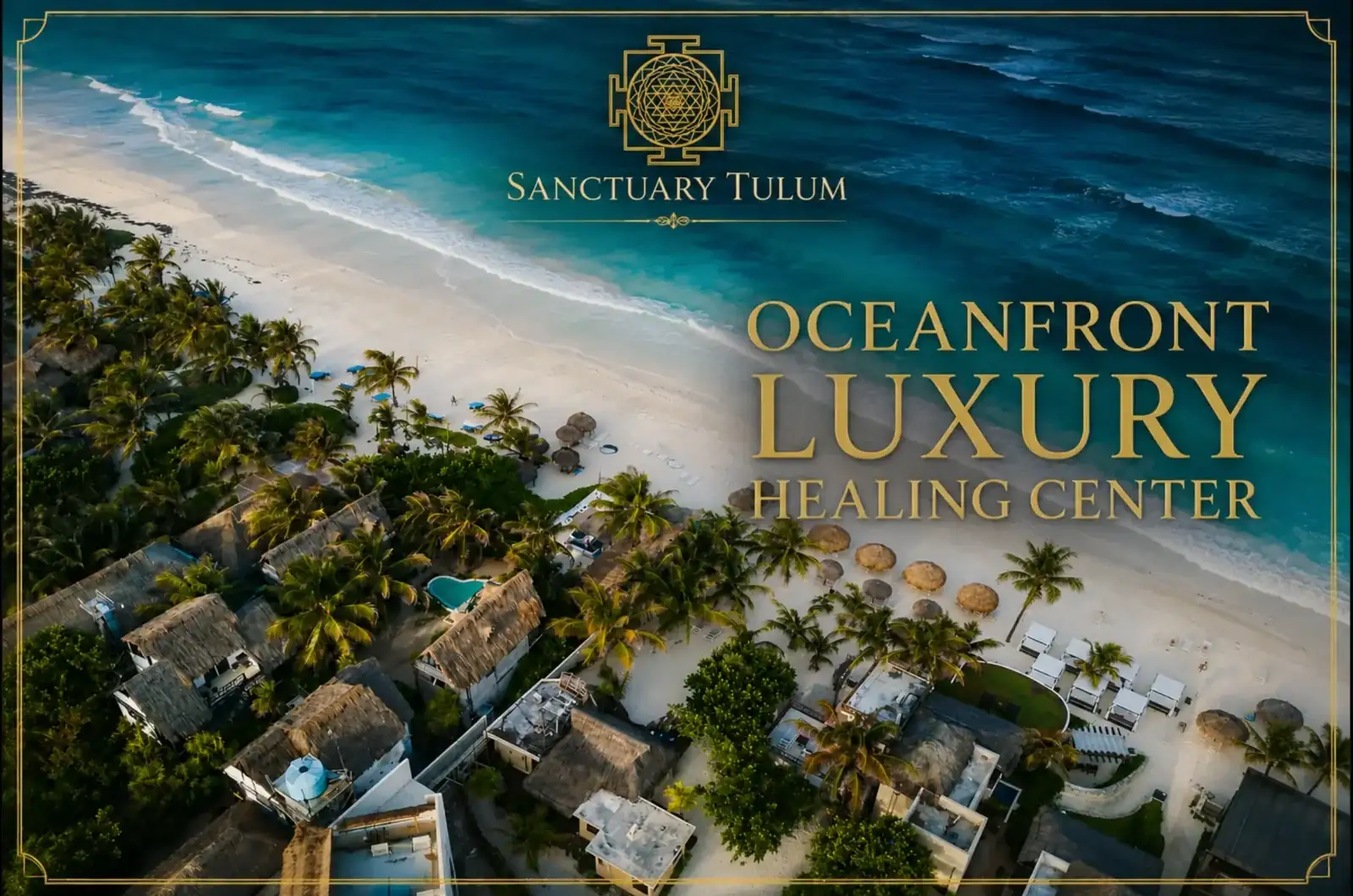
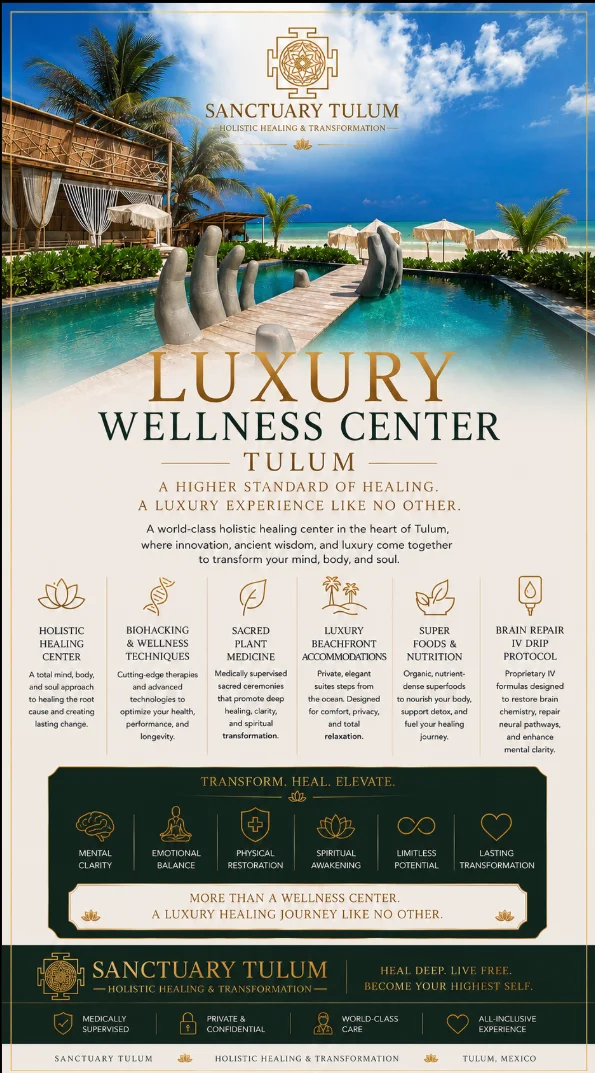
| Setting | Varies, often clinical | Private, oceanfront, Tulum Beach, Mexico |
What "Different" Actually Means Here
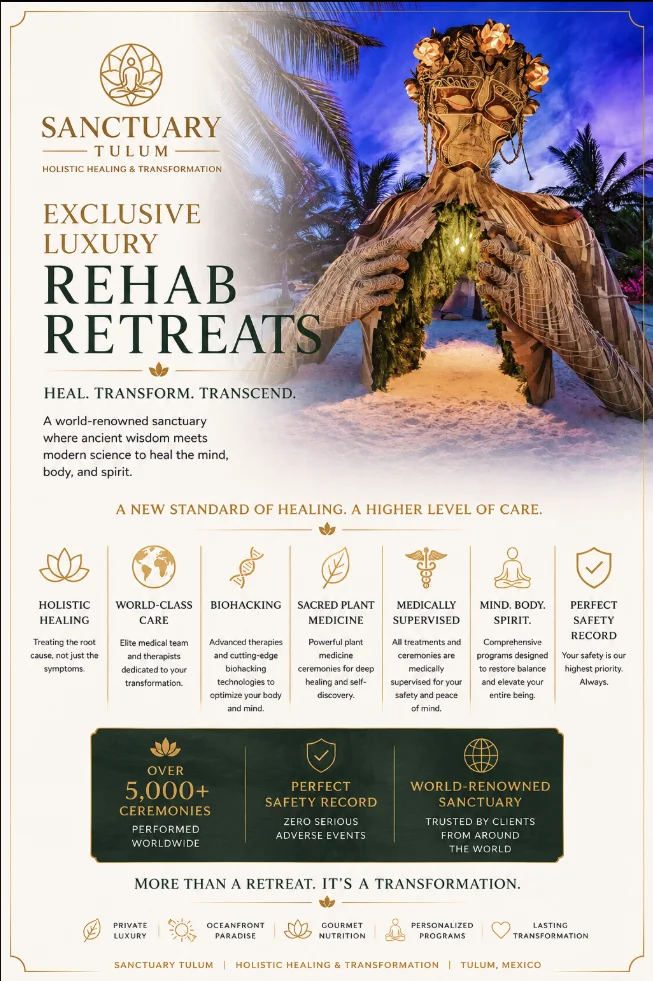
Sanctuary Tulum's program does not run on Alcoholics Anonymous or Narcotics Anonymous meetings, group talk therapy, or a standard psychiatric medication protocol. Care is one-on-one — every session, every day of the program — built around a medically supervised protocol refined over more than fifteen years, combining regenerative medical therapies with, where clinically appropriate, natural plant medicines administered under full physician oversight.
That one-on-one structure is a deliberate design choice, not an improvised one — it's the clinical model behind our executive rehab program, and the reason it looks different from a conventional program is explained in full on our Pouyan Method page.
This isn't a rejection of medicine. It's a different branch of it — one that a growing body of published, peer-reviewed research is now taking seriously at the highest levels of pharmaceutical investment and academic study.
The Research Behind This Class of Medicine
None of what follows is a claim about Sanctuary Tulum's own outcomes. It's a summary of what independent researchers and, increasingly, major pharmaceutical companies have already published about this category of treatment.
In July 2026, Eli Lilly — the world's largest pharmaceutical company — agreed to acquire AtaiBeckley for up to $3.8 billion (approximately $2.8 billion upfront, plus a contingent value right worth up to roughly $1 billion tied to development and regulatory milestones), the largest deal in the history of psychedelic medicine. AtaiBeckley's lead compound, BPL-003, is a synthetic, intranasal form of 5-MeO-DMT being developed for treatment-resistant depression, now in Phase 3 trials. Sanctuary Tulum has worked with the natural form of this same compound, under medical supervision, for more than fifteen years.
At Johns Hopkins, home to the country's leading Center for Psychedelic and Consciousness Research, a randomized clinical trial of psilocybin-assisted therapy for major depressive disorder found a clinically significant response in 71% of participants at four weeks, with 54% in remission. A five-year follow-up study published in 2025 found 67% of participants who completed follow-up were still in remission.
On trauma specifically, a multi-site Phase 3 trial of MDMA-assisted therapy for PTSD found that 67% of participants no longer met clinical criteria for PTSD after treatment, compared with 32% of those who received therapy alone.
This is the research context Sanctuary Tulum's protocol sits inside — not proof of its own results, but evidence that the broader category of medicine it works within is being taken seriously by researchers at Johns Hopkins and by a company the size of Eli Lilly, not dismissed as fringe.
Why This Matters for a High-Profile Client Specifically
Two things conventional executive rehab structurally cannot offer: complete privacy during treatment itself, and a clinical model built around people for whom standard depression and addiction treatment already failed. Group therapy requires disclosing your presence to a room of strangers. Standard psychiatric medication protocols are, for some people, exactly what they've already tried without success. A one-on-one, medically supervised model addresses both — privacy by design, and a genuinely different clinical approach for the subset of people conventional treatment hasn't reached.
How This Fits Into a Full Program
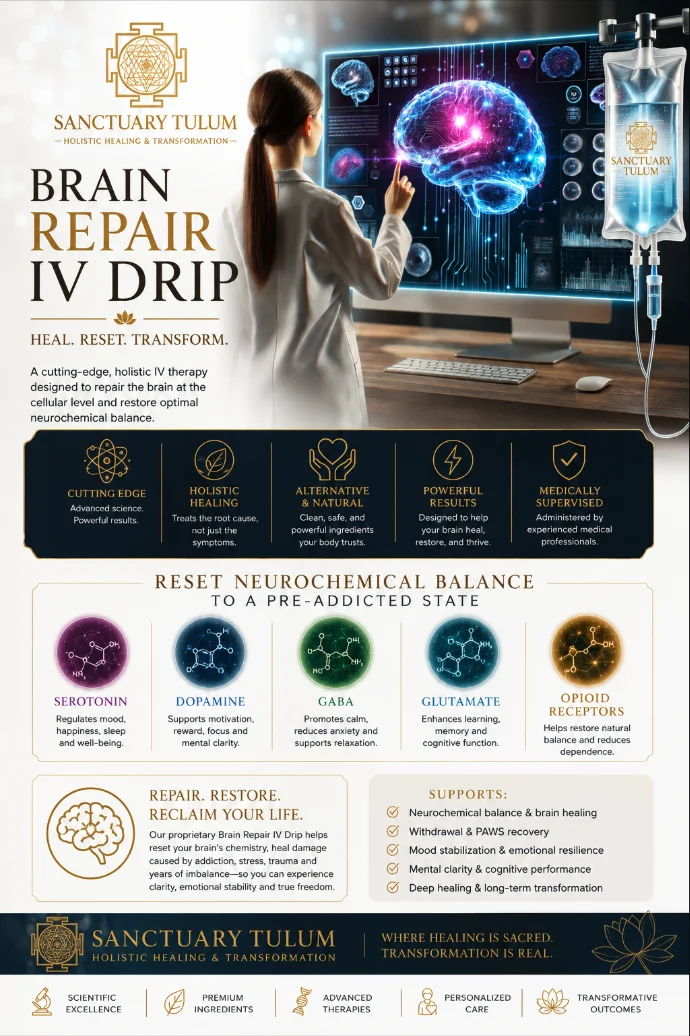
The regenerative therapies referenced above don't run in isolation. Guests in the executive rehab program often combine this protocol with Brain Repair IV for nervous-system support during acute stabilization, and hyperbaric oxygen therapy to support tissue oxygenation and recovery — sequenced individually by the clinical team rather than issued as a fixed package.
What This Program Is Not
It is not a replacement for psychiatric care for everyone, and it is not positioned as a substitute for FDA-approved treatment where that treatment is working. It is a medically supervised, physician-overseen alternative for people who have already been through the conventional path and need something built differently — delivered in a private, oceanfront setting in Tulum Beach, Mexico. Learn more about the full executive rehab program.
References
- Lilly to acquire AtaiBeckley to advance therapies for treatment-resistant depression. Eli Lilly and Company investor relations (July 2026).
- Davis AK, et al. "Effects of Psilocybin-Assisted Therapy on Major Depressive Disorder: A Randomized Clinical Trial." JAMA Psychiatry, 2021.
- Five-year outcomes of psilocybin-assisted therapy for Major Depressive Disorder. Johns Hopkins University, Journal of Psychedelic Studies, 2025.
- Mitchell JM, et al. "MDMA-assisted therapy for severe PTSD: a randomized, double-blind, placebo-controlled phase 3 study." Nature Medicine, 2021.