People searching "ayahuasca san diego" are usually asking two questions at once: is this available here, and can it be done safely? This guide answers both plainly for San Diego, then explains the medically supervised alternative many seekers choose instead.
The Legal Picture in San Diego
California has not enacted a psychedelic-ceremony framework, and DMT remains federally Schedule I. Proximity to Mexico does not create a lawful local ceremony in San Diego. Ayahuasca's principal active compound is DMT, listed at the highest control level in the United States under 21 U.S.C. § 812 and restricted under comparable statutes internationally. The narrow religious exemption recognised in Gonzales v. O Centro Espírita Beneficente União do Vegetal (2006) applies only to specific registered religious bodies — not to secular wellness ceremonies marketed to the public.
What the Local Scene Looks Like
Circles run in North County homes and just across the border in Baja, where facilities range from serious clinics to unregulated houses with no licence at all. The word Mexico on a website tells you nothing about regulatory status.
- No pre-arrival medical screening for cardiac, seizure or psychiatric risk
- No physician on site and no written emergency protocol
- No MAOI interaction review against SSRIs, SNRIs or stimulants
- No verified alkaloid potency or chain of custody for the brew
- No structured integration once the ceremony ends
The Supervised Alternative
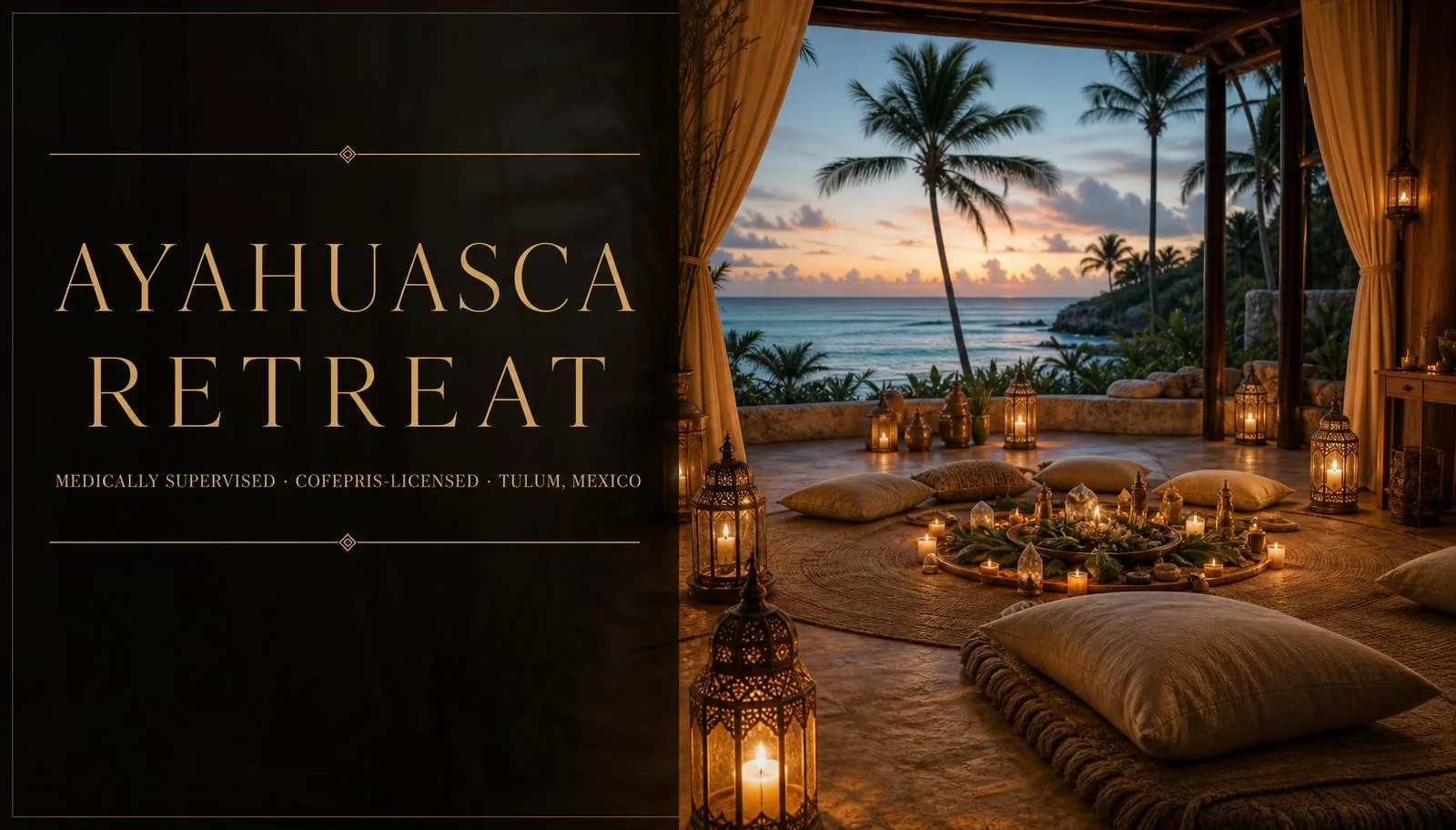
Sanctuary Tulum operates in Tulum, Mexico as a facility licensed by COFEPRIS, Mexico's federal health regulator. Every ayahuasca ceremony is one-on-one and physician-supervised, preceded by medical screening and a full medication review. Where an unregulated circle offers atmosphere, a licensed facility offers accountability: named clinicians, documented protocols, and a plan for the night that does not go as expected.
San Diego (SAN) to Cancún is roughly 6 to 8 hours with one connection; guests should confirm COFEPRIS licensing rather than assume any Mexican location is regulated. For most San Diego seekers, the deciding factor is not travel time — it is whether anyone present is qualified to intervene. Read how the ayahuasca retreat program is structured, or start with the Sanctuary Tulum homepage.
Preparation Matters as Much as the Ceremony
Outcomes track preparation. A supervised program reviews your medications weeks ahead, tapers where clinically appropriate under physician guidance, supports the nervous system before the first ceremony, and builds structured integration into the days that follow. That sequence is what a weekend circle cannot reproduce, however sincere the intention behind it.
Continue through this regional series with Ayahuasca Retreats Near Me, or read the preceding guide on Ayahuasca Scottsdale. For a wider view, see ayahuasca retreats near me.
Medical & Educational Disclaimer
This page is educational and does not diagnose, treat or replace care from a licensed physician. Ayahuasca carries cardiovascular, psychiatric and drug-interaction risks and should only be considered within a medically supervised setting after a clinical evaluation.
What a Screening Call Actually Covers
Before any ceremony date is offered, a supervised program conducts a structured intake that goes well beyond a symptom checklist. Cardiac history is reviewed first, because certain heart conditions and some cardiac medications change the risk calculus for plant medicine work. Psychiatric history comes next: a personal or family history of psychosis, unmanaged bipolar disorder, or an acute suicidal crisis can be a reason to decline or delay a ceremony rather than proceed. Current medications are checked against known MAOI interactions — SSRIs, SNRIs, certain migraine medications and some over-the-counter supplements can create dangerous interactions with the MAOIs present in the ayahuasca brew itself.
This is also where a program should be transparent about what it does not know. Ayahuasca research remains an evolving field, and no responsible facility should promise a specific outcome or claim the ceremony will resolve a diagnosed condition on its own. What a licensed, physician-supervised setting can promise is a documented screening process, a named clinician present throughout, and a plan for the hours after the ceremony ends — sleep, hydration, integration support and a way to reach the clinical team if something unexpected comes up.
Why the Setting Itself Matters
San Diego seekers researching this topic are often weighing convenience against quality of care, and that trade-off deserves to be made with full information. A private home ceremony a few miles away may feel lower-friction than a flight to Mexico, but proximity does not substitute for licensing, medical infrastructure or facilitator training. Sanctuary Tulum's oceanfront setting was chosen deliberately: daylight, ocean air and genuine distance from ordinary routine support the nervous-system regulation that ceremony work depends on, and the surrounding residential program means the days before and after the ceremony are also clinically supported, not left to chance.
Anyone comparing options should ask directly: who is the supervising physician, what happens if a guest has an adverse cardiac or psychiatric event, and what does the written emergency protocol actually say. A facility confident in its model will answer plainly. For guests exploring the full range of programs, our treatment index and about us page describe the team, licensing and history in more depth.
References
- Controlled Substances Act, 21 U.S.C. § 812, Schedule I(c) (DMT).
- Gonzales v. O Centro Espírita Beneficente União do Vegetal, 546 U.S. 418 (2006).
- Callaway JC, et al. Pharmacokinetics of Hoasca alkaloids in healthy humans. J Ethnopharmacol. 1999;65(3):243-256.
- COFEPRIS — Mexico's federal health regulator.