People searching "ibogaine texas" are usually asking two things at once: can I get this here, and can it be done safely? This guide answers both plainly for Texas, then explains the medically supervised alternative most patients choose.

The Legal Picture in Texas
Not yet. Texas passed HB 3717 in 2025 funding ibogaine clinical trials, a significant step — but a research appropriation is not authorisation to treat, and ibogaine remains federally Schedule I. No Texas clinic can legally administer it today. Ibogaine is listed at the highest control level in the United States under 21 U.S.C. § 812, meaning no clinic anywhere in the country may lawfully administer it outside an authorised research protocol. That single fact explains why legitimate ibogaine care is delivered abroad, in jurisdictions where it can be provided inside a regulated medical facility.
What the Unregulated Market Looks Like
Texas's proximity to the border makes cross-border referrals common. Facilities within a few hours' drive range from properly licensed clinics to unregulated houses; the word Mexico on a website says nothing about regulatory status or cardiac capability.
- No pre-treatment ECG or QT-interval assessment
- No magnesium and potassium correction before dosing
- No continuous cardiac telemetry and no physician on site
- No liver function panel or drug-interaction review
- No aftercare — the highest-risk window is the days that follow

The Supervised Alternative
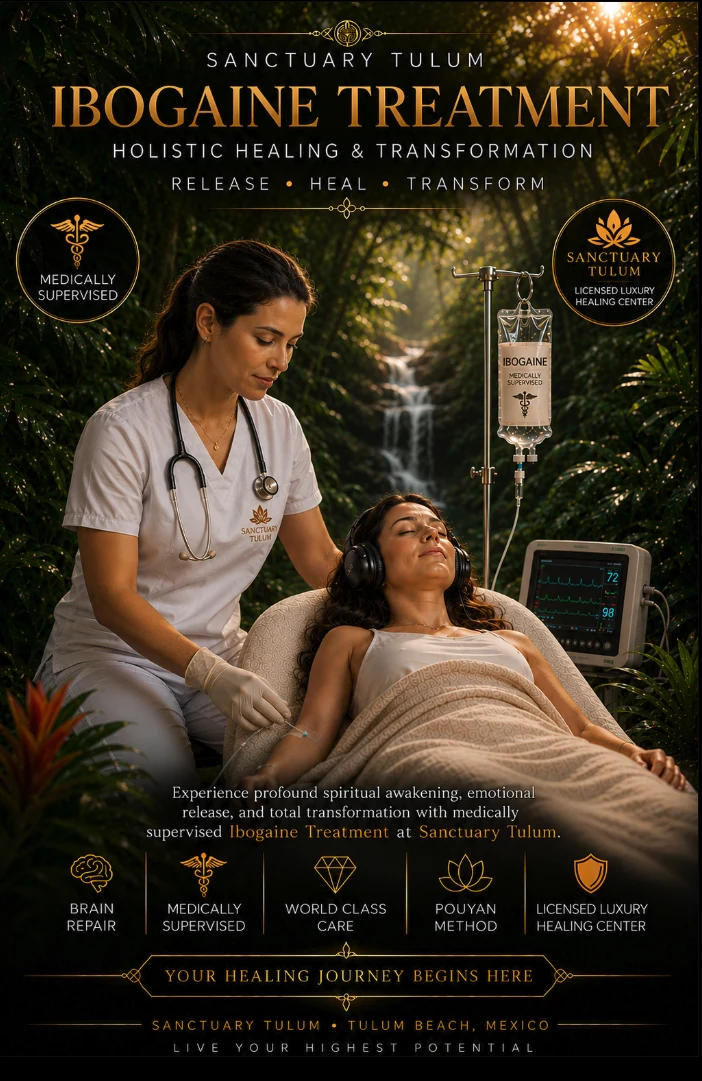
Sanctuary Tulum operates in Tulum, Mexico as a facility licensed by COFEPRIS, Mexico's federal health regulator. Every course of ibogaine treatment begins with cardiac screening and bloodwork, proceeds under physician supervision with continuous monitoring, and continues into structured recovery support rather than ending at discharge. Over more than a decade of medically supervised administration, the facility has maintained a zero-fatality record — notable given documented deaths at unregulated clinics elsewhere.
Houston (IAH) and Dallas (DFW) both offer direct flights to Cancún of roughly 2 to 2.5 hours, making Tulum straightforward for Texas patients. For most Texas patients the deciding factor is not travel — it is whether a physician and a cardiac monitor are in the room. See how ibogaine for fentanyl detox is handled clinically, read the cardiac safety screening protocol, or start with the Sanctuary Tulum homepage.
Preparation Decides the Outcome
Ibogaine is not a one-day event. Screening happens weeks ahead; short-acting opioid transition, electrolyte repletion and nervous-system support come before dosing; and integration, nutrition and follow-up care come after. That full sequence — not the dose itself — is what separates a medical program from a hotel-room administration.
Continue through this regional series with Ibogaine Beverly Hills, or read the preceding guide on Ibogaine Boston. For the full clinical picture see ibogaine treatment in Mexico.
Medical & Educational Disclaimer
This page is educational and does not diagnose, treat or replace care from a licensed physician. Ibogaine carries documented cardiac and drug-interaction risks and should only be considered within a medically supervised setting after a full clinical evaluation.
What HB 3717 Actually Changes
Texas HB 3717, signed in 2025, directs a $50 million state appropriation — led by UTMB Health in collaboration with UTHealth Houston — toward ibogaine clinical trials for opioid use disorder and other conditions. That is a genuine and unusual state-level commitment to studying ibogaine, but it funds research, not patient treatment. Until a trial reaches approval and an FDA pathway exists, ibogaine remains federally Schedule I and no Texas clinic, however well-funded the surrounding research effort, can lawfully dose a patient outside that approved protocol.
The Physiology Behind the Cardiac Warning
Ibogaine and its primary metabolite, noribogaine, block cardiac potassium channels responsible for repolarising the heart between beats. That blockade prolongs the QT interval on an ECG, and a sufficiently prolonged QT interval increases the risk of torsades de pointes, a life-threatening arrhythmia. This mechanism is well documented in the pharmacology literature and is the specific reason ibogaine protocols in regulated settings begin with a baseline ECG rather than skipping straight to dosing. Electrolyte status compounds the risk: low magnesium or potassium further prolongs the QT interval, which is why correcting both before dosing is treated as a non-negotiable step rather than a formality.
A 2021 open-label observational study of ibogaine-assisted opioid detoxification, conducted under medical supervision with continuous cardiac telemetry, documented measurable QTc prolongation during treatment while patients were monitored and managed clinically — underscoring that the risk is real and requires expert monitoring rather than an assumption of safety.
What a Texas Patient Should Ask Any Program
- Is the facility licensed by a named health regulator, and can that license be verified independently?
- Is there a physician on site throughout dosing, not only on call?
- Is a baseline ECG, electrolyte panel and liver function test mandatory before treatment, with no exceptions?
- Is continuous cardiac telemetry used during the dosing window itself?
- What happens in the 72 hours after dosing, and who is responsible for that care?
A program unwilling to answer these questions in writing, before a deposit changes hands, is not one worth the risk — for a Texas patient or anyone else considering ibogaine, border proximity or otherwise.
References
- Controlled Substances Act, 21 U.S.C. § 812, Schedule I(c) (ibogaine).
- Alper KR, Stajić M, Gill JR. Fatalities temporally associated with the ingestion of ibogaine. J Forensic Sci. 2012;57(2):398-412.
- Koenig X, Hilber K. The anti-addiction drug ibogaine and the heart: a delicate relation. Molecules. 2015;20(2):2208-2228.
- COFEPRIS — Mexico's federal health regulator.
- Knuijver T, et al. Safety of ibogaine administration in detoxification of opioid-dependent individuals: a descriptive open-label observational study. Addiction. 2021;117(1):118-128.
- Psychedelic Therapy: A Primer for Primary Care Clinicians — Ibogaine. Am J Med. 2024.
- The pharmacokinetics and pharmacodynamics of ibogaine in opioid use disorder patients.
Ready to take the next step? Learn about our ibogaine treatment at Sanctuary Tulum.