People searching "ayahuasca pacific palisades" are usually asking two things at once: can I do this here, and can I do it safely? This short guide answers both plainly, then explains the supervised alternative most Pacific Palisades seekers end up choosing.
The Legal Picture in Pacific Palisades
Ayahuasca's active compound is DMT, controlled at the highest level in the United States under 21 U.S.C. § 812 and restricted under comparable statutes internationally. Ask any facilitator for their medical screening form, their physician's name, their MAOI interaction review process and their written emergency protocol. A licensed facility answers in writing. The narrow religious exemption recognized in Gonzales v. O Centro Espírita Beneficente União do Vegetal (2006) applies only to specific registered religious bodies — not to secular wellness ceremonies marketed to the public.
What the Local Scene Looks Like
Palisades circles are small, referral-based and often positioned as wellness work rather than the administration of a Schedule I compound. These gatherings vary enormously. Some facilitators are careful and experienced; others cannot tell you the alkaloid content of the brew they are pouring. Nobody in the room is licensed to manage a hypertensive episode, a seizure, or an acute psychiatric reaction.
- No pre-arrival medical screening for cardiac, seizure or psychiatric risk
- No physician on site and no written emergency protocol
- No MAOI interaction review against SSRIs, SNRIs or stimulants
- No verified potency or chain of custody for the brew
- Real legal exposure for participants and facilitators alike
The Supervised Alternative
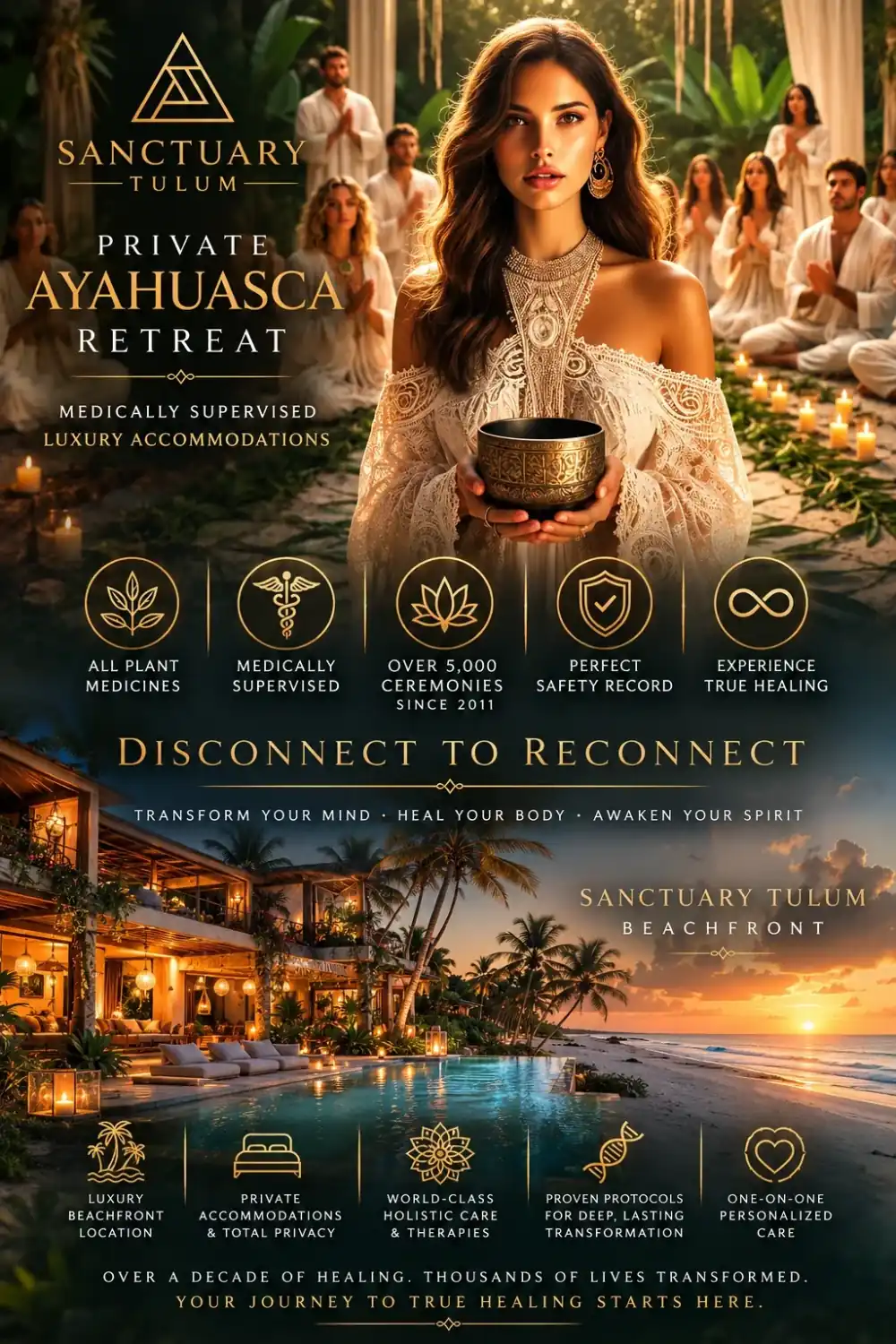
Sanctuary Tulum operates in Tulum, Mexico as a facility licensed by COFEPRIS, Mexico's federal health regulator. Every ayahuasca ceremony is one-on-one, physician-supervised, and preceded by medical screening and medication review. Where an underground circle offers atmosphere, a licensed facility offers accountability: named clinicians, documented protocols, and a plan for the night that does not go as expected.
LAX is roughly 30 minutes from the Palisades; Cancún is a 4.5-hour nonstop from there. For most Pacific Palisades seekers, the deciding factor is not distance — it is whether anyone in the room is qualified to intervene. Read more about the ayahuasca retreat structure, or start with our Sanctuary Tulum homepage.
Preparation Matters as Much as the Ceremony
Outcomes track preparation. A supervised program screens your medications weeks ahead, tapers where clinically appropriate under physician guidance, supports the nervous system before the first ceremony, and builds structured integration into the days after. That sequence is what a weekend circle in Pacific Palisades cannot reproduce, regardless of intention.
Continue through this regional series with Ayahuasca Dubai, or read the preceding guide on Ayahuasca Malibu. For a wider view, see ayahuasca retreats near me.
MAOI and SSRI Interaction Review
Ayahuasca's beta-carboline alkaloids — harmine, harmaline and tetrahydroharmine — inhibit monoamine oxidase, the enzyme that would otherwise break down orally ingested DMT before it reaches the brain. That same inhibition is what makes combining ayahuasca with an SSRI, SNRI, MAOI or certain stimulants potentially dangerous: the risk is serotonin syndrome, a build-up of serotonergic activity that can present as agitation, high fever, muscle rigidity and, in severe cases, cardiovascular instability. A documented medication review has to identify every serotonergic drug a prospective participant is taking, including over-the-counter supplements like St. John's Wort, and set a physician-guided plan for tapering well before the first ceremony date. Sanctuary Tulum's pre-arrival screening exists specifically to catch this interaction before travel, when there is still time to adjust the plan.
The First 72 Hours
The first three days at a supervised program are deliberately unhurried. Day one is arrival, a physician intake that reviews the same medical history covered on the pre-arrival call in person, and time to acclimate before any ceremony work begins. Ceremony itself typically happens on day two, under direct physician observation with continuous monitoring of heart rate and blood pressure, and a plan in place for nausea, purging or an anxious episode — all common, manageable parts of the process rather than emergencies. Day three is rest and a debrief conversation, not a flight home; the nervous system needs time to settle before reentry into ordinary demands.
Who This Is — and Is Not — Appropriate For
Ayahuasca ceremonies are not appropriate for people with uncontrolled hypertension, certain cardiac arrhythmias, a personal history of psychosis or mania, or anyone currently taking medications that cannot be safely paused or tapered under medical guidance. A licensed intake process exists precisely to identify these cases before travel, not after arrival. For Pacific Palisades residents already managing anxiety, depression or trauma with an SSRI, that medication review — and a physician-guided plan for tapering where appropriate — is the step an unsupervised circle has no way to perform safely.
How to Vet Any Facility Before You Travel
Before committing to any provider, ask for specifics rather than assurances: the name and credentials of the supervising physician, the written medical intake questionnaire, how MAOI and SSRI interactions are screened, what monitoring equipment is present during ceremony, the facility's operating licence, and what happens procedurally if a participant needs emergency care. A legitimate program answers each of these in writing before you book. If a provider deflects, cites only testimonials, or cannot name a licence, that is the answer.
Travel and Privacy Logistics from Pacific Palisades
Beyond the short drive to LAX and a roughly 4.5-hour nonstop to Cancún, most Palisades clients value discretion as much as convenience: private airport transfer from Cancún avoids the shared shuttle circuit, and a licensed facility should be able to accommodate arrival timing without requiring a public group intake. Bring current medications in original packaging for the physician review, comfortable clothing, and expect phone and laptop use to be limited during the ceremony window itself.
Medical & Educational Disclaimer
This page is educational and does not diagnose, treat or replace care from a licensed physician. Ayahuasca carries cardiovascular, psychiatric and drug-interaction risks and should only be considered within a medically supervised setting after a clinical evaluation.
What the Screening Process Actually Involves
A medical screening ahead of a supervised ayahuasca ceremony typically covers cardiovascular history, current medications (particularly SSRIs, SNRIs, MAOIs and stimulants), any personal or family history of psychosis, and a review of prior experience with plant medicine. This is not a formality — DMT-containing brews carry documented cardiovascular and drug-interaction risk, and a facilitator without clinical training has no reliable way to assess that risk in advance. A licensed facility documents this process in writing and a physician signs off before a ceremony proceeds, which stands in contrast to an informal circle in Pacific Palisades where screening, if it happens at all, is a verbal conversation.
Integration After the Ceremony
The days after an ayahuasca ceremony are, by most clinical and traditional accounts, as important as the ceremony itself. Structured integration support — a private conversation with a trained facilitator or clinician to process what surfaced, rather than a group share or nothing at all — helps translate an intense subjective experience into something that holds up in ordinary life afterward. A one-off ceremony in a private home, without a program built around integration, tends to leave that part of the process to chance. Sanctuary Tulum builds several days of structured integration into every stay, described further on our ayahuasca resource library.
References
- Controlled Substances Act, 21 U.S.C. § 812, Schedule I(c) (DMT).
- Gonzales v. O Centro Espírita Beneficente União do Vegetal, 546 U.S. 418 (2006).
- Callaway JC, et al. Pharmacokinetics of Hoasca alkaloids in healthy humans. J Ethnopharmacol. 1999;65(3):243-256.
- COFEPRIS — Mexico's federal health regulator.
- Palhano-Fontes F, et al. Ayahuasca for the treatment of depression. Curr Top Behav Neurosci. 2022;56:113-124.
- Uthaug MV, et al. Sub-acute and long-term effects of ayahuasca on affect and cognitive thinking style. Psychopharmacology (Berl). 2018;235(10):2979-2989.